Secret history of RAF base at racecourse marked

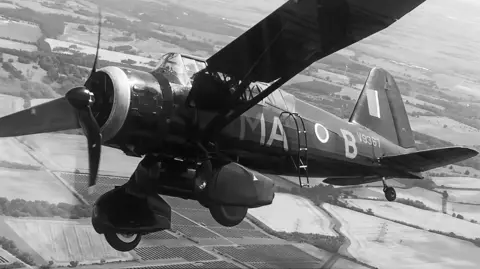 Secret World War II
The secrets of a racecourse which played a vital role in World War Two have begun to be uncovered and a special ceremony has been held.
Between 1939 and 1942, one of Newmarket's racecourses, the Rowley Mile, was home to the RAF's 138 and 161 Special Duties Squadrons.
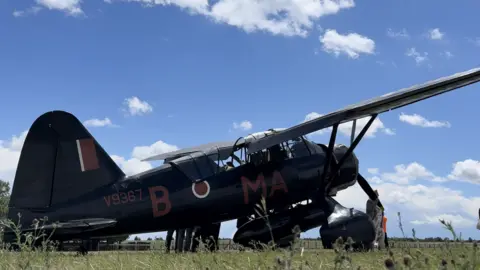
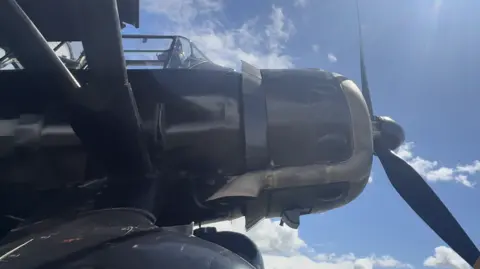
An event was held on Tuesday at the racecourse, on the Cambridgeshire/Suffolk border, to commemorate its role in the war, featuring a special landing by a Westland Lysander plane.
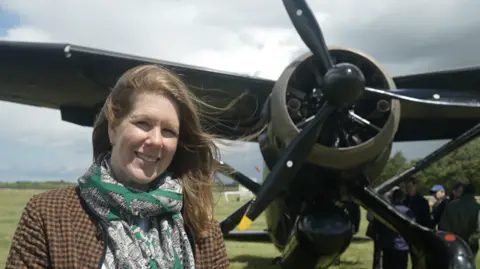
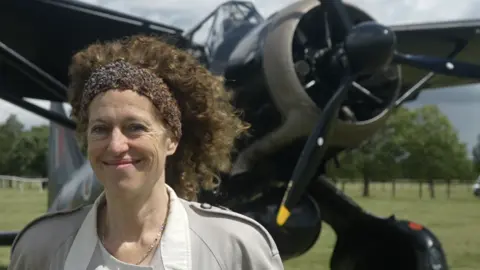
Daisy Vincent, 41, said it had been important to her to attend the event as it had been a "core memory" of her great-uncle Jacques Voyer, who trained there.
 Jamie Niblock/BBC
"[RAF Newmarket] was a core memory for him, I think, so it was important for me to be here and to see that Lysander," she said.
In 1939, the Rowley Mile, which hosts the 1,000 and 2,000 Guineas classic horseraces, became an official RAF bomber command airbase, operations of which were highly secretive.
Westland Lysander planes would leave its airfield on covert flights to drop agents, weapons and supplies into countries including France, Poland and what were then Czechoslovakia and Yugoslavia.
 Jamie Niblock/BBC
Tuesday's event was to help bring some of those secrets to life with military personnel, historians and descendants of those who flew in the missions all in attendance.
The Lysander was pivotal during these wartime missions and it successfully landed at about 11:45 BST on Tuesday at the racecourse's operational airfield before taking off again at 13:15.
As well as this, there was an unveiling of a permanent commemorative installation featuring an information board and blue plaque located at the entrance to the Millennium Grandstand.
 Contributed
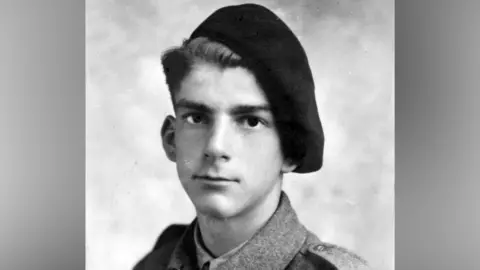
Vincent said her great-uncle was "desperate to fly like all teenagers of his time".
He had been flown over from France to train with the RAF, including at Newmarket on the Lysander.
Later in 1944 during a mission in France, he was captured, shot and killed by the Germans, and Vincent has spent years researching his life and piecing it back together for her family.
She said seeing the Lysander herself had been "really special".
"We can never imagine what it must have felt like to see that plane land in a field in France under the moonlight," she continued.
"It must have been really similar to hear the noise and just see it landing."
 Jamie Niblock/BBC
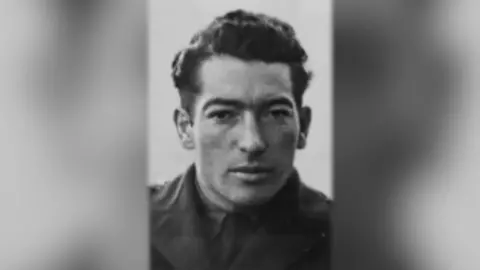
Anne Alexandre was also there on Tuesday and is the daughter of French Resistance operative, Pierre Hentic.
He had been in charge of a reception committee that would welcome the Lysander and the Secret Intelligence Service as well as MI6 operatives during night operations in France.
He died in 2004 and had written memoirs, giving Alexandre an insight into his war experience.
Of visiting Newmarket, she said: "It's very emotional because I think of him and it was so important for him.
"He had the utmost admiration for the Lysander pilots, Hudson pilots, for the officers of the intelligence service he met, and a number of people here.
"He was very grateful to England for what these people had done."
 Contributed
Alexandre added: "[The Lysander] was beautiful and I thought this little aeroplane was bringing so much hope.
"It was the symbol of freedom and it was so important. So little and yet so great for winning the war."
 Jamie Niblock/BBC
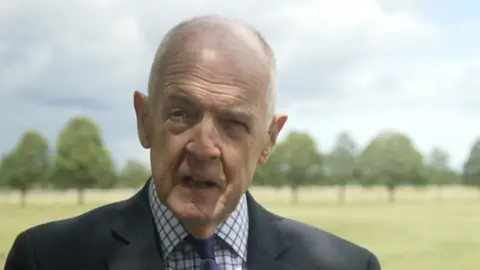
Paul McCue, 68, is executive trustee of the Secret WW2 Learning Network.
He explained that the history of Newmarket during the war became widely known when the National Archives released several files in the 1990s that related to its WW2 role.
"These were secret operations during the war and that secrecy persisted," he said.
"That's part of the aim of our charitable organisation to bring those secrets out into the open and to make them better known, particularly the agents as well as the air crew who delivered them.
"Some of these agents were phenomenally brave.
"They didn't have an intelligence or a special forces background.
"They used women agents and the Second World War saw the first mass use of women agents, so it's very important for women as well."
 Jamie Niblock/BBC
Sophie Able, The Jockey Club's Newmarket racecourses and international director, said it was a "privilege" to install a "lasting tribute" to those who had fought.
"It is impossible for us to truly comprehend the bravery and sacrifice of those who fought in World War Two and the impact felt by their families," she said.
"This event is about recognising the vital roles played by the RAF's 138 and 161 Special Duties Squadrons, who were based here."
Do you have a story suggestion for Suffolk? Contact us below.
Follow Suffolk news on BBC Sounds, Facebook, Instagram and X.
