Firms scramble for battery power in Spain and Portugal

 AFP via Getty Images
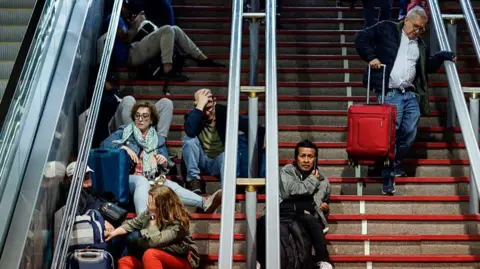
On the 28 April last year, Portugal and Spain went dark for several hours.
A massive power failure caused widespread chaos. People dug out lanterns and old radios, and companies scrambled to save what production they could.
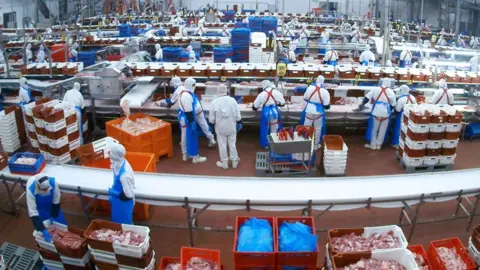
The Spanish meat processing firm Fribin, in Binéfar, in the north eastern province of Aragon, was midway through its morning shift when the sudden shutdown brought production lines to a halt.
For Andrés Altabás, Fribin's technology and systems director, it was a nightmarish situation.
Emergency systems didn't have the capacity for continued operation. "Refrigeration was prioritised but all the lines had to be stopped," he adds.
Many tonnes of meat in the processing stage had to be discarded. "There were losses of hundreds of thousands of euros," says Altabás.
The bosses at Fribin realised they had to rethink their back up plans.
It was a big undertaking as the company's energy needs are "quite large", amounting to more than 25 gigawatt-hours a year, most of it for refrigeration.
The business had been considering investing in a battery back-up system for years, but it had been judged too expensive.
"And then came the blackout, and all of that together catalysed the investment," Altabás tells the BBC.
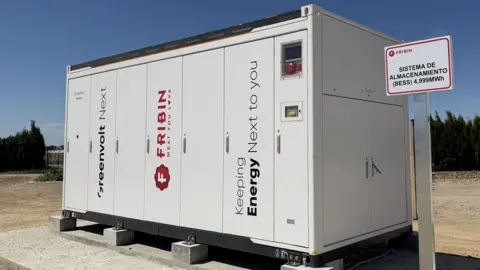
The first purchase of a five megawatt-hour module was made in June 2025, and a second module with the same storage capacity was ordered in early June 2026, both amounting to a total investment of around €1.5m (£1.3m; $1.7m), funded in part by the European Union's Next Generation funds.
 Fibrin
Firms across Europe have been switching from fossil fuels to electricity for their industrial needs, encouraged by subsidies from EU funds.
While that is helping bring down emissions of climate-warming gases, it has also made firms more vulnerable to power cuts.
And in Spain and Portugal that threat was made painfully clear last year.
On both sides of the border, firms are looking for ways to avoid disruption.
"The industrial sector has been one of the first to look at storage systems, since it can't have its production drop off too abruptly," says Miguel Matias, founder of the Portuguese energy services company Self Energy, headquartered in the UK.
"A backup for a few hours, or even minutes, might guarantee that machines don't get damaged," he says.
And there have been more recent incidents to spur investment.
At the end of January, Storm Kristin toppled thousands of electricity and telecom poles across central Portugal, cutting power and communications to hundreds of thousands of people - some for weeks.
So, companies and other organisations have been taking action.
In Spain, battery storage capacity has risen almost sevenfold since last April, from about 28 MW before the blackout to 193MW in April 2026, according to the grid operator Red Eléctrica.
And much more capacity is planned.
In December, the IDAE, Spain's Institute for the Diversification and Saving of Energy, awarded €827m in EU funds to 133 energy storage projects totalling 2,400MW. Around 80% of that is battery storage.
The new capacity will be close to 10 times the amount that Red Eléctrica currently registers on the Spanish grid.
It's all good news for battery suppliers.
"We are seeing not only an increase in demand, but also a clear evolution in customer requirements," says Alberto Bodegas, from battery storage company Sungrow.
Traditionally, commercial and industrial clients were looking for partial or full backup solutions, Bodegas says.
Today, Bodegas says customers are demanding more advanced capabilities, such as seamless backup, meaning the switch from grid to backup occurs instantaneously and without any noticeable interruption.
This is particularly critical for sensitive environments such as hospitals and data centres.
Delivery times are also crucial for buyers, currently under tight deadlines linked to EU funding programmes. Battery companies are being pressed to meet increasingly shorter delivery dates, Bodegas says.
 Vista Alegre
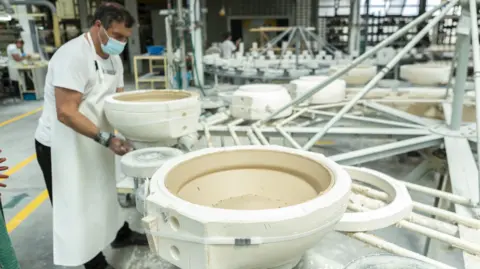
Portugal's Vista Alegre, the oldest and largest porcelain maker in the Iberian country, decided to install energy storage systems in 2022, seizing the opportunity of abundant funds from the EU's Recovery and Resilience Plan.
"The blackout ultimately served, above all, to accelerate this process," Emília Encarnação of Vista Alegre explains. The company's facilities in the coastal city of Ílhavo, in the province of Aveiro, are now equipped with modules with around 2MWh of storage capacity.
"The blackout caused some irreparable losses, particularly at the plants operating on a continuous production basis, where sudden power interruptions have a direct impact on production processes," Encarnação recalls.
Advantages go beyond being able to respond to sudden shocks in the energy network. For example installing batteries also means the company can profit from selling energy into the general network.
 Fibrin
At Primus Ceramics, located near the city of Aveiro, in central Portugal, a diesel generator saved the day during last year's blackout.
Their roller kilns - which transport materials through every production phase inside industrial ovens - are powered by electric motors.
During the power cut, the generator kept the products rolling, minimising the day's losses.
The experience accelerated the company's plan to make their production process more resilient, company CEO Paulo Almeida tells the BBC.
Primus already had two batteries installed in 2022 to back-up their energy supply and for selling electricity back to their energy company when market conditions were favourable.
By the end of this year Primus will have more than double its battery capacity, to store more energy from the factory's solar panels.
For Almeida, that would be reassuring after the stress of last year's blackout.
"We were at it until eight, nine at night, deciding whether we should stop, whether we should lower the furnace temperatures, or whether we'd take the risk and wait for the power to come back in time," he says.
The power did come back in time, but it was near miss for Primus.
