What you need to know as Kingston upon Thames heads into local elections

Amy ClarkeLondon
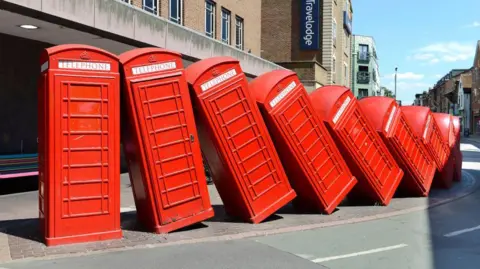
News imageGetty Images A outdoor sculpture on a suburban street consisting of a row of 12 red phone boxes that have collapsed onto each other.Getty Images
The Out of Order sculpture is a Kingston landmark

What happened in Kingston upon Thames at the last council election in 2022?

The turnout was 45.5%.

Lib Dems: 44 seats (+5)

Conservatives: 3 seats (-6)

Independent: 1 seat (+1)

Since the election there have been a number of defections: the Kingston Independent Residents Group now has three councillors.

Election expert Tony Travers on what might happen in Kingston upon Thames in 2026

What might happen in Kingston?

Professor Tony Travers, of the London School of Economics, said Kingston is currently Liberal Democrat held, it was a Conservative/Liberal Democrat marginal in the past.

Given the plight of the Conservative Party nationally in the polls, this looks like a pretty safe hold for the Liberal Democrats, but with the possibility the Greens could win one or two wards.

Why do the local elections in London matter?

At the moment, Labour are dominant in London - they have 21 of its 32 councils, a record-equalling high.

The Conservatives run just five - having lost their former "crown-jewel" councils of Wandsworth and Westminster to Labour at the last borough elections in 2022.

The Liberal Democrats run three councils in south-west London and will be looking to gain Merton from Labour.

The Aspire Party run Tower Hamlets and two boroughs are currently in no overall control.

Nick Bowes, insight director from the London Communications Agency, said: "These are likely to be the most consequential elections in London, certainly for the past 20 years - possibly since the first borough elections in 1964."

He added: "The ways things are fragmenting in the polls it's very difficult to predict exactly what's going to happen but it does look like being a very bad night for Labour and the Conservatives in London."

When are the 2026 local elections in Kingston upon Thames and who can vote?

More than six million Londoners can vote in the council elections on Thursday 7 May 2026.

All 32 London boroughs are up for election.

There are also elections for the mayor in five boroughs: Croydon, Hackney, Lewisham, Newham and Tower Hamlets.
All candidates in the Kingston upon Thames Council election are listed on the borough's website.

Use our tool to see what elections are being held in your area.

Key dates in Kingston upon Thames Council local election

The deadline to register to vote is Monday 20 April 2026.

The deadline to apply for a postal vote is Tuesday 21 April 2026 at 17:00 BST - you must be registered to vote before you can receive a postal vote.

The deadline to change existing postal or proxy voting arrangements is also Tuesday 21 April 2026 at 17:00.

The deadline to apply for a proxy vote is Tuesday 28 April 2026 at 17:00.

Photographic voter ID is required to vote at a polling station - if you do not have valid Voter ID, the deadline to apply for photo ID to vote (called a Voter Authority Certificate) for this election is Tuesday 28 April 2026 at 17:00.

Election Day: Thursday 7 May 2026 from 07:00 to 22:00.

You can find more information about voting in Kingston upon Thames on the borough's website.

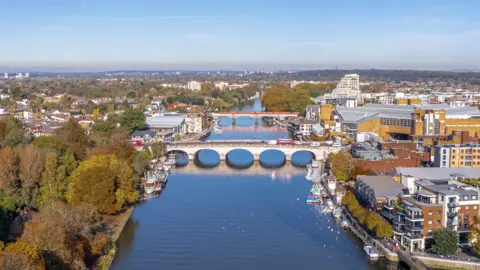
News imageGetty Images A bridge across the river Thames - there are parks and office and residential buildings on both sides of the river. Getty Images
Kingston is on the River Thames

Where is Kingston upon Thames and who lives there?

The Royal Borough of Kingston upon Thames is located in south-west London and is bordered by Merton, Richmond and Surrey.

What's it like? A historic, cultural and affluent borough that is popular with families. It combines a feel of the countryside and city living.

Neighbourhoods: The main town areas are Kingston, Surbiton, Chessington, Malden Rushett, New Malden, Old Malden and Tolworth.

Places of interest: Ancient Market Place in Kingston, Canbury Gardens, Rose Theatre, Coronation Stone, All Saints Church, Clattern Bridge, Kingston Museum and Out of Order, an art installation of 12 falling red telephone boxes.

Pub quiz fact: The Clattern Bridge, which carries traffic over the Hogsmill River in the town centre, is believed to be the oldest surviving bridge in London.

Population (2021 estimate): 168,100

Demographics:According to the census in 2021, 68.3% of residents identify as white, 17.8% as Asian, 5.4% are mixed race and 2.8% identify as black.

Average property price: According to the Office for National Statistics (ONS), the average house price in January 2026 was £578,000.

Average monthly rent: The ONS reported that the average monthly rent in February 2026 was £1,808.

Council tax: Band D council tax in the borough in 2026/27 is £2,097.61.

Transport: There are 11 train stations in Kingston and around 400 bus stops, along with two bus stations.
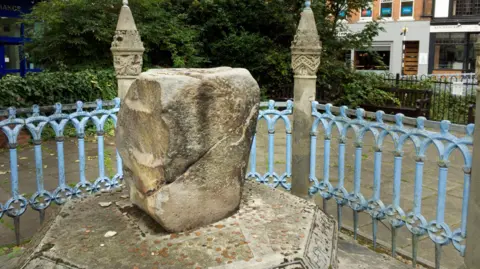
News imageGetty Images An ancient block of stone surrounded by railings in a suburban London street. Getty Images
The Coronation Stone is believed to have been the site of the coronation of seven Anglo-Saxon kings

What is Kingston upon Thames's local history?

Kingston upon Thames is one of England's oldest royal centres and has been linked to the coronation of several Saxon kings.

Early rulers such as Æthelstan and Eadred are believed to have been crowned in the town, which is why Kingston is often described as the place where England began.

The Coronation Stone, traditionally associated with these ceremonies, remains a key historic landmark. The town's name comes from the Old English word Cyningestun, which means royal farm or estate.

The town preserves important medieval features including Clattern Bridge, considered the oldest surviving bridge in London, as well as a 12th Century undercroft.

Kingston grew as a significant market town during the Middle Ages and later developed as the administrative centre of the surrounding area.

What is Kingston upon Thames's electoral history?

Kingston has swung back and forth between the Conservatives and the Lib Dems since 2002. From its creation in 1965 it was a Tory borough until 1986 when it went to no overall control. The Lib Dems first took the council in 1994 and have run it since 2018.

Listen to the best of BBC Radio London on Sounds and follow BBC London on Facebook, X and Instagram. Send your story ideas to hello.bbclondon@bbc.co.uk