Second Tube strike to impact London from midday

 Getty Images
The second in a series of 24-hour strikes by London Underground drivers begins at midday on Thursday.
The strike by members of the Rail, Maritime and Transport union (RMT), which represents roughly half of drivers on the Tube network, is expected to cause travel disruption across the capital.
The union is in a dispute with Transport for London (TfL) over changes to the working week and said it was concerned about the safety impact of proposed shifts lengths. It said it had planned four more 24-hour strikes in May and June if the row was not resolved.
TfL said the industrial action was "completely unnecessary" and the proposed working week pattern was optional.
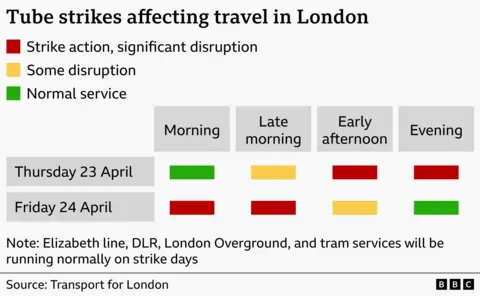
- The industrial action will begin at 12:00 on Thursday and last for 24 hours
- The Piccadilly and Circle lines will be closed entirely
- The Metropolitan line will be closed between Baker Street and Aldgate
- Central line services will not run between White City and Liverpool Street
- Other lines that do run will be offering a significantly reduced service
- Latest status updates here
Why are Tube drivers striking?
The RMT has rejected an offer for Tube drivers to voluntarily work a four-day week.
Under the proposals, most drivers would see their working week reduced from 36 hours to 35 hours, but their salary would remain the same.
The union said it was concerned about shift lengths, unacceptable working time arrangements and the possible impact of fatigue on safety.
The union it wanted a 32-hour week over four days, which would see drivers work three fewer hours each week for the same salary.
RMT official Jared Wood said: "TfL need to come forward with changes to their proposals for this dispute to be resolved."
Claire Mann, TfL's chief operating officer, said the four day week proposal "allows us to offer train operators an additional day off, whilst at the same time bringing London Underground in line with the working patterns of other train operating companies."
She added: "The changes would be voluntary, there would be no reduction in contractual hours and those who wish to continue a five-day working week pattern would be able to do so."
Forthcoming strikes
- 23–24 April (midday Thursday - midday Friday)
- 19–20 May (midday Tuesday - midday Wednesday)
- 21–22 May (midday Thursday - midday Friday)
- 16–17 June (midday Tuesday - midday Wednesday)
- 18–19 June (midday Thursday - midday Friday)
Listen to the best of BBC Radio London on Sounds and follow BBC London on Facebook, X and Instagram. Send your story ideas to hello.bbclondon@bbc.co.uk
