Why Pride is facing a backlash - from inside and outside the LGBT community

 BBC
BBCMatt left Crewe as soon as he could, aged 18, feeling that he wasn't accepted as a young gay man. The only LGBT scene to mention was a tiny, makeshift bar behind a curtain in the back of an out-of-town pub.
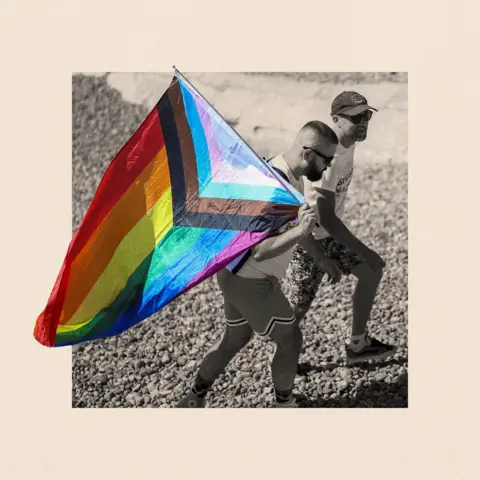
He left in 2015, but this June found himself returning home, for Crewe Pride.
For Matt, it was a significant homecoming. "It really took me back to when I was a kid growing up here, trying to navigate my identity. It felt so important to be there and see how a town that wasn't particularly welcoming… has changed and flourished."
For many, these small, community Pride events feel a world away from the huge celebrations in the UK's largest cities.
But Matt's happy weekend in Crewe masks a growing culture war over Pride. Over the last few years, a number of councils have withdrawn their support for Pride festivals, while some big brands - perhaps nervous about being seen as too "woke" - have become hesitant to associate themselves with them. On top of all that, there's a long-running complaint from some LGBT campaigners that Pride has become overly commercialised; while the argument over trans issues has also made matters more fraught.
It's leading some to ask: what future do Pride events have?
The roots of Pride
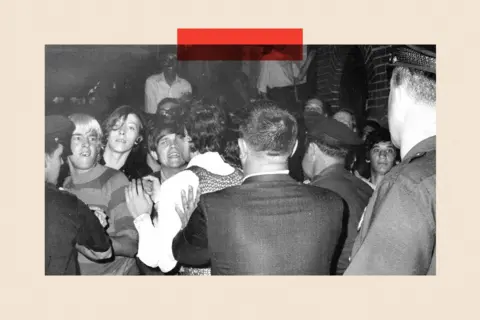
Pride started as a protest, with Britain's first official Pride march in London in 1972. Homosexual acts between men were illegal in England and Wales until 1967 (and for longer in Scotland and Northern Ireland), and LGBT people lost jobs and housing because of their sexuality, while police forces frequently targeted the community with raids and surveillance that made everyday life precarious.
In Manchester, Pride started small in 1985. A bring‑and‑buy sale on Canal Street was organised to raise money to spruce up the rather drab-looking hospital ward treating those with HIV and Aids at the height of the epidemic.
 NY Daily News Archive via Getty Images
Little did those early attendees realise how big Manchester Pride would become: a four-day, city centre extravaganza over the August bank holiday weekend, with colourful floats, loud music, and every inch of pavement filled with enthusiastic spectators dressed to the nines, streaked with rainbow face paint.
By 2019, the event had outgrown the city's famous Gay Village. That year's headline act, American superstar Ariana Grande, performed in a purpose-built stage in another part of Manchester - for a premium ticket price. It prompted criticism, and the organisers of Manchester Pride would later come under fire for ending funding for various charities (including an HIV charity, and a scheme that distributed free condoms).
The company behind Manchester Pride went into voluntary liquidation last year, owing more than £1m to suppliers and performers, including Nelly Furtado. Since its collapse, local businesses and charities have created a not-for-profit group - Manchester Village Pride - with the aim of organising a much cheaper festival more rooted in the community.
Carl Austin-Behan, who is helping to organise this year's scaled-back event, says he's been "frustrated for a number of years" by the direction of Manchester Pride. "When things were being taken out of the village, that was the first sign that things were going in the wrong direction… It should be about the community. We certainly don't need to be spending the amount of money that was spent on Manchester Pride."
And Manchester's problems aren't isolated. London Pride has faced criticism for feeling overly corporate and overcrowded; Brighton has struggled with the financial burden of staging large‑scale concerts and policing. Against that backdrop, smaller events like Crewe seem to be the direction many Prides are going in 2026.
A corporate 'nervousness'
But the political winds have also changed - with seemingly less corporate enthusiasm for diversity and inclusion initiatives.
Phil Douglas, organiser of Newcastle Pride, says: "There is a general nervousness from organisations and companies to be front and centre in their support. We see some wanting to still support us but not wanting their logo attached… they don't want the backlash which is right there ready in the online community. It's quite a complex time to navigate support for Prides as a whole."
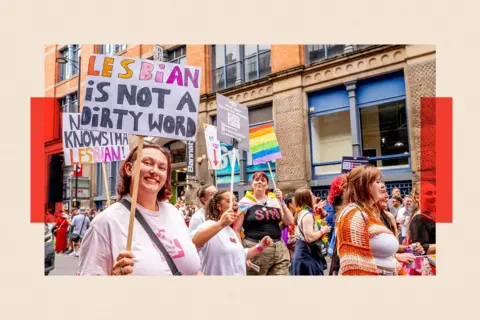
A few years ago, you couldn't go on social media in June - known as "Pride month" - without seeing what felt like every corporate logo incorporating the Pride flag. Critics called it "rainbow‑washing", arguing that the displays of solidarity were more about marketing than meaningful action.
But now, according to Guardian analysis, the corporate presence has been waning. Last year, mentions of Pride on social media by the UK's 10 biggest listed or headquartered companies had fallen by 92% compared with 2023 - a drop that suggests brands are pulling back from overt LGBT messaging.
 Getty Images
"There has been a general rowing back of corporate support for LGBT causes globally," says Paul Martin, chief executive of the LGBT Foundation charity. "We've seen that with politics changing in some countries and diversity and inclusion being seen as too woke… We don't get support from some quarters like we used to.
"And that has played out with Pride festivals as well. Corporate funding has been pulled back and that has caused a real challenge for Pride organisers to balance the books."
A survey by the pollster Ipsos found that the share of British adults who want companies and brands to promote LGBT rights dipped from 52% in 2021 to 44% this year.
Flags stop flying
In Liverpool, Merseyside Police did not take part in the city's Pride parade last year after legal advice warned that uniformed participation by a public body could breach rules on political impartiality.
This summer, firefighters and police again stayed away: Merseyside Fire and Rescue Service said it was taking a "pragmatic approach" following a High Court ruling that found officers in the north‑east should not have been allowed to join a Pride event. West Midlands Ambulance Service also withdrew from Birmingham Pride on similar legal advice.
Back in May's local elections in England, Reform UK won power on 14 councils, adding to the 10 they already controlled. Last month, the party's leader, Nigel Farage, said he is "fine" with Pride events going ahead but did not want local authorities to promote them.
A few weeks after taking power in Durham last year, the town's new Reform administration removed a rainbow flag from the council headquarters. Councillors also withdrew their funding contribution of £2,500 for Durham Pride. In the Merseyside town of St Helens, meanwhile, the Reform council leader instructed officials to cease engagement with all aspects of Pride; the council also removed displays celebrating the festival from libraries.
 Getty Images
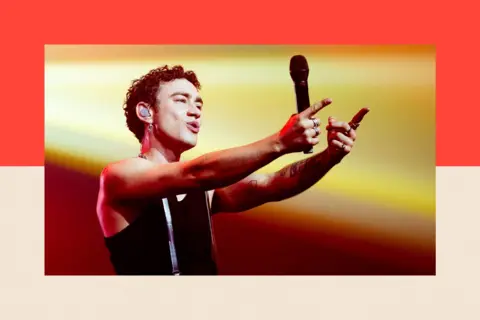
Explaining the cuts to funding, Reform's Darren Grimes, deputy leader of Durham Council, says: "I feel that we've moved away from that laudable aim of gay equality. We achieved same-sex marriage and that was the final frontier."
Durham Pride organiser Mel Metcalf says taking the flag down made LGBT people in the community "feel unwelcome". The festival did still take place; organisers said it was their "biggest" year ever, after raising around £25,000 from individual donors and trade unions.
As well as Reform's approach, the new Conservative council leader in Enfield, north London, has said they will only fly certain flags outside Enfield Civic Centre - and the rainbow flag is not one of them.
The trans dividing line
Debate around trans rights is also fuelling the Pride culture war. Some gay and lesbian people who describe themselves as "gender critical" - and whose beliefs mean they're sceptical of some of the aims of the trans rights movement - say they feel sidelined by Pride; while some trans people say they no longer feel safe attending.
A lesbian woman who describes herself as gender critical, and did not want to be named, told me she no longer attends Pride because she thinks it has become dominated by a focus on trans issues.
Grimes, one of Reform's highest-profile gay members, argues that Pride has moved away from its focus on gay equality and become bound up with the wider gender identity debate: "You've slain the dragon in the pursuit of equality and now all you are left with is a few rambling sheep." He says that "public subsidy" for LGBT issues has become a "cash cow" that fuels "narratives of victimhood".
For some, the focus on trans rights is a reason to step back from Pride; for others, it underscores why events like Sparkle matter.
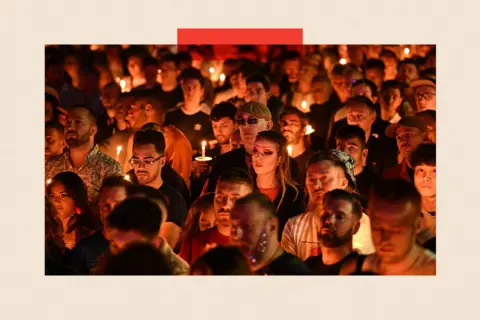
Sparkle is the UK's biggest transgender celebration. It takes place in late June in Manchester's Gay Village, a few months before the Pride weekend. This year's event had live music and comedy. Lauren, a transgender volunteer at the event, told me: "We've got a lot of stigma and hatred against us… You've got people trying to push us back into the dark and it does make it harder to live our lives."
 Getty Images
Another transgender woman I spoke to, who was staying in a hotel in Manchester's Gay Village, said she wanted to be in the city for the event, but was wary of leaving the hotel because she felt unsafe.
Security has also become a central consideration, especially after the events of last month in Berlin, when 21-year-old Abdul Ballout drove a car into a crowd at the city's Pride festival, killing one woman and injuring 29 others. Guy Mathias, from the Security Commonwealth - a trade group for security firms - says he thinks many Pride organisers will review their plans following the Berlin attack.
"Smaller events generally would cost less individually, but they still need many of the same safety measures in place," he adds.
Others think that Pride festivals can create headaches for local residents. Andy Winter, a columnist for the Brighton Argus, attended Pride marches in the 1980s in his role as a Brighton councillor. He recalled in one piece how he was vilified by the press at the time for supporting a pro-LGBT council motion. But last year, he wrote that Brighton's Pride weekend comes with "alcohol and drug-fuelled excesses".
He wrote: "Even though I am not gay, Pride impacts on me. One of the parks I use is 'closed' for ten days... to allow largely straight performers to entertain those able to pay the large entry fee." He added: "The streets are littered with plastics and broken glass. I pity neighbours of the park and surrounding streets who see their driveways and gardens used as toilets."
The future of Pride
I've been to dozens of Pride events over the years. Manchester has always been a must. When I was a teenager in Ulverston, Cumbria - a place where I was pretty certain I was the only gay in the village - Manchester always seemed like the bright lights, a land where you could be free and your true self.
This year I'll return again, excited to catch up with my friends and intrigued to see what the new community-focused Pride is all about.
But I suspect there'll be a slightly different mood in the air this year; an awareness that in some parts of the country, Pride has become controversial.
Younger LGBT people still say Pride matters. A 2024 YouGov survey of more than 500 LGBT Britons, aged 16 to 24, found that 90% say it is "very" or "fairly" important that Pride month still exists.
As a young man, I eventually left Ulverston to live in Manchester. But this summer I took a trip back to my old hometown for their Pride festival, a tradition still in its infancy.
The once-familiar cobbled streets looked so different to how I remembered them, lined with cheering locals clapping and filming on phones as a procession bedecked in rainbow flags swept past, led by a brass band playing upbeat gay anthems. It felt a world away from Manchester's famous pop stars and stages covered in corporate logos.
Matt had a similar reflection on returning to Crewe. "What really resonated with me and blew my mind was the fact that it was so family-centred. These small towns put on events that are for the community first and foremost."
As I looked around Ulverston, the national debates that have shaped Pride in recent years felt distant. I was distracted by the small things: people laughing, the spread of ages in attendance. It was the community my teenage self never would have imagined he'd see.
Correction 3 September: This article previously stated that homosexuality was illegal in the UK until 1967. It has been corrected to make clear that it was homosexual acts between men that were illegal, and that the partial decriminalisation of 1967 only applied to England and Wales (not Scotland and Northern Ireland).
Top image credit: Getty Images.

BBC InDepth is the home on the website and app for the best analysis, with fresh perspectives that challenge assumptions and deep reporting on the biggest issues of the day. Emma Barnett and John Simpson bring their pick of the most thought-provoking deep reads and analysis, every Saturday.Sign up for the newsletter here
