What would new regional mayors mean for the South?

 Press Association
Plans for two new regional mayors have moved a step closer after they were named in the Budget.
The government said it was in the "final stages" of agreeing mayoral authorities for Wessex and the Thames Valley, as part of 10 new devolution deals across England.
Supporters say a mayor would bring more money and control over transport, housing and skills, with decisions made locally rather than in Westminster.
But some council leaders and MPs have questioned the areas being covered and whether the benefits will outweigh the costs.
Is this the same as my local mayor?
Unlike civic and ceremonial mayors, regional mayors are directly elected by the public.
They preside over mayoral strategic authorities, also known as combined authorities, which comprise a group of local councils.
Regional mayors, like those in Greater Manchester and London, are intended to provide strong local leadership, giving people a single prominent individual they can hold to account.
They also give central government a single point of contact when delivering work in a particular area.
Local councils would continue to run day-to-day services such as bin collections, social care, schools and local planning.
What could a mayor actually do?
The English Devolution and Community Empowerment Act, passed in April, set out a standard set of powers for strategic authorities.
They typically include control over aspects of transport, skills, housing and local infrastructure investment.
In some cases they also hold power over planning, policing, health and employment support.
Police and crime commissioners are due to be abolished in 2028, with their powers passing to mayors where possible.
The Budget also said mayors would receive a share of business rates from next year and a share of income tax from 2028.
The government also plans to give all strategic authorities the power to introduce an overnight visitor levy.
Regional mayors can also exercise soft power as champions of the areas they represent.
Why does the government want more mayors?
The government says people who know their places best should have more power to shape their future.
Ahead of the Budget, Prime Minister Andy Burnham, himself the former mayor of Greater Manchester, said he was "calling time on local leaders going cap in hand to Westminster".
The Budget included £120m for areas moving towards a devolution deal, ahead of a £1.5bn borrowing facility for mayoral authorities being introduced from 2028.
Is a Wessex mayor finally happening?

The combined bid for a Heart of Wessex authority and mayor, comprising Bournemouth, Christchurch and Poole (BCP), Dorset, Somerset and Wiltshire councils, was rejected by the government in January 2025 for not being advanced or developed enough.
Speaking during Prime Minister's Questions on 21 October, West Dorset MP Edward Morello urged the prime minister to "commit to a mayor of Wessex by 2028".
Andy Burnham said: "Yes, I'm always happy to create more mayors. Let's move quickly to get a fully devolved Wessex and south west of England."
Speaking to BBC Radio Solent on Wednesday, Morello said the decision meant "more buses" and "more investment" for residents.
"This means we can steam ahead with those plans," he said.
In a joint statement, the four council leaders added: "Wessex is ready. We have done the groundwork."
Why has the Thames Valley plan been so rocky?
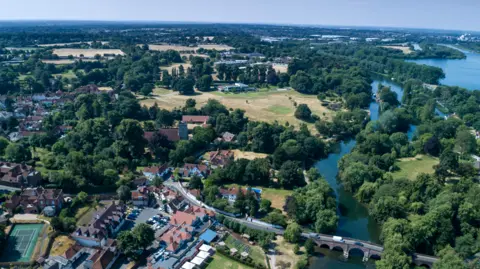 Getty Images
Oxfordshire County Council and the Royal Borough of Windsor and Maidenhead had vetoed earlier proposals, with concerns over Swindon's inclusion and calls for a mayor from the start.
Oxfordshire council leader Tim Bearder said what he had vetoed was a non-mayoral authority, and it had been "quite wise to make sure that we held out for something that's far, far better".
Authorities in Oxfordshire, Berkshire and Swindon have spent the last two years drawing up plans for devolution.
The 13 councils involved say the government has proposed £9.1m of funding as the plans are developed.
They say a consultation is planned for the new year, with a formal proposal going to government in spring and mayoral elections expected in 2028.
Oxford City Council leader Susan Brown described it as "a once-in-a-generation opportunity".
Reading Borough Council leader Liz Terry said the authority would "unlock enormous benefits for residents in Reading".
Neighbouring Hampshire and the Isle of Wight are further down the same path, with their strategic authority launched in July and a first mayoral election due in May 2028.
What do the critics say?

Despite backing the next stage, Bearder said he had "serious, unanswered questions" about whether the benefits would justify "the costs and disruption involved".
He said leaving out Buckinghamshire, which shares some services with the rest of the Thames Valley, could have "significant" implications for policing, the NHS and fire services.
South Oxfordshire District Council leader Maggie Filipova-Rivers said councils had been given "just two working days" to consider proposals that "could reshape public service boundaries across the Thames Valley for years to come".
In Dorset, Poole's Labour MP Neil Duncan-Jordan has said there was "no real public support for creating an artificial entity called Wessex".
Conservative North Dorset MP Simon Hoare warned the BCP conurbation had "an entirely different economy" to the rest of the area.
The Local Government Association said "genuine devolution must go beyond mayors and strategic authorities to empower councils themselves".
