Oranges and kisses: Your guide to Tutti Day

 BBC
BBCFor many, it will be just a regular Tuesday.
But for one Berkshire town it is a day to celebrate Tutti Day - a part of the English medieval Hocktide festival, marked on the second Tuesday after Easter, also known as Hock Tuesday.
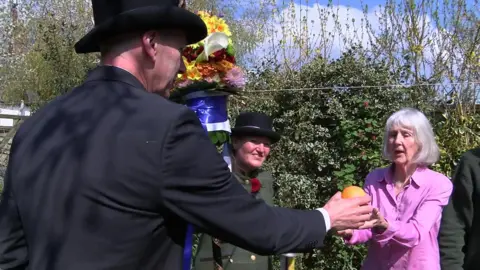
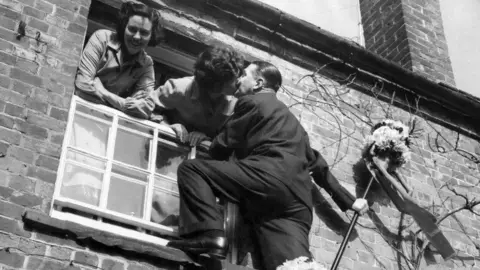
According to tradition, the "Tutti-men" would walk through Hungerford collecting rent from commoners on Hock Monday, while on Hock Tuesday both Tutti men and Tutti women would collect kisses in exchange for an orange.
This is your guide to the celebrations of the Town and Manor of Hungerford charity's "most important event" which allowed the villeins in 12th Century to "let their hair down after Lent".
 Mirrorpix via Getty Images
The festivities will kick off with summoning of all commoners by the bell and proclamation from the Town Hall Balcony.
The festival dates back to when John of Gaunt, the Duke of Lancaster, granted commoners grazing rights and permission to fish in the Kennet River.
The Tutti men and women will then set off from the Town Hall steps, accompanied by the Orangeman and Tutti girls and boys.
Residents no longer have to give kisses in return if they do not wish to.
The oranges are a reference to the town's support for William of Orange who became King William III after negotiating the terms of his reign at Hungerford's Bear Hotel in 1688.
The tradition also involves the Hocktide Court, which a selected jury attends and all commoners are called.
The charity says that at the head of the Court is the Constable, "who takes his or her seat in a carved ebony chair which is probably of Portuguese origin, and possibly dating from the Elizabethan period".
If a called commoner is absent, the Bellman and Assistant Bailiff "slams down a penny and shouts 'Here Sir!'".
The Steward of the Manor then reads customs handed down since 1583.
A traditional highlight is the Hocktide Luncheon at the Corn Exchange, which involves a four-course meal.
In the evening, the Three Swans Hotel on the High St will take centre stage in the celebrations as the last port of call for the Tutti men, women and the orange man.
The charity says the hotel will serve "a traditional and tasty treat" of anchovies on toast.
Nigel, who was the orange man last year, said his role was to "look after the tithing men and make sure they don't get too drunk when we visit the commoners properties".
"I carry around a large sack of oranges and one is handed to the lady of the house of each property that we visit," he added.
The event will be broadcast live on BBC Radio Berkshire.
You can follow BBC Berkshire on Facebook, X, or Instagram.
