A country that made huge progress on measles now reports 120,000 cases

 BBC
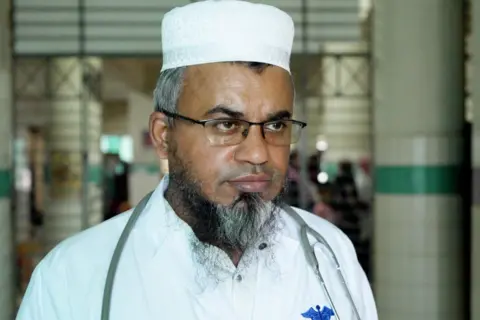
BBC"I have never seen an outbreak this huge," says paediatrician Dr Mohammed Golam Mawla, as we look around a measles ward in the Bangladeshi city of Mymensingh.
Until March this year, Bangladesh had made "substantial progress" towards eliminating measles, according to the World Health Organisation.
Vaccination rates had been higher than 90% until recently.
But that progress has quickly and suddenly come undone.
Since March, government figures show nearly 750 people, mostly children, have died from the highly contagious disease, which spreads easily through breathing, coughing or sneezing.
The death toll includes confirmed and suspected cases of measles. But Unicef says the true numbers are likely to be higher, given the sudden surge, an overwhelmed health system and difficulties in gathering data.
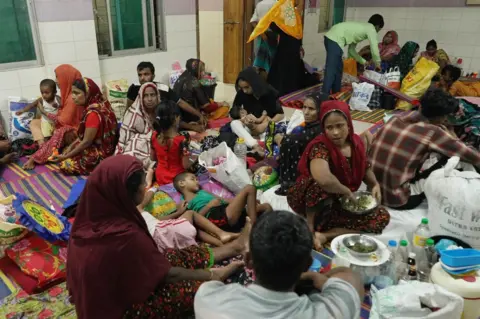
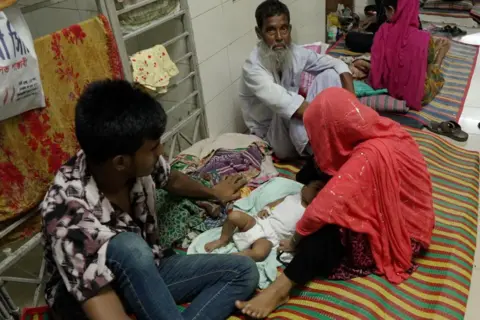
Those numbers are made real by the dozens of families around us who have no choice but to lie on blankets on the floor, in the hallway. The ward at Medical College Hospital is at more than double its capacity, with nearly 130 patients in just 32 rooms.
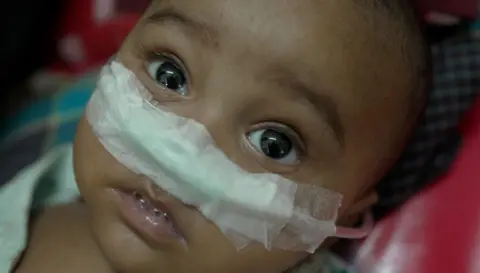
Four-month-old Arafat is one of them.
His nose is too small for oxygen tubes to sit comfortably so doctors have bandaged and taped them into place.
"We have been in the hospital for about 15 days now, but my baby isn't getting any better," his father, Mohammad Alam Mia, tells us. His baby is writhing in the heat and struggling to breathe.
Arafat's parents travelled nearly 10 hours to the hospital. His father vomited and fainted in the ambulance, as his first child became unresponsive.
Doctors diagnosed Arafat with pneumonia and heart failure, both complications of measles. The little money Mohammad has is not enough for his treatment, and he's been forced to borrow from neighbours.
Arafat is one of Bangladesh's more than 120,000 suspected and confirmed measles cases since cases spiked in mid-March, according to government figures.
"This disease was under control in our country," says Mawla. Vaccines are highly effective. "Why did this suddenly happen?"
Miguel Mateos Muñoz, Unicef's spokesperson in Bangladesh, puts it down to a "perfect storm" of several factors.
Firstly, there were alleged delays in vaccine orders.
Bangladesh has seen years of political turmoil, with student-led protests in 2024 toppling the country's authoritarian leader, former Prime Minister Sheikh Hasina. Unicef claims the interim government, under Muhammad Yunus, delayed ordering vaccines last year, opting instead to consider new vendors and restructure how the purchases were financed.
Muñoz says Unicef insisted the interim administration give themselves enough time to make the changes. "We were worried about possible [vaccine] gaps increasing, and it unfolding into what we're now seeing."
A shortage of vaccines is exactly what the new government, under Tarique Rahman, claims to have discovered once they took office.
The BBC contacted the office of former interim leader Muhammad Yunus, but he declined to be interviewed.
Yunus’s former top health ministry official, however, denies any shortage of vaccines, and tells the BBC while Unicef had raised concerns, "these communications did not contain any specific warning about a potential measles outbreak".
Syedur Rahman claims experts "including representatives from other UN agencies suggested that a competitive procurement process could, over time, create opportunities for greater cost efficiency".
Muñoz also points to other factors fuelling this particular surge: the Covid pandemic delaying routine jabs, a lack of regular measles-rubella mass vaccination campaigns since 2020, overcrowding and Eid holiday travel.
Globally, Bangladesh is not the only country seeing an outbreak this year.
The United Kingdom was considered to have eliminated the disease altogether, but lost that status this year following a rise in cases. The United States has also seen a rise in measles cases in recent years, and children under five in both countries fall short of the 95% vaccination threshold needed for herd immunity.
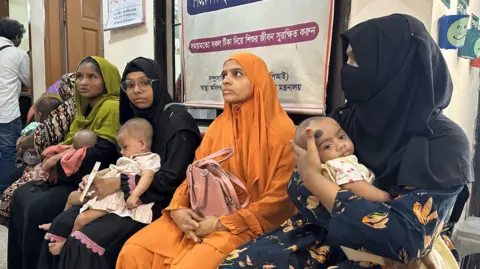
Public health experts are warning the outbreak in Bangladesh is proof of the dangers of any interruption in vaccine coverage.
Three hours outside of the capital Dhaka, we witness the consequences of the vaccine shortage.
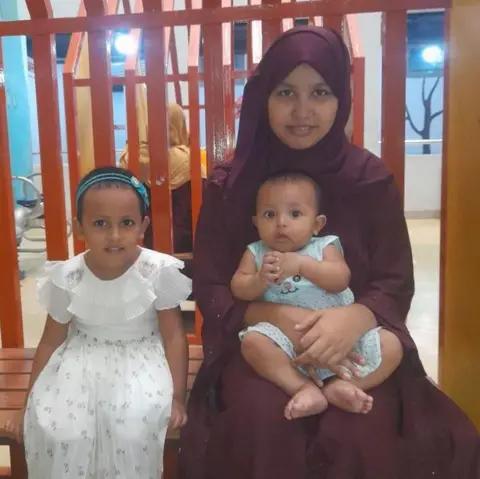
Mosammat Nila Akhter and her husband took their 10-month-old child, Maliha, to a clinic for her vaccine in February, but were told there were none left.
In late March, as the outbreak took hold, Maliha was admitted to hospital with pneumonia, but was discharged just days later. Her parents later noticed a rash beginning to form on her belly.
Back at the hospital, they were told there were no beds available. Desperate, they waited three hours at yet another hospital until another child was discharged. Akhter claims bed shortages led to children with and without measles sharing wards.
"No matter how much we wiped her body down, her fever didn't come down. The doctors just kept coming and saying, 'keep wiping her body,'" Akhter says.
They were told Maliha needed an ICU bed, but that the hospital had none to offer. For hours, they travelled in an ambulance, while Maliha was struggling to breathe, until they found one.
"She would just look at me. Even with all those tubes and machines attached to her, she would try to reach out, wanting to crawl into my lap," Akhter remembers, in tears.
Three days later, Maliha died.
"Everything about her was wonderful," Akhter recalls, her voice breaking.
"Who to blame?" she asks. "Should I blame the government because my child did not get the vaccine?"
 Supplied
The government and Unicef launched an emergency vaccination campaign in April in certain regions, and have so far inoculated more than 18.4m children.
They say reported cases and deaths have now slowed, but Bangladesh is still recording nearly 1,000 suspected measles cases on average a day, and multiple deaths daily.
Health Minister Sardar Sakhawat Hossain acknowledges the strain on the health system but says it is to be expected given the country's population of more than 170 million people.
"The accommodation facilities are comparatively low, but we have managed," he says.
But public health expert Mushtuq Husain says the government is refusing to accept this is "not an outbreak, it's an epidemic". He calls the current figures "the tip of the iceberg".
"We have to take the numbers with a pinch of salt, but what it's telling us is that the work is still not done," Muñoz tells us.
"It is still a grave situation," Husain argues. "It is unacceptable that every day children are dying, and thousands of people are being infected."
Days after our visit to the measles ward in Mymensingh, we hear news that baby Arafat has died. He is now one of the hundreds of children claimed by this preventable disease.
On the phone, his father is in tears. "I spent all my money, took loans, and tried my best to save my son. But everything is gone now."
Additional reporting by Prem Boominathan and Sardar Ronie
