The man-made river that turned a town's fortunes

 Getty Images
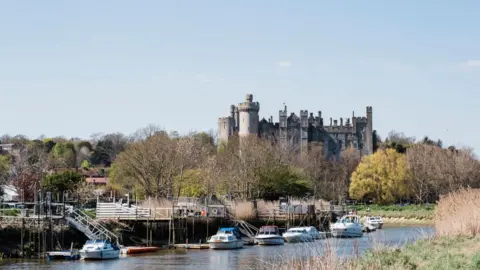
The River Arun, now one of Sussex's most distinctive waterways, has not always flowed in the form familiar today.
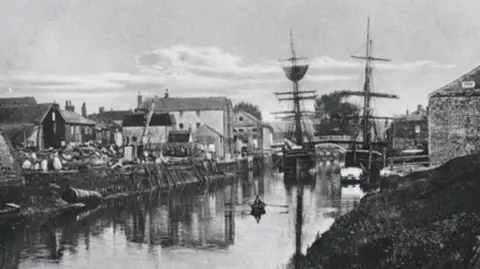
Running through Arundel, West Sussex, the river became one of the county's busiest trading routes, carrying coal, timber, tea and salt.
Before human intervention, however, it was difficult to navigate, with the tidal reach stopping short of Arundel and limiting access for larger vessels.
Martin Alderton, from Arundel Walking Tours, told Secret Sussex: "Everyone thinks we're named after the river, but it's actually the other way round."
Alderton believed it may have been someone with high authority, like the Duke of Norfolk, who was responsible for naming the river.
 Arundel Historic Tours
In the 18th century, major improvements were made to the river to enhance its role in trade.
A 1732 Navigation Act allowed the creation of a new channel at Littlehampton, making the harbour safer and more stable for ships.
A later act in 1793 permitted more extensive engineering works to take place such as dredging, straightening the river and strengthening its banks to accommodate larger vessels.
Alderton described the mammoth engineering works as "an amazing achievement" as everything was done by hand.
He said the transformation had meant by the late 18th Century and early 19th Century, Arundel became a thriving town.
"We had lots of hotels, coach houses and 30 pubs, each with accommodation, and we had tea clippers coming in," he said.
However, said Alderton, Arundel's reputation as a bustling trading port fell into decline when the railway was built.
"The original Ford railway bridge was a sliding bridge and mechanically, it wasn't suitable so it was turned into a fixed bridge," he explained.
Alderton said as a result, this has restricted the size of vessels that could sail on the river.
Follow BBC Sussex on Facebook, on X, and on Instagram. Send your story ideas to southeasttoday@bbc.co.uk or WhatsApp us on 08081 002250.
