US mother's mental health spiralled before her children's murders, ex-husband says

 Reuters
Warning: This story contains distressing details and discussion of attempted suicide
Lindsay Clancy, the Massachusetts woman accused of killing her three children, was "very depressed", and her mental health grew "worse and worse" before their deaths, a jury has heard.
Patrick Clancy, her ex-husband and first witness in the trial, which is expected to last several weeks, told jurors that the month before the children's deaths "was really where her big spiral started".
Prosecutors allege Lindsay Clancy "knew exactly what she was doing" and made a "calculated" decision to kill Cora, five, Dawson, three, and eight-month-old Callan.
Her legal team argued she was "suffering from psychosis at the time". Clancy has pleaded not guilty but does not dispute she carried out the killings.
 Getty Images
She is charged with three counts of first-degree murder over the January 2023 deaths. If convicted, she faces life in prison without parole.
In the coming days and weeks, prosecutors will attempt to convince the 12-member jury that Clancy deliberately committed murder, while the defence will plead that she was not responsible and raise an insanity defence.
On Monday, her ex-husband, Patrick, answered prosecutors' questions about Clancy's relationship with her children, her mental health and his knowledge of her prescription drug use.
He described her intermittently seeking help from doctors and taking a variety of medications, and he recalled her saying she was starting to have suicidal ideations.
"She kept getting worse and worse," Clancy testified.
He said she switched psychiatrists because "it wasn't working" with a previous doctor. "It was just really stressful," he said of witnessing his wife struggle through anxiety and depression.
In December 2022, a month before the children's deaths, "that was really where her big spiral started", he said.
"She started to lose a lot of weight, and she became very depressed, and she was having a really hard time."
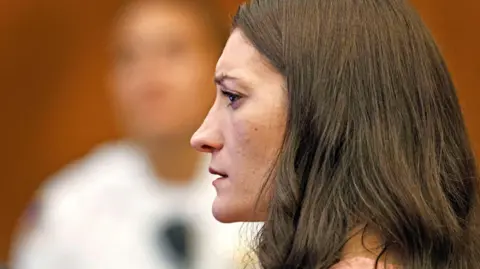
In their opening remarks, prosecutors sought to paint a damning picture of Clancy, occasionally bringing her to tears in the courtroom.
She was visibly shaking as Assistant District Attorney Shanan Buckingham described the Clancy children.
"This was a woman who acted intentionally, rationally, and swiftly to accomplish a very specific goal – to kill," Buckingham said.
"She is criminally responsible for the murders, because the evidence will prove to you that she knew exactly what she was doing."
 REUTERS/Brian Snyder
Buckingham said the trial would last for weeks, as prosecutors call a variety of witnesses, including law enforcement, firefighters, family, friends and psychiatrists.
While the prosecution asked the jury not to see the trial as a referendum on women's health, Clancy's lawyer argued: "It sure as hell is."
"The issue of consideration is, what was going on in that woman's mind," defence lawyer Kevin Reddington said.
Reddington described Clancy as a loving mother who was very involved in her children's lives and who "had no motive" to kill her children.
"This is a woman that did not get the medication, did not get the medical treatment, that she so deserved," he said.
Reddington said her children's deaths - and her suicide attempt afterwards - were a result of Clancy suffering psychosis, a rare postpartum side effect.
He showed the jury photos of a bloodied butcher's knife, wounds on Clancy's neck and wrist, and her lying intubated in a hospital bed following her attempted suicide.
Postpartum psychosis is a severe psychiatric emergency affecting about 1 in 1,000 mothers after childbirth, according to the UK National Health Service.
Symptoms can include hallucinations, delusions, a mixture of manic and low moods, and confusion.
If you are suffering distress or despair and need support, you could speak to a health professional, or an organisation that offers support. Details of help available in many countries can be found at Befrienders Worldwide. www.befrienders.org.
In the UK a list of organisations that can help is available at bbc.co.uk/actionline.
