The space race to create gym equipment for future astronauts

 John Kennett
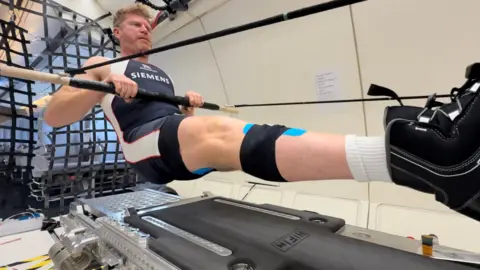
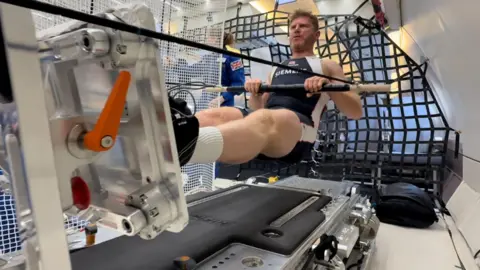
Olympic medallist Matthew Wells rows as hard as he can as his body begins to float up for 22 seconds.
Instead of a boat and water beneath him, he is 8500m (28000 ft) above the ground on a plane maneuvering to create weightless space-like conditions.
He's part of a different kind of race, one to create the equipment to keep the astronauts of the future fit during space missions.
The British invention he's trialling is amongst others being developed across the world, competing with the hope of a place on upcoming moon bases and space stations.
 ESA/Novespace
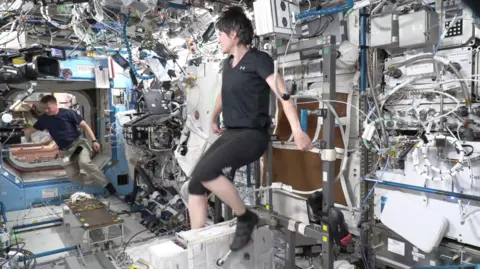
Astronauts have to work hard to keep fit in space to maintain muscle mass and bone density, but current machines need them to set aside a lot of time every day to maintain a certain level of fitness.
"Isn't it every kid's dream to be an astronaut?" Wells says. "It's an opportunity to be able to do something really different."
Wells, who won a bronze medal at the Beijing Olympics, says contributing to something that might end up in space is "out of this world".
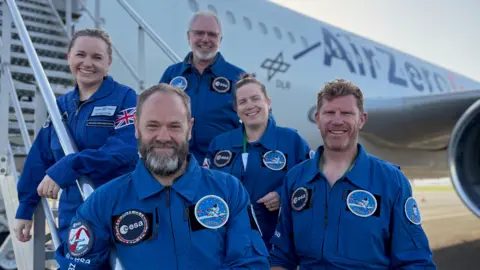
The European Space Agency (Esa), Nasa, the Canadian Space Agency and the UK Space Agency have all played some part in the equipment's development and testing, including Esa providing the parabolic flight tests.
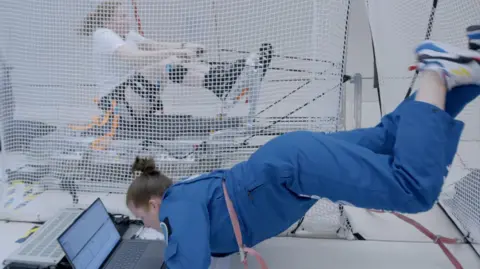
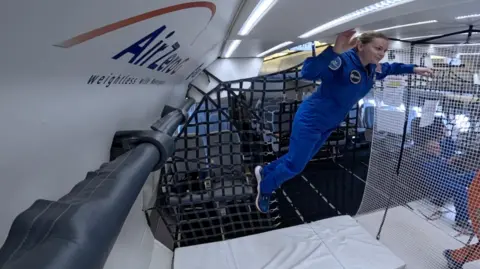
This is where a plane climbs and nose dives to create weightless conditions like in space, giving the researchers 22 seconds to gather data before the maneuver is repeated to build up their analysis.
 ESA/NASA
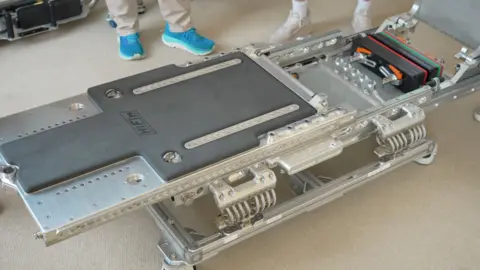
Called HIFIm (High-Frequency Impulse for Microgravity), the kit has already been through a round of testing for other exercises, such as its "jumping" setup.
The idea for the device came out of a competition between three different consortia around Europe to come up with an exercise device for the Gateway Space Station, an orbital space station for the Moon, explains Dr Meganne Christian – a reserve astronaut for the European Space Agency and Senior Exploration Manager at the UK Space Agency.
Although Gateway has effectively been sidelined by Nasa, Christian says we are at a "really exciting moment in space exploration" where these devices can be used for new space stations and "the lunar surface" with Artemis missions going back to the moon "this time to stay".
 ESA/Novespace
The British invention is not the only piece of equipment in development and testing.
Other teams across the globe are working on projects, including one commissioned by ESA and developed by the Danish Aerospace Company (DAC).
The European Enhanced Exploration Exercise Device (E4D), currently under astronaut testing, boasts four modes - resistive training, cycling, rowing and rope pulling. It also has motion capture technology so astronauts can track their performance.
Whilst these devices are designed for longer term space missions, the recent Artemis II mission around the moon took a specially developed exercise device called the flywheel.
Nasa says the work that went into developing it and the work on the next generation of exercise devices will play a vital role in astronaut health.
 John Kennett
Much like the toilet which kept playing up during the Artemis II mission, this research reminds us even astronauts operating in other worldly conditions are still human.
Our skeletons and muscles are incredible structures that deal with gravity - even when we simply move our bodies on Earth we are dealing with forces.
"In space we don't experience any forces, our muscles, our bones immediately start to diminish because we're not being loaded by those forces," says Dr Dan Cleather, professor of strength and conditioning at St Mary's University who is on the team developing the British equipment, HIFIm.
He designed the technology that allows it to monitor how effectively the user is exercising.
If astronauts do not do exercise, they also lose coordination and cardiovascular fitness, they become less able to carry out the functional tasks that they're required to do.
But there are challenges with exercising in space too, from the weight of current exercise equipment to the limited range of exercises you can do and the time it currently takes astronauts to keep fit.
 BBC/Tony Jolliffe
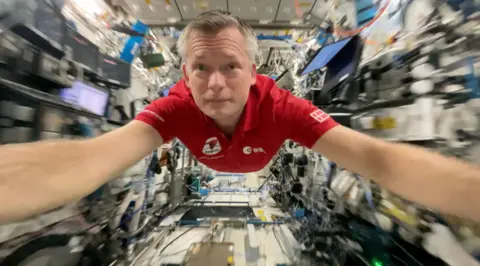
"On the International Space Station, for example, astronauts spend about two hours of every day doing exercise… that all adds up, it takes time," Christian explains.
For her, if you can reduce the amount of time you're exercising, it frees up more time for astronauts to do science and experiments "which could cause a whole range of breakthroughs."
The team behind HIFIm believe their device can reduce this exercise time down to 1/2 hour a day.
It's billed as the next generation of astronaut exercise equipment for long space missions by its inventor, John Kennett, who says his small piece of equipment can handle 300 exercises.
 ESA/NASA
Kennett says the device works without electrical power and is engineered so vibrations are isolated so as not to interfere with fragile experiments or the structural integrity of a vessel in space.
Kennett, a former aircraft engineer and owner of a pilates studio, came up with the idea when he was working with a client recovering from cancer who had very low bone density.
He then made the connection with space, believing the International Space Station was "missing a trick".
 John Kennett
The device was made at Pinewood studios by special effects engineers who won an Oscar for 1917 and who work on Star Wars, James Bond and Mission Impossible.
But to really put it through its paces, it requires testing in space-like conditions on parabolic flights.
The latest test involved the device's rowing attachment, which couldn't be properly tested on Earth. That's how Wells got involved.
"Every year since the Olympics I've always done some sort of physical challenge. I've been in boxing rings, I've done an Ironman, I've done swimming 6k, you know things like this and playing rugby for a season," he says. "This is another step again. Off the chart. The most outrageous so far."
You can watch Harriet's report for Tech Now on the iPlayer from Saturday or via the programme's website.
