A brutal gang rape in India revives painful memories of 2012 Delhi assault

 Shahnawaz Ahmad
Thirteen years after the gang rape of an Indian woman on a bus in the capital Delhi made global headlines, a new case that comes close in brutality inflicted on a woman has been reported from the northern state of Bihar.
Campaigners say her story is also one of apathy from the police and medical authorities that women who face sexual assault, especially in small towns and villages, routinely encounter in India.
Warning: This story contains details that some readers may find distressing.
Indian law prohibits naming victims of sexual assault so we are going to call the survivor Soma (not her real name).
The 28-year-old mother of four young children told BBC Hindi that she was attacked in her own home and gang-raped by a group of men who allegedly inserted objects into her vagina.
The incident took place on the night of 11 June in a village in Begusarai - a district that is officially recognised as one of India's most socially and economically backward.
The case gained national attention after hospital officials confirmed she was assaulted with objects, which doctors removed. She also brought a bullet casing, which she said was one of the items used.
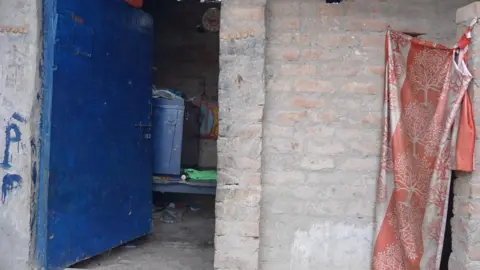
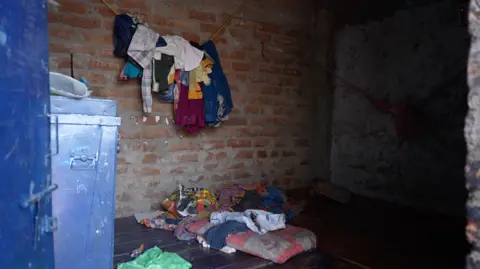
Giving details of the horrific assault, Soma said she was in the toilet outside her one-room home at night when five men barged in. The toilet does not have a door, only a curtain hangs over it to provide some privacy.
"They stripped me, gagged me, and tied my hands. When I tried to fight back, they slashed my chest with a blade and raped me," she added.
Her husband, she said, initially dismissed her groans as noises made by a stray cat, but then he grew suspicious and tried to check.
"But the house was locked from the outside. He called a neighbour who came and unlocked the door and everyone saw my condition and began to cry."
 Shahnawaz Ahmad
Begusarai superintendent of police Maneesh (who uses only one name) told the BBC that Soma's "medical report has confirmed sexual assault".
"There are three named and two unidentified accused in this case. We have arrested two of them. A Special Investigation Team (SIT), which has been constituted for the case, is conducting raids to arrest the others and the investigation is ongoing," he said.
Police say some of the accused have a previous history of crimes and have invoked sections dealing with gang rape against them.
On the night of her horrific assault, Soma said she received little help from the police or medical authorities.
The husband, an e-rickshaw driver, reportedly took his unconscious wife to a police station about 3 km from their home. He says the police refused to file a complaint and sent them away, advising him instead to take her to a doctor.
The police station head Rajiv Kumar has since been suspended for "negligence, apathy, and insensitivity", Begusarai police said. They said an FIR (First Information Report) in the case was registered at the local police station on 13 June.
Since the assault, Soma and her husband say she has also struggled to get proper medical attention.
On the night of the attack, she was reportedly turned away by a nearby private clinic, which said it did not handle emergencies and had no doctor on duty. She was then taken to a government community health centre, where she received first aid before being referred to a district hospital.
 Shahnawaz Ahmad
Soma told the BBC the initial treatment she received at the hospital was far from satisfactory.
After she regained consciousness on 12 June, she told her husband and the doctor who treated her about the gangrape. "The doctor asked me while administering an injection, 'Were you raped as well?' I kept telling her, 'Yes, Madam, I was'," she said.
Ashok Kumar, the Civil Surgeon of Begusarai, however, told the BBC that the woman was brought in with complains of stomach pain. And that they were informed of the gangrape only on 13 June "after which the physicians immediately conducted her medical examination".
The hospital sent Soma home after that, but she was back in hospital the next day after she lost consciousness, her husband told the BBC. She was again discharged a day later.
"A village midwife, who examined her after she kept fainting and complaining of intense stomach pain, warned that there was something inside her body. On the morning of 18 June, Soma showed us a bullet casing which had dropped out from her vagina," he said, adding that he then took her back to the hospital.
"It was an empty cartridge or shell casing," Civil Surgeon Kumar said. "We re-examined her and doctors removed other objects from her. She is currently stable and recovering."
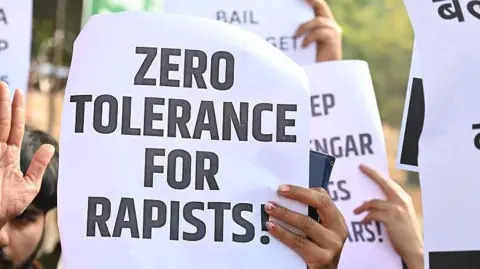
Soma's case has provoked outrage in India and drawn comparisons with the horrific 2012 Delhi gang rape - and subsequent death - of a 23-year-old physiotherapy student who was also violated with objects.
 Getty Images
The crime sparked global outrage, mass protests across India, and prompted tougher anti-rape laws, including the death penalty in severe cases. Four men convicted were executed in 2020, one died in prison, and a juvenile offender was released after serving time in a reform centre.
But despite the heightened scrutiny of sexual crimes since then, more than 30,000 cases of rape are recorded in India every year.
"We have learnt no lessons," says anti-rape campaigner Yogita Bhayana, adding that most cases go unreported or unnoticed because society has become desensitised to extreme brutality.
"Such cases keep happening because the message has not percolated down to every last corner of India that rape can get them capital punishment. Fear has not been instilled in society," she told the BBC.
"The media attention Soma's case has received is only because of the reports that a bullet was inserted into her private parts. At least she survived and I see that as a positive," Bhayana says.
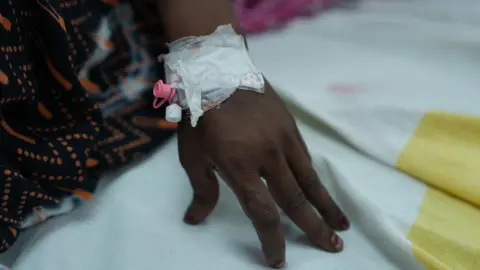
Back in Begusarai, Soma remains in a hospital bed, frequently disturbed by visits from journalists, politicians, and social workers. She is still in significant pain but hopes to recover soon and return home to her children.
"I am very worried about my children, they are so young. They are being look after by relatives in the village about 35km away from here. I want to get back home to them soon."
