From primates to climate - ten of David Attenborough's best documentaries
Sir David Attenborough's landmark natural history programmes have educated and inspired us for more than seven decades.
From hanging out with primates to early climate warnings, here's a selection of his trailblazing programmes - to mark his 100th birthday - and where to watch them in the UK.
1. Life on Earth (1979)

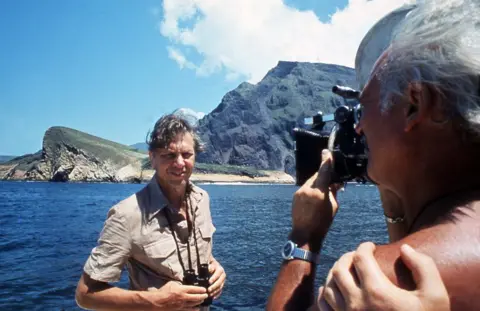
Life on Earth was Attenborough's ambitious, globe-spanning attempt to tell the story of life in a way that had never been attempted before, "from the first primitive cells to the plants and animals that now live around us".
It established Attenborough as the foremost TV naturalist, as well as an iconic British cultural figure.
It was "absolutely groundbreaking for the time", according to Dr Jean-Baptiste Gouyon, author of BBC Wildlife Documentaries in the Age of Attenborough.
"It was the first time that they sent cameramen all over the world to capture images of animal behaviour in the field," he explains. "It's the first series which has Attenborough talking to camera [on location], instead of being in the studio and commenting on footage.
"Life on Earth is the first on-screen appearance of David Attenborough as a character, rather than just as a presenter. It's the first for everything, basically."
Memorably, the penultimate episode found Attenborough playing with and being groomed by a group of mountain gorillas, which he later described as "one of the most exciting encounters of my life".
The Bafta-nominated series was watched by up to 500 million people worldwide and set the template for what would follow with what became known as his Life Collection, including The Living Planet, The Private Life of Plants and The Life of Birds.
And to mark his 100th birthday, the BBC also revisited it in a new documentary called Making Life on Earth: Attenborough's Greatest Adventure.
2. The Trials of Life (1990)
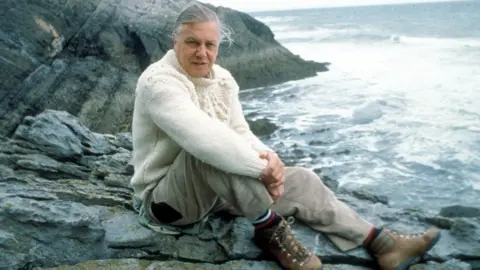
This series set out to capture animal behaviour from birth to death, as producers worked closely with scientists to uncover fascinating and surprising stories and insights.
"For example, they got on film for the first time evidence of chimpanzees using tools," Dr Gouyon says.
It also captured shocking but significant footage of chimps working together to brutally catch, kill and eat colobus monkeys. "That was a first for wildlife television and something which had been debated in science circles.
"They really worked with field researchers and filmed behaviour which had never been seen before on television."
3. The Blue Planet (2001)
 James Honeyborne
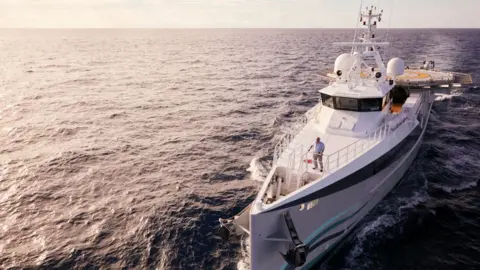
The Blue Planet found Sir David exploring the world's oceans and many of their mysterious inhabitants - from monsters of the deep to pack-hunting killer whales attacking a grey whale calf.
It has been described as the first comprehensive series on the natural history of the world's oceans, revealing the spectacular variety of life under the sea.
"For the first time we were able to share the life experience of marine animals, which is something we could previously only imagine, and we're really deep in the middle of it," Dr Gouyon says. "That's what made such an effect."
Blue Planet II followed in 2017, and helped alert the world to "the crime of chucking plastic into the ocean that can throttle and poison creatures, including ourselves", Sir David told BBC News in 2019.
4. Planet Earth (2006)
Allow Google YouTube content?
This was filmed across 64 different countries over five years, celebrating the amazing variety of the natural world.
It became the most expensive nature documentary series ever commissioned by the BBC and allowed viewers to watch wildlife drama - like an epic battle between a hungry polar bear and a walrus - in high definition for the first time.
Blue Planet and Planet Earth rekindled the public's love of nature documentaries, and had a more cinematic sweep than their predecessors, according to Dr Gouyon.
"It's the quality and the scale of what was shown which was really groundbreaking with Blue Planet and Planet Earth," he says.
That was taken to another level for the sequels. In 2016, Planet Earth II included gripping moments of tension and drama like snakes chasing newly-hatched iguanas, and attracted more young viewers than ITV hit The X Factor.
5. Frozen Planet (2011)
 Alex Board
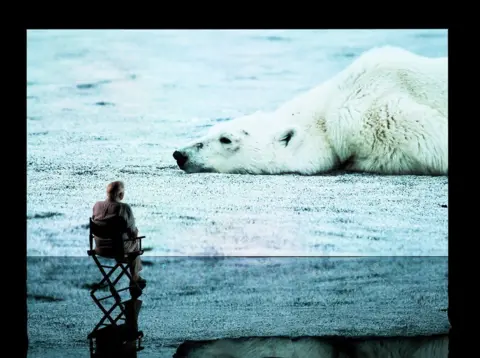
Frozen Planet focused on life in the Arctic and Antarctic regions and underlined how climate change was affecting the land and its native animals.
It showed penguins, fur seals and polar bears attempting to adapt to their ever-changing surroundings, against the backdrop of glaciers and arctic volcanoes.
A sequence showing a minke whale's desperate break for freedom from a hunting team of killer whales provided an enduring image.
For the final episode, titled On Thin Ice, Sir David appeared on screen to give an impassioned speech about the effects of shrinking glaciers and rising temperatures for people and wildlife.
A decade later, the sequel went to other regions, where the stunningly-shot natural behaviour was almost as chilling as the temperatures - from golden eagles hurling mountain goats off cliffs, to more cunning killer whales ganging up on helpless seals.
Frozen Planet II also pioneered the use of racer drones, which captured the terrifying experience of flying down a mountainside alongside an avalanche.
And 11 years after the original series, it had an even starker warning about the effects of climate change.
6. Our Planet (2019)
 Netflix
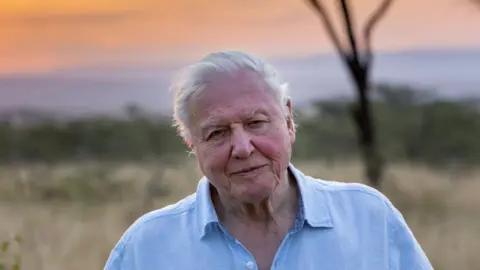
In keeping with the times, Sir David arrived on Netflix in 2019, for an eight-part series showing some trademark stunning imagery while also addressing conservation. The streaming giant's first nature documentary was made in collaboration with the World Wildlife Fund (WWF).
"It's an interesting one because it was the first natural history entirely devoted to addressing climate change," Dr Gouyon says. "Other than that, the cinematographic quality of it is akin to what you could see on Blue Planet or Planet Earth."
Netflix said 100 million households watched the series - although those in Spain and Latin America heard narration from Penelope Cruz or Salma Hayek instead of Sir David.
In his review, then-BBC arts editor Will Gompertz wrote that Our Planet "gives us some of the most dazzling images you are ever likely to view on TV". He concluded: "It is the voice of a man who knows he won't be around forever but hopes passionately that Our Planet will."
7. Wild Isles (2023)
 BBC/Silverback Films/Alex Board
Sir David has shown us almost every corner of the globe - but he did not focus on his home country until he was in his mid-90s.
That's when he finally broke an internal BBC agreement he said dated back to the 1950s to stick to other nations. But the British Isles have "astonishing scenery" and "extraordinary animal dramas and wildlife spectacles to match anything I have seen on my global travels", he said.
The memorable encounters in Wild Isles included a white-tailed eagle catching a barnacle goose in mid-air, which had not been filmed in the UK before; plus leaping Scottish salmon filmed using underwater drones for the first time; and toadlets swallowed whole by demonic leeches with five pairs of eyes and three sets of teeth.
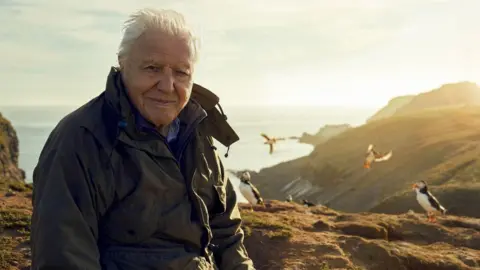
Sir David was not too old to go on location either. He took a boat and 87 steep steps to reach a puffin colony on Skomer Island off the west coast of Wales, where he had to wait for two hours for the birds to arrive. (He was accompanied by a doctor and a defibrillator, in case of emergencies.)
He also filmed on a Dorset clifftop, on a chalk stream in Wiltshire, and beneath his favourite tree - a 700-year-old oak in Richmond Park, London.
In early 2026, Wild London saw him revisit the capital's wild side, including the "huge thrill" of a meeting with some urban foxes.
8. Ocean (2025)
 Conor McDonnell
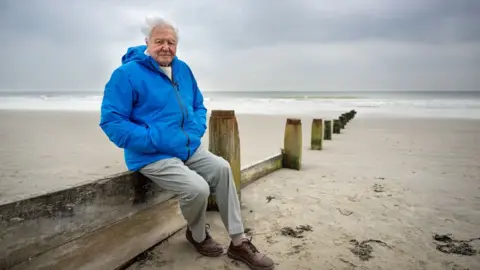
In May 2025, Ocean saw Sir David tackle mankind's "final frontier" once more.
"After almost 100 years on the planet, I now understand the most important place on Earth is not on land, but at sea," he said.
He described it as one of the most important films of his career as he entered his 100th year, and said he believed the film could play a decisive role in saving biodiversity and protecting the planet from climate change.
The ocean is the planet's support system and humanity's greatest ally against climate catastrophe, the film argues. It shows how the world's oceans are at a crossroads.
"If we save the sea," noted Sir David in the film trailer, "we save our world."
9. Secret Garden (2026)
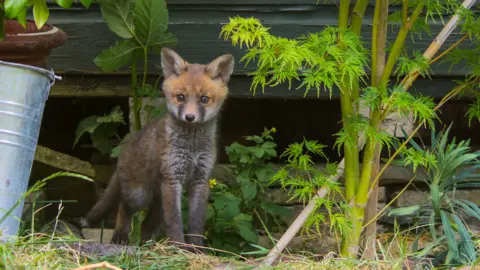
Sir David was close to home again for this series, which lifted the lid on the teeming activity that can make UK gardens just as fascinating as wilder and more exotic places.
It showed some of the life-and-death drama that often goes on behind our backs, from a duck protecting her ducklings from a hungry otter in Oxfordshire, to a blue tit chick under threat from a fierce predator - a cat called Mr Fluffy - in Bristol.
Sir David also highlighted the benefits of considering how to accommodate wildlife from hedgehogs to newts in ordinary gardens.
Series producer Bill Markham said: "At a time when wildlife gardening is becoming increasingly important for supporting struggling species, his voice carries particular weight.
"If Secret Garden succeeds in encouraging people to rethink what their gardens can be, it will be in no small part due to his influence and enduring credibility."
10. Gorilla Story (2026)
 Silverback Films/Ben Cherry via PA
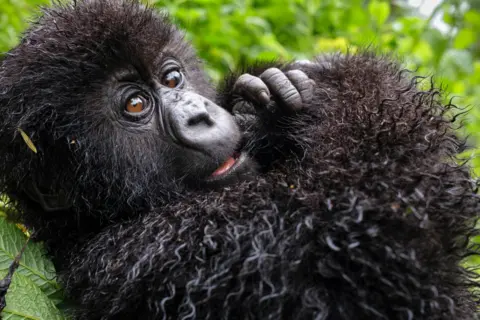
Sir David has shown no signs of easing his workload, and as his centenary approached he revisited the most famous encounter of his long career - with the gorillas he met back in the 1970s in Life on Earth.
He didn't go back to Rwanda to hang out with them again, but narrated the story of what happened to the original group - including his young friend Pablo - and the struggles for survival and supremacy among their descendants.
The 77-minute Netflix film is directed by Oscar winner James Reed and has Leonardo DiCaprio as an executive producer.
The Guardian's five-star review said viewers would "find yourself overcome with awe".
