When to see the eclipse in the North East and Cumbria

 Reuters
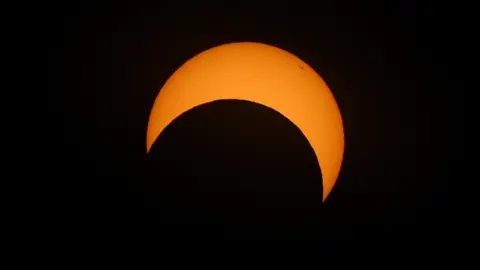
Clear skies and warm temperatures are expected across north-east England and Cumbria during Wednesday evening's partial solar eclipse.
The UK will be slowly plunged into darkness from about 18:10 to 20:00 BST as the moon passes in front of the sun, temporarily blocking its light.
Gatherings are planned across the regions, including free events at Kendal Castle, Wynyard Woodland Park near Stockton and Merryoaks Community Hall in Durham.
Kielder Observatory is expecting thousands at its free event at the Glasshouse in Gateshead and director of astronomy Dan Pye said it would be "really significant" but reminded people not to look directly at the sun.
According to NASA, the maximum eclipse will be visible at:
- Carlisle - 19:07
- Kendal - 19:08
- Durham - 19:07
- Middlesbrough - 19:08
- Newcastle-upon-Tyne - 19:07
- Alnwick - 19:06
About 90% of the sun will be obscured in the UK, compared to a path of totality across Spain.
 PA Media
BBC Weather presenter Paul Mooney said: "After a dry, sunny and very warm day, most places should have light winds and clear skies going into Wednesday evening providing ideal viewing conditions for the solar eclipse.
"There is a small risk of a localised shower, perhaps over the North Pennines or Cumbrian Fells, but these should be very few and far between."
The sun will be setting in the west at the time of the partial eclipse.
Pye said it would inspire the next generation of astronomers.
"There are many people I've spoken to in the past who have cited things like eclipses as being the reason why they got into astronomy, because I think it's one of those reminders that the universe is moving around us all of the time," he said.
"It's one of those real stark moments to go 'wow, we are part of a much bigger cosmic ballet'."
The event at the Glasshouse and Baltic Square in Gateshead will include family activities and live coverage on a large screen.
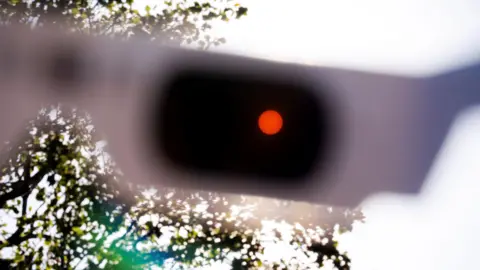
Looking directly at the sun, even with sunglasses, can cause permanent damage.
People are encouraged to wear specialist eclipse glasses from a reputable seller, or create a pinhole camera.
The next full solar eclipse in the UK is due to take place in 64 years on 23 September 2090.
