How an old cemetery disappeared beneath a city centre

 Peterborough Civic Society
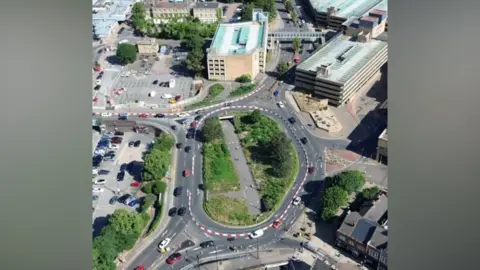
Every day, thousands of people use the Queensgate roundabout in Peterborough without realising what lies below.
But work on the City Link scheme – which is part of the Peterborough Station Quarter project – has uncovered seven human skeletons, shedding light on a cemetery from Georgian and Victorian times.
The discovery has sparked interest in a forgotten chapter of the city's history.
So why were people buried there, and what can the remains tell us about the city's past?
Where was the cemetery?
 Discover Peterborough
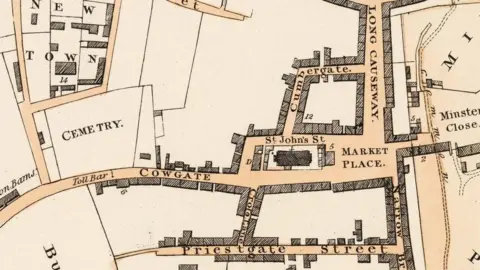
According to Rebecca Jackson of Discover Peterborough, the city's main burial ground near the cathedral had become overcrowded by the early 1800s.
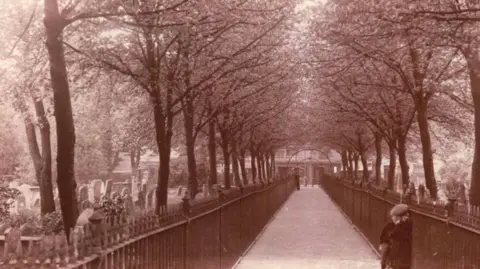
The churchwardens of St John the Baptist Church, near Cathedral Square, bought three acres of farmland at the western end of Cowgate to create a new cemetery. The first burial was that of Elizabeth Money, in 1805.
For the next 50 years, the site resembled a traditional churchyard, complete with walls, gates and rows of gravestones.
In 1830, the burial ground was targeted by body snatchers – people who secretly dug up newly buried corpses from graves to sell them – prompting officials to install iron railings for protection.
By 1858, the cemetery had reached capacity.
A new burial ground opened between Eastfield Road and Broadway and has served the city ever since.
What happened to the graveyard?
 Peterborough City Council
The former Cowgate cemetery was affected by major changes to the city's infrastructure in the 20th Century. Part of the site was cleared to make way for Crescent Bridge, which opened in 1913.
The area was transformed again for the Crescent roundabout, roads serving Queensgate Shopping Centre and pedestrian subways built by the Peterborough Development Corporation in the late 1970s. Over time, almost all visible traces of the burial ground disappeared.
Today, a blue plaque installed in 2017 at the western end of Cowgate is one of the few reminders of the cemetery.
Local historian Jackson van Uden said the Cowgate and Queensgate area would once "have been quite an important area for Peterborough".
"Normal people or citizens would have been buried in these graveyards," he added.
"The shape of the town has completely changed over the last few hundred years... I think that's why we tend to forget about the graveyard and these bodies, which were incredibly important."
Why is the council digging up the site?
 Shariqua Ahmed/BBC
The remains were uncovered during the first phase of the Station Quarter redevelopment project, which began in July.
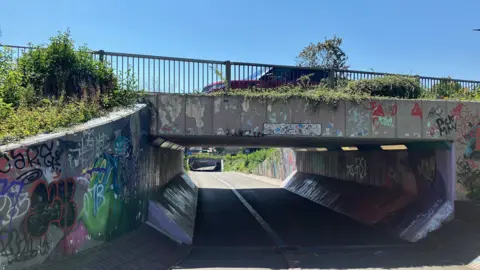
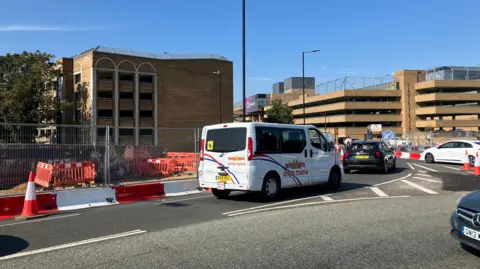
As part of the scheme, about 1,000 tonnes of concrete is being used to fill two pedestrian underpasses beneath the Queensgate roundabout.
Built about 50 years ago, the subways will be replaced by the City Link walkway – a street-level crossing connecting the railway station with Cowgate and the city centre.
The work has already led to disruption for motorists and pedestrians.
 Shariqua Ahmed/BBC
Peterborough City Council confirmed human remains had been found deep within the roundabout.
Toby Wood, from the Peterborough Civic Society, said the discovery was not unexpected.
"In the early 1970s, a friend who was part of the council's engineering department was responsible for building the Queensgate roundabout," he said.
"Because it was a cemetery, they knew there would be bodies there. So, they employed a company to excavate and collect all the bodies and rebury them. It was quite an undertaking with specialist and skilled teams.
"This time, the council might have dug deeper [to] have found these bodies."
What happens to the skeletons?
 Graham Smith
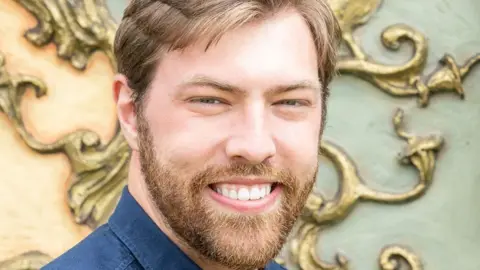
Jackson van Uden, a PhD student who grew up in Longthorpe, said: "When something happens like this you have to stop digging immediately, and I know that a lot of people in Peterborough are going to find that really irritating given how long these [City Link] works are going to take.
"The process is that you have to call the police, who will verify that this wasn't a murder, and then you have to call in the heritage archaeology teams.
"They'll be assessing and doing tests. They will check the area for any other evidence as well, and as soon as they've confirmed the bones are ancient they'll take them away and rebury them again."
Van Uden said discoveries such as this are not unusual in older parts of Peterborough because the area has been inhabited since Roman times.
"I think it's actually very good for people... because it helps us understand that Peterborough was a historic place," he said.
A spokesperson for the city council said: "We have obtained an archaeological licence and appointed an archaeologist to ensure the skeletons are reburied in line with national guidelines.
"As a result, we are forecasting that the City Link works may be delayed by four weeks. However, we are looking at options to reduce this delay in later phases of the project."
Do you have a story suggestion for Peterborough? Contact us below.
Follow Peterborough news on BBC Sounds, Facebook, Instagram and X.
