'It slows you down, you become more present'
Phone, click, click, click, check, click again, check, edit (within an inch of its original life) and finally, upload that "candid" picture.
It's a pattern we've all seen when taking photos on our phones but now that fast-paced, instant gratification is being challenged.
Let's welcome back, film photography.
"In a world where we can get everything easily, it's taken the beauty out of it all," Hope Deamer, co-owner of The Film Safe, says.
Hope, 30, from Romsey in Hampshire, studied film at university where she fell in love with the "art form".
"I love film. Shooting digital is almost too perfect, film photography you can see real emotion and grain," she said.
She met co-director of the Film Safe, Jack Cole-Bailey, 29, back in lockdown where he learnt more about film.
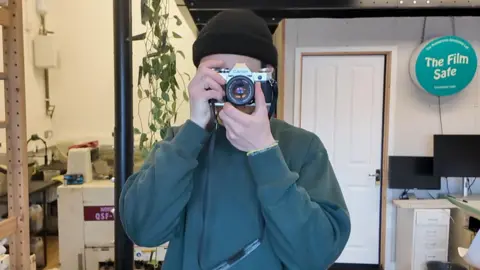
They started the shop in 2020, originally as a side hustle, but now a growing local business where they scan and develop film rolls for people across the country.
"Our target demographic is 18-35-year-olds but we often have university students come in being based in Southampton but we also have hobbyists, professional photographers and musicians too," Jack says.

But why is an art that started back in the 1880s coming back?
"There's a romanticism behind it, a nostalgia," Jack says, a view echoed by Hope.
"You're taking a step back and slowing things down a bit. Everything these days is so instant so only having 36 photos [on a roll] you're making conscious decisions."
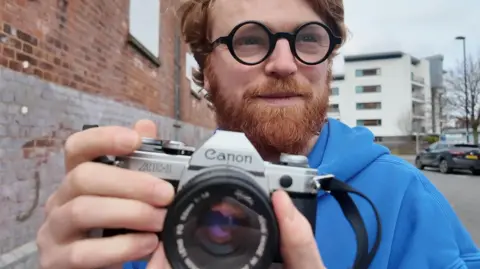
Alex Douglas shoots a mix of film photography and digital after copying his older brother when he was younger.
"Film is just more fun. And no matter what edits, changes I can make to digital photos, film is just better," he says.
"If you want to learn how to use a camera, you have to shoot film. Anyone can have a good eye for photography but to get that emotion, it needs to be film."
Alex shot film photography for Michael Kiwanuka on his UK tour last year, as the musician prefers all of his shots to be film only.
"It makes you more unique - like Michael [Kiwanuka], his passion is electrifying for film so being in the [concert] pit, it was great fun," Alex reminisces.
Kiwanuka is not the only musician using film in concerts.
Most recently, Harry Styles banned phones at his Manchester gig, providing concert-goers disposable cameras instead.
Although a humorous backlash came online with the quality of pictures produced, Hope says it was a "clear sign" film is becoming more popular.
What is film?
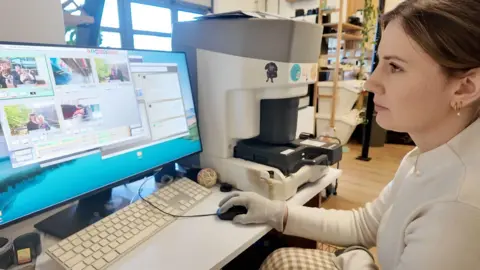
"Film is a long plastic strip with light sensitive chemicals on it, that when you shoot a shot, it creates a temporary image on the strip as it's exposed to light," Hope explains.
"So when you develop it, they'll fix the image permanently on the strip and stop it being light sensitive anymore so you can then scan it and print it."
Film cameras, or analogue cameras, have a roll of film in them. You can have a mix of makes and models, or even disposable cameras where the film roll is already in it.
But film disappeared when digital cameras and phones become more accesible, with major company Kodak declaring bankrupcy in 2012.
 Alex Douglas
'Taking a step-back'
Since then there has been a resurgence.
The film camera market value is expected to reach more than £303m by 2030, up from £223m in 2023, according to a study from research company Cognitive Market Research.
"With film, you're not going to look back and think 'oh that was a bad photo' you'll look back and think 'remember that moment'," says Hope.
"We've had people come into our store who haven't shot film before and want to learn and also older people who haven't used film in 20 years coming back to it, it's amazing."
"Vinyl's coming back, record players are coming back and so is film, people are taking a step back."
Why are film cameras coming back?
It does beg the question, why are we going back to paying to get a picture when you could get one instnalty on your phone.
"It's a mindful activity," clinical psychologist Audrey Tang explains.
"It can be a lovely expression of creativity – that photo is your choice, your angle, your concept – and ultimately yours.
"That sense of ownership can boost our feelings of self-esteem.
"We can also influence the emotions of others by the photos we share – such as joyful photos of people smiling often make people smile, and photos of cute animals can make us tap into our nurturing instinct, photos can be extremely powerful."
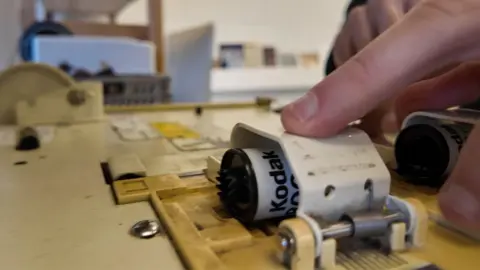
But despite a growing trend, a film camera roll can be expensive, from disposable cameras being about £17-20 to buy and then paying for a roll to be developed on top.
Or owning a camera, film roll costs vary from £4-12 per roll and £8-12 to develop it.
"Every hobby is expensive but just do a bit less of it, or buy old film, or learn to develop yourself - everything can be made cheaper, you've just got to have fun with it," Alex says.
"It doesn't have to be one or the other, it can be some photos on your camera and some on your phone," Jack adds.
You can follow BBC Hampshire & Isle of Wight on Facebook, X, or Instagram.
