Why dangerous teen sex choking is raising alarm

 Getty Images
Warning: This article contains details of sexual acts.
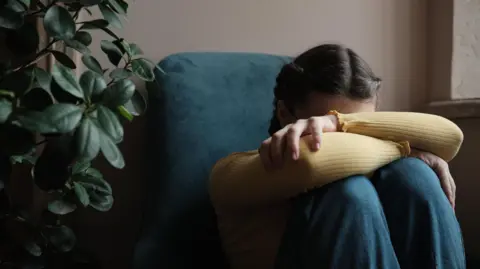
"It started as a sexual thing, something he experimented with," 17-year-old Louise, not her real name, tells us.
Having spoken to friends about non-fatal strangulation (NFS), or "choking" as it is often referred to, she thought it was a normal part of sex.
But as her relationship progressed, she says it increasingly became more aggressive: "He'd hold on for tighter for longer and when I'd tap he wouldn't let go so I used to scratch and claw... and then it wouldn't be till I passed out that he'd stop."
Louise ended the relationship last autumn.
She shared her story with the BBC as research showed 43% of sexually active 16 and 17-year-olds had been strangled during sex.
Looking back, Louise now recognises the control her ex-boyfriend had over her life, from what she was "allowed" to wear, to who she could see and speak to and tracking her location via apps on her phone.
"He'd get frustrated and push me either on to a bed or into a wall and then put his hands round my neck to shut me up... the next day he'd act like nothing happened and we'd go out and he'd buy me lots of nice things," she said.
Louise says the abuse became "relentless" and it was hard to avoid as the couple were spending all day, every day together.
Initially she reported her ex-boyfriend to Thames Valley Police but decided to drop her complaint after learning how long it would take to get to court.
According to the force, in the first three months of this year it identified 85 victims of teenage relationship abuse aged 17 and under, of those, 13 said they had been victims of choking.
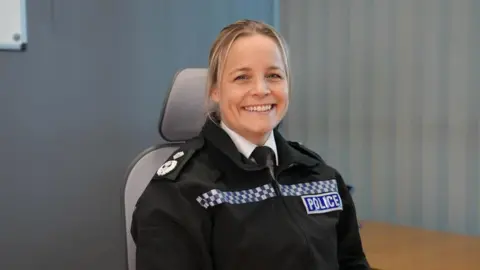
"Nationally there has been an increase in strangulation and sexual violence offences involving under 16s," says Deputy Chief Constable Katy Barrow-Grint, of Gloucestershire Constabulary, who is co-leading a project to identify the scale of the problem.
The project, funded by the Office of the Police Chief Scientific Adviser, plans to analyse police data to identify incidents involving under-16s over the past 10 years that have remained hidden in police records.
The research will also provide guidance on identifying and responding to teenage relationship abuse for people working in the police, social services, education, health and other specialist support services.
 Gloucestershire Constabulary
Cases have been hard to identify previously, due to under 16s not being flagged as experiencing domestic abuse under current law - campaigners want to lower the age so that more young people in abusive relationships can access help.
Barrow-Grint said: "We need to review the data and see how we can identify and deal with the risks to ensure we can safeguard children and prevent the abuse from happening in the first place."
Strangling someone is a criminal offence in England and Wales, abusers can face up to five years behind bars. Legally, consent is not a defence if harm occurs.
NFS can lead to life-threatening complications, even when there are no visible external injuries.
The main risks include restricted oxygen and blood flow to the brain, which can cause acquired brain injury, stroke and even death.
Yet despite the dangers, more than half of people under 35 have either strangled someone or been strangled during sex, according to a recent survey by the Institute for Addressing Strangulation (IFAS).
The research found more than two in five sexually active 16 and 17-year-olds had experienced it.
IFAS is calling for a public health campaign.
"Consent does not make strangulation safe - there is no safe way to apply pressure to the neck," said Bernie Ryan, chief executive at IFAS.
"IFAS urges young people, parents, educators and professionals to understand this clearly, and to seek support if they have been affected by strangulation in any context," she added.
- If you are affected by the issues in this story, help can be found at the BBC Action Line
The charity SAFE! supports children and young people who have been victims of crime and abuse in the Thames Valley.
"I think what we're hearing from young people is a normalisation of some of these behaviours through things they're seeing online, or TV or relationships," said Chloe Purcell, chief executive of SAFE!
"Peer-on-peer sexual harm has always been around, it's not a new phenomenon but it does seem to be that young people have access to more and more these days which enables them to see more harmful content than previously," she added.
Research from the Children's Commissioner for England has shown 27% of 11-year-olds have been exposed to pornography.
Online sexual material showing strangulation or suffocation is due to be criminalised as part of government plans to halve violence against women and girls (VAWG) over the next decade.
Within the strategy are plans to tackle misogyny in the classroom and prevent young men from becoming violent abusers.
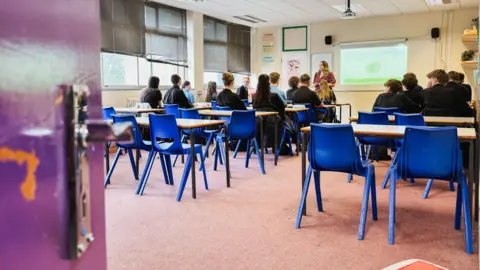
From September, all state schools in England will follow the new RSHE curriculum, teaching about healthy relationships and harmful behaviours.
Lessons will include updated content relating to AI, deepfakes and online harms, new content on sexual harassment and intimate image sharing, as well as teaching children the skills for developing positive, healthy relationships from primary.
There has been some criticism over the lack of training for teachers ahead of the new curriculum with only a small number of schools selected for teacher training pilots.
Sally Conoley, deputy head and safeguarding lead at The Hurst School in north Hampshire, welcomes the extra focus on prevention but questions whether there will be enough resources to support those who need it.
"I'm not worried that we'll have more disclosures, more disclosures are good because it means young people are coming forward with their problems... but it's whether there is access to sufficient resources," she said.
"You only have to look at the pressure on mental health resources in the country to see that is there going to be equal amount of pressure on domestic abuse, for example, so that is something to be wary of."
The government said it was investing £16m to support schools, has introduced the Online Safety Act to protect users from harmful content and is bringing in a ban on social media for under 16s.
Louise welcomes better education around coercive control and how to spot red flags, something she says she wishes had been taught in her school.
She hopes sharing her story will help protect others from abuse in their own relationships.
"I feel it's so normalised for partners to have access to your 24/7 location... I don't think that's healthy."
She added: "Pushing you away from your friends and driving that wedge between your friends and family it's so mild and can be so hard to spot but it is such a big stepping stone into domestic violence."
- You can contact BBC journalist Katharine Da Costa about this story at katharine.dacosta@bbc.co.uk or @bbckatharinedacosta on Instagram
