World's largest chipmaker does not rule out price rises as costs increase

 BBC
BBCThe world's largest chipmaker has told the BBC that inflation is pushing up the cost of doing business, and did not rule out price rises.
Taiwan Semiconductor Manufacturing Company (TSMC) makes the most advanced chips designed by companies such as Nvidia, AMD and Apple, so any increase in pricing could ripple through to the cost of AI infrastructure, and potentially over time, the prices customers pay for their electronic devices.
However, the firm's chief financial officer, Wendell Huang, said it would not introduce sudden "fourfold, fivefold" price rises. "We reflect our value," he said, pointing to its "technology leadership" and "manufacturing excellence".
In an exclusive and wide-ranging interview, Huang also denied that the AI boom was a bubble and that the firm's global expansion was due to geopolitical pressure.
The global chip industry and TSMC sit at the centre of escalating US-China trade tensions, with Washington pressing leading chipmakers to expand production in the US to secure critical supply chains.
Taiwan, the US ally and self-governed island that Beijing claims, produces the majority of the world's most advanced chips, the tiny processors that sit inside smartphones, laptops and AI data centres.
Chinese President Xi Jinping warned at a recent summit with US President Donald Trump that mishandling Taiwan could put the relationship between the two superpowers in an "extremely dangerous situation".
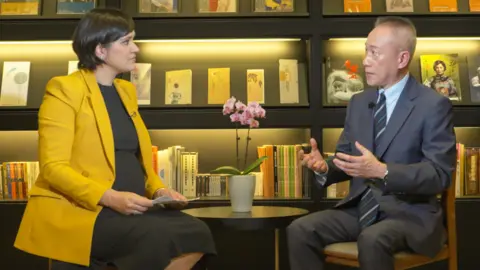
The BBC travelled to Hsinchu Science Park, a dense cluster of fabrication plants or "fabs" south of the capital Taipei, for TSMC's annual shareholder meeting and for a rare interview with Huang.
TSMC is expanding manufacturing in the US, Germany and Japan as well as in Taiwan itself, but Huang pushed back against the idea that this was a response to pressure from either Washington or Beijing.
"We go out of Taiwan to build capacity based on customers' demand. The customers want us to go there. It's not the request of government," he said.
But on the question of where the world's most advanced chips will be made, Huang was clear: the most cutting-edge production will remain in Taiwan.
Moving the manufacturing ecosystem to the US, he said, would take "five or 10 years, or even longer" - a timeline that directly challenges the ambitions of US industrial policy, which has pushed TSMC to commit $165bn to its Arizona operations.
AI boom or bubble?
While Huang stopped short of committing to price rises, he said: "Inflation, yes, did cause [our] costs to increase."
Earlier in the day, the company's chairman and chief executive CC Wei told shareholders that he would "like" to raise prices, as its competitors have done.
TSMC's shares have surged over the past year as demand for AI chips has accelerated, and Huang described a company under pressure to keep up.
"We're doing everything we can, wherever we can, and however we can," he said.
"The customers ask us to grow so much, but all we can do is try to grow as fast as possible. So far, still trying."
There is pressure in the stock market too, as investors around the world grapple with questions about whether the huge spending wave on AI infrastructure can be sustained.
Tech shares in Asia tanked earlier this week following a similar sell-off in the US on Friday amid growing concerns about stretched valuations.
It came after an extraordinary period of gains across global chip and AI-related equities.
But Huang insists the AI boom is not a bubble about to burst.
"Our conviction in this AI megatrend is very strong. We talk to the customers and also the customers' customers… who are mainly the hyper-scalers," he said.
"These companies are financially very strong with a lot of financial resources, so we believe that they're able to continue to invest."
Additional reporting by Jaltson Akkanath Chummar
