'Helping hauliers would keep inflation down'

 LDRS
LDRSHauliers have urged the government to provide support after the US-Israel war with Iran caused the largest jump in petrol and diesel prices in three years.
Logistics companies in West Yorkshire said they had seen price rises of more than 24%, which is passed on to the customer, leading to increased costs at the supermarket.
Fuel prices - especially diesel - have risen due to the blockade of the Strait of Hormuz, a key shipping lane controlled by Iran, following the US and Israel's attack on the country in late February.
A government spokesperson acknowledged hauliers were paying more because of the conflict but said it was "determined to keep costs down for motorists".
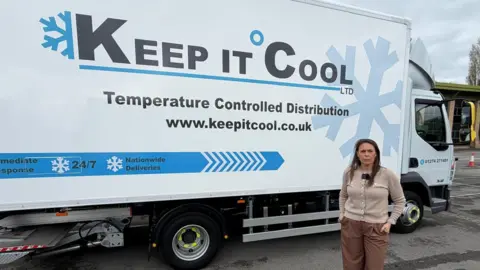
Nikki Redhead, managing director of Bradford firm Keep It Cool, told the Local Democracy Reporting Service she was urging the government to introduce an essential user rebate for hauliers.
The company, based on Roydsdale Way within the Euroway Industrial Estate just off the M606, provides food deliveries to supermarkets across the country.
Redhead said: "It now costs us circa £112 more to fill a tank of one of the HGVs than it did six weeks ago - it's not something that's sustainable.
"We can't absorb these fuel costs so they must be passed on to our customers and put very simply this will very seriously impact the bottom line.
"Consumers will literally pay the price, with food inflation expected to cause double the levels of food poverty within the UK in the next five years."
 Tom Ingall/BBC
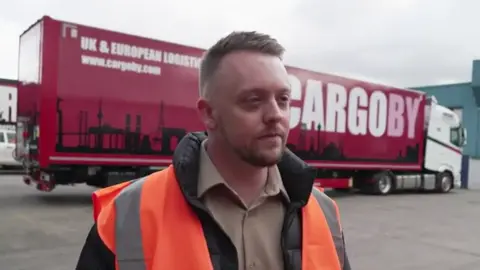
Jordan Potts, operations director at Brian Yeardley Continental in Wakefield, said it was spending between £15,000 and £20,000 extra on fuel a week.
"I'm not in any way certain that we've now hit the peak and it's coming down," he said.
The company delivers cargo as well as supporting tours by some of the world's biggest music artists including Taylor Swift.
He said international customers were cancelling work because of the high prices and would like to see the 5p cut to fuel duty - introduced as temporary cut in 2022 - extended further.
"It's not just the haulage industry, it's the economy in general. Eventually if the UK is not competitive on exporting, it's going to affect exporting and importing, which ultimately affects us as being a primarily international portfolio.
"The main thing at the minute is the uncertainty really. We just don't know where fuel is at the moment, you know, we've seen it come down at the minute, but is it going to skyrocket even further? There's just a lot of uncertainty."
'It's an emergency'
A government spokesperson said it had extended the 5p fuel duty cut and urged de-escalation in Iran.
They said: "This is not our war and that is why we did not join it.
"The chancellor has made clear that our economic approach to this crisis will be both responsive to a changing world and responsible in the national interest."
Shipley Transport managing director David Clarke said the company, which moves food, drink and packaging, spent £50,000 more on fuel in March than in February.
"It's a bit like Covid isn't it? It's an emergency. So I think they should be giving a rebate to farmers and truckers - the people who are using everything because that's going to help inflation come down and at the minute all they're doing is they're stoking inflation up," he said.
The company has been operating since 1990 and employs 92 people as well as running 48 trucks and 85 trailers.
Shipley Transport employs a fuel escalator, which passes on some of the increased fuel costs to customers.
This week it is set to 24% but before the Iran war it was set at 8%.
"So you can see the customers are having to pay like an extra 16% more across the board. And it's been creeping up," said Clarke.
"I don't think the government helps the situation because they're raking it in with all the tax on the additional price."
He added that many hauliers were struggling with National Insurance contributions, the increased minimum wage, and the rising costs of lorry parts and tyres.
He said: "If they gave hauliers some help, then the fuel escalator would come down.
"And with that prices would come down, and with that inflation would come down, and with that interest rates would come down."
Speaking in the House of Commons, Chancellor Rachel Reeves said claims the Exchequer was receiving a VAT windfall were "economically illiterate".
She said: "The truth is that the IMF and every other forecaster is clear that tax revenues are going to be lower, not higher, because of this conflict in the Middle East."
Listen to highlights from West Yorkshire on BBC Sounds, catch up with the latest episode of Look North.
