'We'll never return': What next for families evacuated from homes built on former mines?

 BBC
BBCA resident evacuated from his street following ground movement linked to historical mining work says he expects his family will never return to their home.
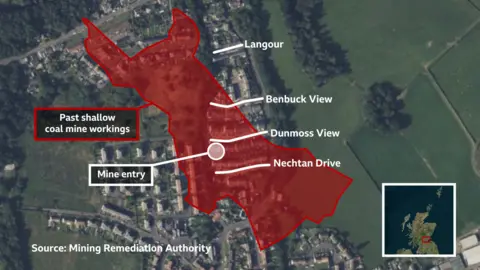
More than 250 people from 97 homes in the village of Coalsnaugton, Clackmannanshire, were told to leave their homes after the ground movement was discovered in May.
An eight-week investigation by the Mining Remediation Authority (MRA) at the four affected streets has confirmed that the issue is related to past mining work.
Aaron Anderson, who has three children including 11-year-old twins with autism, says he now "firmly believes" his house will be condemned and demolished.
UK Energy Secretary Michael Shanks, who visited the site on Monday, said some of the properties would be able to be rectified, but "some will not".
The MRA said there were still signs of ground movement at the site.
This has seen cracks appear in roads, paths and gardens, as well as damage to some properties in the village.
A meeting will be held on Tuesday to update affected residents.
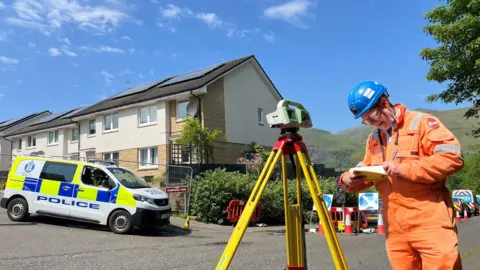
Residents have been able to collect belongings from their homes on an appointment basis.
Aaron's family are now staying in Dunfermline, following a spell at an Airbnb in Grangemouth.
He said he was "not surprised" at the result of the MRA investigation.
"Since day one of our evacuation, I have been a realist about the situation," he said.
"I firmly believe these houses will be condemned and demolished. I can't foresee anyone getting back regardless if their house has moved or not.
"They will not want a repeat down the line if any houses were to survive."
Aaron told BBC Scotland News he thought it was "a good thing the UK government has stepped in to provide financial support".
But he said he has "grown detached" from his home and now wants to "move my family to somewhere safer."
Another resident, William Podwalski, said he was hopeful there was a "light at the end of the tunnel".
He said: "We've been left in limbo. The whole community has been left in limbo, particularly our street which was the first to be evacuated.
"We've been out of our house since the 18th of May. Me personally, I've been sleeping on a couch at a friend's and I've only recently got accommodation."
But he added: "We've been waiting for this news for a long time and it's good to get clarity in terms of who's taking responsibility."
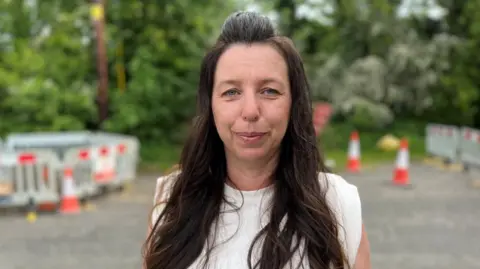
Langour resident Naiomi Stevenson had managed to stay in her home until a dangerous building notice was served earlier this month.
She is now staying with her family in a holiday let in the East Neuk of Fife, an hour-and-45-minute drive away.
She said: "I just don't know if I'm coming or going.
"Insurance are trying to find us a long-term let, which has proven really difficult."
She said she was thankful the MRA had taken responsibility for the incident and hoped the caseworkers assigned to each affected resident would provide more information.
She added: "My house is ok, I've got very little damage.
"I do have some hairline cracks, but my house hasn't crumbled as the council are making out.
"So, I just want to go home, just want to get back to my normal life."
The Department of Energy Security and Net Zero said that all evacuated residents would now be protected by the law, with the UK government meeting the costs of making homes safe.
Under the Coal Mining Subsidence Act 1991, the UK government has a duty to remedy coal mining subsidence damage.
Shanks said the cost could run into tens of millions of pounds.
The UK energy minister told BBC Scotland News: "What now has to happen is an individual assessment of individual properties.
"Some will be able to be remediated, and for people to move back in, and if that's possible that will be their best outcome.
"But some will not and therefore there is a legal right for us to provide the value of that house before this incident occurred to families so that they can find their own accommodation elsewhere."
He added: "As much as we would like to be able to resolve this tomorrow, the ground is still moving here, albeit more slowly.
"We will have to continue monitoring that, safety is our number one concern and we'll move people back into whatever accommodation is possible as quickly as we can."
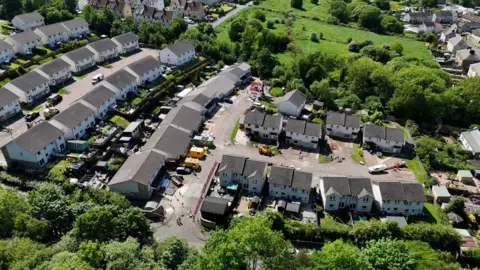
Carl Banton, the MRA's chief operations director, said it was the biggest incident of its kind that the body had dealt with.
He said: "It will mean different things for different streets.
"Two of the streets have got damage within them and two of the outer streets haven't, so it's different conversations with different people."
Asked about the possible demolition of properties, Banton said: "We're having to look at that, it's speculating at this moment in time.
"We're looking across the spectrum and there is facility within the Coal Mining Subsidence Act that if we have to purchase properties, then that's what we'll do."
