Why are quarries staying open for longer?

 Appleford Parish Council
Residents living near a quarry in Oxfordshire are calling for a review of planning policy after continued extensions have kept the site open for a decade longer than originally planned.
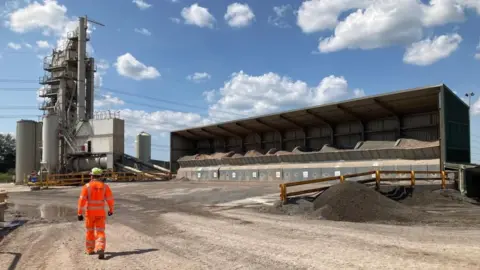
Gravel and sand has been extracted from land near Didcot for more than a century, with the most recent work starting at Bridge Farm in 2009.
But after the county council granted permission to extend its lifespan, it will now be at least 2030 before the site is due to close.
People from the nearby village of Appleford say the decision has left them with "no end in sight". Oxfordshire County Council said extensions were made on merit.
It comes as a similar quarry in Cholsley has been granted permission by the planning inspector to stay active for a further five years.
In Oxfordshire, there are 17 active mineral sites, digging out limestone, ironstone, sand and gravel.
And with the government aiming to build 1.5 million new homes by 2029, there is a high demand for aggregates, adding to pressure to keep existing quarries staying open for longer.
It is the county council's responsibility to grant planning permission, monitor the site and decide whether to allow extensions.
There is also an obligation on local authorities to plan for a "steady and adequate" supply of minerals, including about seven year's worth of aggregate available on demand.
Oxfordshire County Council said it was currently below those targets.
Because of the unpredictable nature of the work, extensions, known as a section 73, can be granted to allow continued excavation and variations to the original planning consent.
For residents who live close a quarry, the disruption can seems never-ending.
Parish councillor Greg O'Broin lives in Appleford, bordering Bridge Farm, and says the extensions are having a negative impact on the village.
"When permission is granted, we want that to be honoured and time-limited.
"And, when that time is up, for that activity to cease and for the land to be turned back to the natural environment," he said.
Oxfordshire County Council said that all section 73 planning applications were "subject to a statutory period of public advertisement and consultation", including with local parish councils.
It added that, as with any planning application, there was a right of appeal to the Secretary of State for the applicant.
 Appleford Parish Council
Bridge Farm quarry is now the responsibility of Heidelberg Materials UK.
Ben Ayres, land and mineral resources manager, said it had now submitted a new application extract sand and gravel from the remaining areas of the site that have yet to be explored.
He said it was needed for projects such as the Local Housing Infrastructure Fund 1 which includes a number of road-building schemes.
"This could help supply the local Housing Infrastructure Fund 1 road project with locally produced materials, reducing vehicle movements and associated carbon emissions," he added.
But once quarrying is complete, the question remains, what to do with the hole?
Landfill is one idea, with some of the older parts of Bridge Farm quarry already being used for this purpose.
The 290-hectare site opened in 1980 and takes 350,000 tonnes of waste each year.
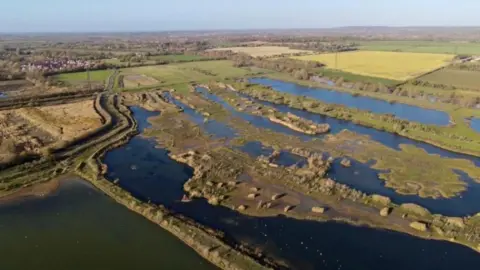
Other areas of Bridge Farm have been restored to a wetland area, known locally as "the finger lakes".
Nationally, quarried land has also been used for solar farms, nature reserves and housing developments.
At the former Wicklesham Quarry, near Faringdon, plans have been approved for science and technology park to be built.
