Iran says it has seized two ships in Strait of Hormuz after vessels attacked
Iran's navy said it has seized two cargo ships in the Strait of Hormuz and taken them to the country's coast after reports that three vessels came under fire from Iranian forces.
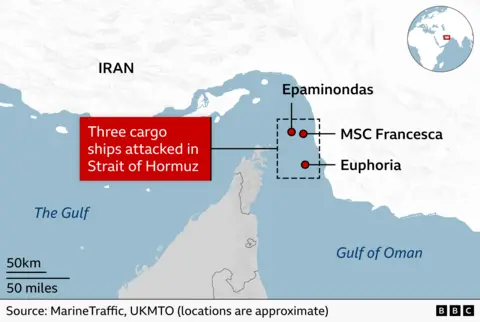
Nour News, affiliated with Iran's Supreme National Security Council, said the Islamic Revolutionary Guard Corps (IRGC) opened fire on the first ship, which it called the Epaminodes, after it had "ignored the warnings of the Iranian armed forces".
A second ship, named Euphoria, was then stopped after being "fired upon", followed by the targeting of a third vessel, the MSC-Francesca, according to BBC Verify.
IRGC-affiliated outlet Fars News Agency said the Revolutionary Guard was behind the attacks.
The interceptions came hours after US President Donald Trump extended a two-week ceasefire with Iran until talks between the two nations come to a conclusion.
BBC Verify understands the first ship targeted by the IRGC on Wednesday morning was a Greek-owned vessel called the Epaminondas.
IRGC Naval Command said both it and the Panama-flagged MSC-Francesca had been seized after endangering maritime security "by operating without the necessary permits and tampering with navigation systems".
The two vessels will have their cargo and documents examined, it added in an announcement reported by Iranian state television.
The reportedly captured vessels appear to have been part of a larger convoy belonging to the world's biggest shipping company, MSC, which had been in the Persian Gulf since before the conflict began.
Four other vessels in the convoy have since crossed the strait, according to maritime data from Linerlytica. They appear to have turned off their transponders, which share a ship's location, during the passage.

Greece's Foreign Minister Giorgos Gerapetritis later said he could not confirm that the Epaminondas had been detained.
He told CNN: "I can confirm that there was an attack against the Greek cargo ship, but I cannot confirm that this has been seized by the Iranians."
The vessel was not transmitting a detectable signal while crossing the strait, according to data from Marine Traffic.
Reports from both UK Maritime Trade Operations (UKMTO) and maritime intelligence firm Vanguard indicate that the ship's master had been told the vessel had permission to transit the strait.
However, it was approached by an IRGC gunboat which opened fire and caused significant damage to the bridge.
Later, the MSC-Francesca was targeted about six nautical miles off the coast of Iran while it was heading south out of the strait and into the Gulf of Oman.
Vanguard told BBC Verify the ship was hailed by the IRGC and "instructed to drop anchor". The vessel has reported "damage to the hull and accommodation".
The IRGC did not mention the Panama-flagged Euphoria in its statement and it is unclear who targeted it. Data showed the ship, owned by a UAE-based company, had Jeddah in Saudi Arabia is listed as its destination.
The ships were targeted on the day the initial truce between the US and Iran was due to expire.
Trump said on Tuesday that he had had been asked to hold off on attacking Iran by Pakistan, which has been acting as a mediator, while a US blockade of Iran's ports would continue.
He also said the Islamic republic was "collapsing financially" due to the blockade of Hormuz.
Iran's chief negotiator Mohammad Bagher Ghalibaf said on Wednesday that it was "not possible to reopen the Strait of Hormuz considering all the blatant violations of the ceasefire".
He said such breaches included the US blockade of Iranian ports, which he said amounted to taking the global economy "hostage".
The country's President Masoud Pezeshkian later said the blockade and "breach of commitments" were obstacles to "genuine negotiations" with the US.
Iran and the US agreed the initial two-week truce on 8 April. Trump said the deal was struck on the condition that Iran reopens the Strait of Hormuz, a vital shipping route for oil and other exports from the Gulf.
Iran agreed to allow vessels through the strait for two weeks, with their passage coordinated by the Iranian military.
On 13 April, the US then started a naval blockade of maritime traffic entering and leaving Iranian ports - announced less than a day after lengthy talks between the US and Iran in Pakistan failed to reach a deal.
US Central Command said on Tuesday that 28 vessels had so far beendirected to turn around or return to an Iranian port.
The US also intercepted and seized an Iranian-flagged cargo ship for the first time in the conflict on Sunday as part of the blockade, which Tehran deemed an "act of piracy".
With no concrete agreement for a peace deal yet in place, uncertainty has remained and brought little relief to global markets.
Iran's foreign ministry earlier told the BBC that Tehran had still not decided whether it will attend a new round of peace talks with the US.
Additional reporting by Kayleen Devlin, Jonathan Josephs, and Paul Brown
