China's internet got so mad about a celebrity's 'bad' singing, her concert was cancelled

 Getty Images
Popularity can make or break a career in show business. But for one celebrity in China, even a legion of devoted fans was not enough to stave off the wrath of the internet.
Xie Na, one of the most recognisable faces on Chinese television, realised this recently when her attempt to hold a nationwide concert tour ended in ignominy.
Her first leg of the tour, slated to begin in Beijing later this month, was cancelled abruptly over the weekend, after her singing talent was mocked and questioned online - and even admonished by state media.
This is the latest reminder of the pitfalls celebrities face navigating China's entertainment scene, where observers say they have become outlets for young people's social and economic frustrations.
For two decades, Xie was a main member of Happy Camp, a popular variety show. Initially known for minor roles in dramas, her bubbly personality and comedic chops soon won her recognition as one of China's top TV personalities.
But she has apparently long harboured the dream of being a singer. "This year, I finally have the chance to seriously fulfil this dream," she wrote on social media site Weibo in April, announcing that she would hold her first solo concerts in Chengdu, a snazzy city in the southwest.
When thousands of tickets went on sale days later, they were snapped up immediately, much to even Xie's surprise. "My hands are trembling," she posted on Weibo eight minutes after the tickets were launched, announcing that they had sold out.
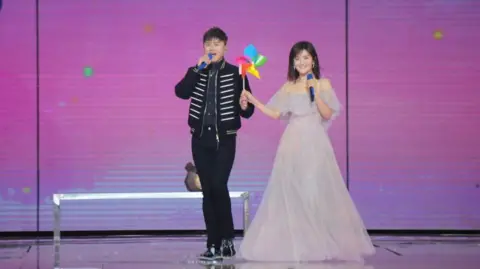
The two concerts, held in Chengdu in May, were warmly received by fans, who were treated to nostalgic performances featuring Xie's celebrity friends.
Her confidence soared after the shows. In a livestream, she expressed disbelief at her own singing skills. "By the end, I was not even out of breath," she said, adding that she could have been a "pop queen".
"Do you think I can do a tour?" she asked her viewers.
 Visual China Group via Getty Images
Buoyed by the success, Xie soon announced that she would embark on a nationwide tour. First stop: Beijing, with tickets reportedly priced between 380 yuan to 1,180 yuan ($56-$174; £42-£130).
But then public opinion began to sour. Some questioned if she deserved to hold a concert given her "bad" singing. Others accused her of relying on her friends' star power for the shows. Yet more wondered if this was just an easy way for her to rake in more money.
As the disgruntlement grew, some claimed they had lodged official complaints against Xie's concert for not getting the right approvals. A widely circulated screenshot appeared to a show a direct message from someone to Xie's husband, a professional singer, telling him to "control your wife".
All this might have been dismissed as frivolous chatter - until state media and authorities chimed in with stern words for Xie.
According to an article published last month by a department of the Zhejiang province party committee, Xie's nationwide tour had given rise to the suspicion that she was not trying to fulfil her dreams but rather "chasing profits".
The controversy is a "reminder", the article said, that "mere superficial popularity will not only fail to generate sustainable profits, but also lead to a loss of cultural refinement".
Days later came another article, this time a commentary from state newspaper People's Daily, about an unnamed "popular celebrity whose main job is to host who lacks well-known musical works".
"Excellence and brilliance often lead to wider recognition, but those who gain recognition without real ability may eventually run into trouble," it read.
 Getty Images
The public pressure eventually proved too much for even Xie's devoted fanbase. Her concert organiser announced over the weekend that it would cancel the Beijing show and refund those who have purchased tickets.
It's unclear if the concert was cancelled because of a government directive. Xie has not commented on the cancellation.
It might have been a "risk-management calculation" by the event organiser and artist's management team, says Dr Jian Xu, an associate professor who studies Chinese internet and pop culture at Australia's Deakin University.
To be sure, Xie is not the first TV celebrity to venture onto the concert stage. Many actors have done the same in recent years. Like Xie, most of them boast a modest discography, marketing the concerts as treats for their fans rather than serious musical pursuits.
But the backlash against Xie's touring ambitions "reflects growing public resentment towards celebrities who are perceived to be 'cashing in on their online popularity'", says Xu, the academic.
Just last month, when acclaimed Chinese singer Han Hong lent her star power to the promotion of a spy thriller, urging audiences to "give her some face", she was accused of emotionally manipulating them into watching the film. She later issued an apology.
Xie's concert also "serves as an emotional outlet for broader frustrations over income and wealth inequality in contemporary China", Xu adds.
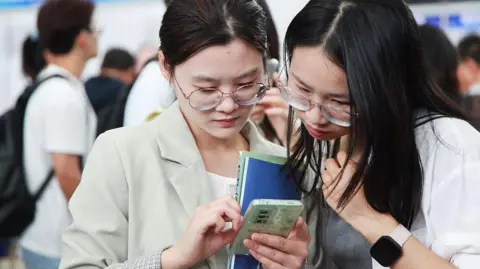
Since the pandemic, millions of Chinese youth have dealt with increasing financial pressure, high unemployment rates and a flagging economy. In contrast, celebrities appear to be earning exceptionally large incomes with "relative ease", Xu adds.
 Getty Images
In recent years, the Chinese internet has gone after people perceived to be enjoying unfair privilege. Last year, an up-and-coming actress had her name scrubbed from drama credits after social media users accused her of leveraging her mother's connections to enroll in a prestigious drama school; a month before that, another actress was the subject of online speculation after she was seen wearing exorbitant earrings.
Criticism of celebrities may be "one of the 'safest' forms of criticism in China", according Zichen Wang, founder of the Pekingnology newsletter.
"It allows people to express frustration about competence, privilege, money and social fairness without directly touching more sensitive subjects," he tells the BBC.
It also allows them to direct their anger at someone other than those in power.
But the bigger question, Wang says, is whether anything should be done about such criticism.
"A society can have strong opinions about taste. But taste should not easily become administrative power, or an excuse for it," he says, adding that "dislike should not become cancellation power".
Such questions were also raised by some Chinese internet users as Xie's saga unfolded.
"If you don't like it, just don't go for it or follow it. Why the possessiveness over other people's wallets?" someone wrote on Weibo.
Another said: "If her singing is bad and she holds a concert, she should face market consequences, not personal humiliation."
