Therapists urge change to 'outdated' massage rules

 BBC
BBCMassage therapists in Nottinghamshire are campaigning for a change to rules on how they can operate as they claim the current system is "outdated" and "unfair".
Therapists in Bassetlaw have to pay their local council about £200 every year to obtain a licence to practise, but in some parts of the country this is not needed at all.
Some practitioners in the area believe they are being treated unfairly because of historic associations with sex work, and called for the licences to be scrapped or applied more broadly.
The local authority said it had to insist on licences because of a 1985 act of Parliament, and denied it was linked to regulating sex work.
The General Council for Manual Therapies - a group of organisations representing massage therapists - added licences were one of the few ways councils could regulate businesses, but agreed there should be more consistency.
 SimpleImages via Getty Images
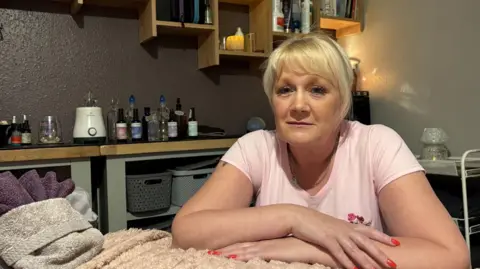
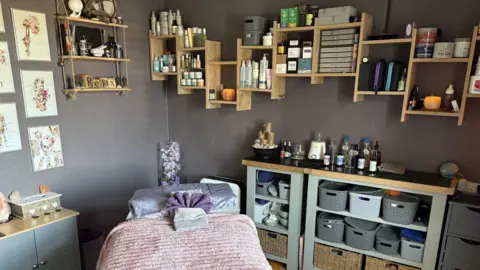
Sharon Sheriff, 56, has been operating her massage business for six years from her home in Retford, Nottinghamshire.
She believes the regulation of massage businesses in the county, currently based on a 1985 act of Parliament, is "outdated".
"I think the reason massage therapists are being treated this way comes back to the sex industry thing," she said.
"The legislation was brought in to stop massage parlours.
"There's still a misconception that massage therapists are part of the massage parlour world and we're just not, and it's very difficult for us to break away from that."
Sharon said the "industry has moved so far".
"We are now classified more for mental health and wellbeing than we've ever been for anything else, and yet we're still being tarred with a brush from 1951 [when legislation came in in Nottinghamshire]," she said.
"I've worked hard to get qualifications to do this.
"I'm not unqualified and I'm not unregistered and I've got my insurances in place.
"So I can't understand why we're still being put in with the massage parlours and I think that's the bit that's really starting to grind."
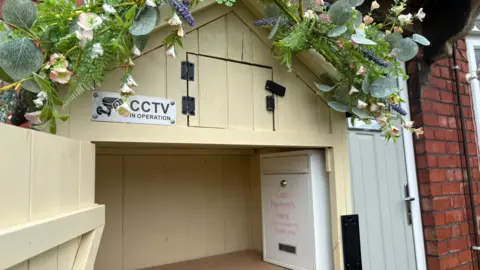
Campaigners said a recent high-profile row between the council's licensing department and cake shed owners, in which the authority has temporarily paused taking action over, has given extra impetus to their plight.
Massage therapists are not regulated in the UK.
The need for a "massage and special treatments licence", which can also include treatments such as saunas and sunbeds, depends on your local authority, according to a government website.
For example, one is needed across Nottinghamshire - but not in Rotherham or Doncaster in Yorkshire, just on the other side of the county border.
The cost is also not the same everywhere. For example, a licence in Camden can cost up to £2,873, while in Birmingham it costs about £180.
In Bassetlaw, you only need a licence to massage parts of the body that would normally be covered by clothes, so one is not needed to massage the hands, head and wrists.
 Liz at the ZenDen
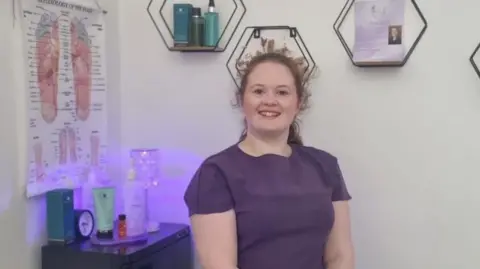
Massage therapist Clare Pal, 34, lives in Gainsborough, Lincolnshire, where no licence is needed but operates just across the border in Retford, where she has to pay for one.
She has joined up with Sharon and other massage therapistsin the campaign to scrap, reduce or standardise the licence.
Clare said: "I just feel it's penalising us for working in Bassetlaw.
"I want the council to know we feel like we're treated unfairly.
"There's that stigma that the industry's had for quite a while, and we've always had to try and defend that.
"And then there's this licence that sort of says, 'you're being treated differently'."
Another local therapist, who wished to remain anonymous, said she could drive 20 minutes down the road to Derbyshire and not need a licence.
"It's ridiculous," she added.
"There are many therapists operating who don't have licences because they're not prepared to pay the money.
"I'm affiliated with the federation of holistic therapists, for which you need a certain standard of training, so the council can check I'm a professional therapist.
"There's no benefits to us or to the clients, the only one who benefits is the council, who pockets the money.
"It's extremely annoying... because of a misconception that it's something that's unsavoury, there needs to be another layer of regulation."
The council has denied any link between its licensing rules and regulating sex work.
Both Sharon and Clare accepted regulation and licensing could help ensure standards, but said it needed to be consistent across the country and applied to other parts of the beauty industry.
They said they did not get any benefit from the council in return for the fee they pay.
Clare said: "For example, with your insurance, you're getting protection [if someone sued you].
"If you get a licence to sell alcohol, you're then added to lots of forums and groups of people and Pub Watch or Shop Watch, and things like that, whereas with this licence, you don't get anything."
They have gathered a group of about 10 massage therapists and started writing to their local MP and councillors.
Sharon added: "The whole situation, it's just unfolded a whole heap of other inaccuracies within it all.
"If it was a national thing and we were all paying it, then it would be fair."
'Better than nothing'
While there is no regulation, there are a number of bodies for massage therapists which give out qualifications and maintain the standards of their members.
The General Council for Manual Therapies brings some of these together.
Chairwoman Ruth Duncan said: "In the absence of statutory regulation, [licensing] is currently one of the available routes councils have to check basic standards and protect the public.
"Licensing is better than nothing, but consistency would be a better option."
On the therapists' claims of associations with sex work, she added: "It is not quite right to say that massage licensing is solely related to historic assumptions about sex work.
"It is fair to recognise that massage therapy has carried historic stigma, and that some therapists may feel these licences are connected to that.
"However, the current licensing process should be understood primarily as a public protection measure, not as a judgement on legitimate massage practice."
A spokesman for Bassetlaw District Council said all the councils in Nottinghamshire had to ask for licences because of the act of Parliament and any demands to change it needed to be directed to MPs.
He added: "We can categorically confirm that the act and licensing of massage premises have no correlation to any regulation of sex work.
"There is separate legislation that covers this area and Bassetlaw District Council does not license any sex establishment venues."
He also said it currently licensed 42 massage premises, and had no information to suggest many were flouting the rules, but that it was an offence to do so.
"The cost of a licence equates to less than 60p per day," he added. "This should not be a significant barrier to practitioners applying for a licence."
A spokesperson for Nottinghamshire County Council, which covers the whole county, said: "The Nottinghamshire County Council Act 1985 requires those wishing to offer massage/special treatment services from a fixed premises to be licensed by their relevant district or borough council or Nottingham City Council.
"Pricing for these licenses is set by individual district and borough councils across Nottinghamshire or Nottingham City Council."
Listen to BBC Radio Nottingham on Sounds and follow BBC Nottingham on Facebook, on X, or on Instagram. Send your story ideas to eastmidsnews@bbc.co.uk or via WhatsApp on 0808 100 2210.
