Jersey to legalise assisted dying after Royal Assent

 BBC
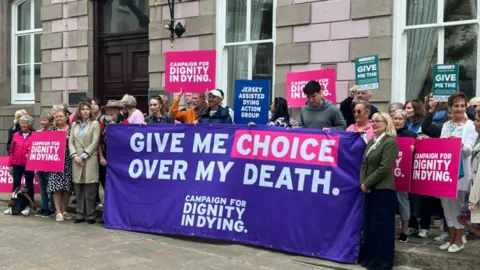
BBCA law to allow terminally ill adults the right to choose to end their own lives in Jersey has been granted Royal Assent, meaning the island's government can bring it into force.
The government said this was a "critical step" in making sure the assisted dying service could begin on schedule later next year, after the bill was approved by the States in February.
When it comes into law, which is expected in a few days' time, Jersey will be the first part of the British Isles where assisted dying is legalised.
The Minister for Health and Social Services Tom Binet said he was delighted Royal Assent had been granted: "Our focus now is on continuing our work to get the service set up and running."
The Assisted Dying (Jersey) Law 2026 will come into force when it is registered at Jersey's Royal Court, although it will not come into effect until next year.
The government said work had been ongoing to set up the service and recruitment for key roles had started.
Senator Binet said: "There is still a lot of work to do, but I've every confidence that we can do it within the schedule we set ourselves.
"Assisted dying is a complex and emotive issue, and I'm grateful to everyone who's worked so hard to ensure we considered this so thoroughly and produced such comprehensive legislation."
Lorna Pirozzolo, who has incurable breast cancer and campaigned for the assisted dying law to be passed, said: "I am incredibly relieved that Royal Assent has been granted and assisted dying will become law in Jersey.
"I am personally so grateful to everyone who started this campaign and all those who joined it."
She added this meant no-one would have to experience "torturous symptoms in their final days, weeks, occasionally months, and the positive impact of that cannot be understated".
The campaigner added: "This proves that people can make a difference when they engage with politics."
In November 2021, Jersey's States Assembly became the first parliament in the British Isles to decide "in principle" that assisted dying should be allowed.
In May 2024 it voted in favour of drawing up laws for an assisted dying service after the government said it intended "to bring forward proposals without further delay".
In February this year, 32 politicians voted in favour of the law with 16 voting against.
At the time Binet, said: "Jersey would have one of the safest and most transparent assisted dying laws in the world."
Under the law, eligibility for an assisted death requires someone to be at least 18 years old.
They must alsohave been resident in Jersey for at least 12 months, to have a voluntary, settled and informed wish to end their own life, and be terminally ill with a life expectancy of six months, or 12 months if they have a neurodegenerative disease.
Government of Jersey said there was an assisted dying capacity test, which states that the doctor must be satisfied that the individual is able to:
- receive the information given to them or advice about their assisted dying decision
- understand the information and all matters relevant to their decision, including the effect of their decision
- retain the information for long enough to make their decision
- weigh up information for the purposes of making their decision
- communicate their decision clearly
The person may require communication support to do what was required in the capacity test.
As a Crown Dependency, for primary legislation to get Royal Assent and therefore formally become law in Jersey, the Ministry of Justice and the Lord Chancellor – currently David Lammy – ensure the proposed laws do not conflict with fundamental rights or international rules and then recommending to the Privy Council that assent should be granted.
Isle of Man
While the Isle of Man's Tynwald became the first parliament in the British Isles to agree a framework for assisted dying in March 2025, it has not yet been granted Royal Assent.
The Ministry of Justice has so far declined to grant royal assent there on the basis that key safeguards, including around coercion, had not been written directly into the Isle of Man bill.
In June, Tynwald approved further amendments around protecting vulnerable people and establishing what Dr Alex Allinson – the Isle of Man politician behind the Bill – described as a "comprehensive system of independent post‑death review".
He said he would now be encouraging Tynwald members to sign the bill, "ensuring that it will survive the dissolution of this parliamentary session ahead of the island's general election in September".
England and Wales
A bill to legalise assisted dying will formally return to the Westminster Parliament for debate on 11 September.
Labour MP Lauren Edwards reintroduced the Terminally Ill Adults (End of Life) Bill in the House of Commons in June – almost two months after it ran out of time in Parliament's last session.
The Private Member's Bill, first brought by her party colleague Kim Leadbeater in 2024, fell in the House of Lords in April, having run out of time to become law before Parliament was prorogued that month.
Peers faced accusations of filibustering – or delaying – the bill after more than 1,200 amendments were put forward, with more than 800 of those tabled or sponsored by seven peers.
Opponents at the time branded the bill "hopelessly flawed" while supporters accused them of a "denial of democracy".
The bill proposed allowing adults in England and Wales with fewer than six months to live to apply for an assisted death subject to the approval of two doctors and an expert panel.
That piece of legislation previously passed two votes in the House of Commons, although the second one, which took place in 2025, saw the majority in favour of the bill narrow to 23 from a previous majority of 55.
'Major milestone'
Andrew Copson, Humanists UK chief executive, said: "Royal Assent marks a historic moment for Jersey and a major milestone for care and choice at the end of life.
"Next year, terminally ill people in Jersey will, for the first time, have the option of an assisted death under a compassionate and carefully safeguarded system."
He said Humanists UK was proud to have supported the campaign over many years and worked with local campaigners, politicians, and supporters to help bring about this change.
"The law reflects the clear wishes of the public, expressed through citizens' juries and repeated opinion polling, and provides terminally ill people with greater choice at the end of life while protecting those who may be vulnerable," Copson said.
Law puts lives 'at risk'
Care Not Killing, a campaign group, said it had "deep disappointment" after the decision to grant Royal Assent to Jersey's Assisted Dying (Jersey) Law 2026.
The group believed the legislation breached the UK's obligations under the European Convention on Human Rights and "highlighted that the law fails to adequately test for coercion, duress or undue influence - particularly in the case of disabled people - by relying on an assessing doctor simply asking the individual if anyone has coerced them."
Dr Gordon Macdonald, from Care Not Killing, said: "This legislation will fundamentally alter health and palliative care on Jersey and put the lives of vulnerable people at risk, exactly as we have seen in those places that have introduced assisted suicide or euthanasia.
"It fails on a number of fronts, including: lack of legal protections for doctors and nurses who do not want to be involved, protections for the elderly and disabled people at risk of being coerced, will see money taken out of palliative care and has been sold to the public as a way to end suffering."
He said Care Not Killing would be consulting its lawyers to determine its next steps.
Analysis by Ammar Ebrahim, Jersey political reporter
Jersey's assisted dying law was passed in February and that was seen as a landmark moment, as it was the second place in the British Isles to approve an assisted dying law.
But there was still a little bit of doubt that there may be a further hurdle ahead because the law would need Royal Assent from the Privy Council.
All laws made in Jersey need Royal Assent, which means they get the final seal of approval from the King.
However, this is usually just a formality, but there was concern among Jersey politicians and campaigners as the Isle of Man's assisted dying law, which had been passed in its parliament nearly a year before Jersey's, had not received Royal Assent.
This raised the question if Jersey's law would face the same challenges, but it seems that getting Royal Assent has been a smooth process.
Senator Tom Binet has always been confident that Jersey's law was very robust and was unlikely to face the same issues as the Isle of Man.
This means Jersey will be the first place in the British Isles to legalise assisted dying, which means other nations will look closely at what Jersey has done.
Follow BBC Jersey on X and Facebook. Send your story ideas to channel.islands@bbc.co.uk.
