Buses won't be council-run due to commercial risk

 Stagecoach
Gloucestershire County Council is not looking to take over the running of the area's bus services, a cabinet member has confirmed.
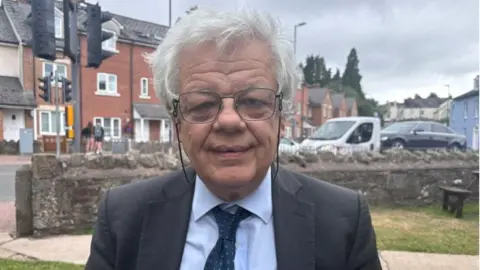
Roger Whyborn has said a franchising model like ones in Manchester and London – which are being considered by other councils – would carry "a lot of commercial risk" which his authority does not want to take on.
"We don't think it is something we should go for at this stage as a relatively small player in a big market," he added.
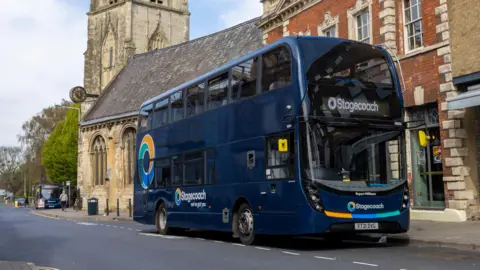
Bus services in Gloucestershire are run by commercial operators, with some less profitable routes subsidised by the council to ensure they are maintained.
Some councils in England are exploring the idea of franchising bus and public transport services to give them control over routes and ticket prices.
It follows success in Greater Manchester, where the mayoralty took over the running of the bus and tram networks three years ago.
Similarly the Greater London Authority has controlled Transport for London – which runs Tube trains and buses – for more than 25 years.
Whyborn said Gloucestershire's rural make-up meant it would be hard for the council to franchise services; he said the model worked better in larger, more urban areas.
"The big metropolitan areas can franchise buses in huge quantities and they've got big populations and they get huge economies of scale," he said.
"But we're in a very different ball game here."
The Robin
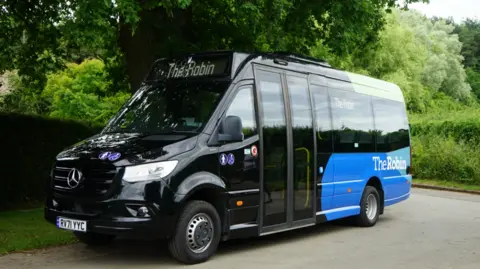
The council does operate its own hyper-local bus service called The Robin, with users able to book bespoke routes around rural areas.
The service costs £1.4m a year and provided more than 53,000 journeys last year, with an average distance of 10 miles (16km) per trip.
 Gloucestershire County Council
"The Robin is really ideal because there are so many combinations of journeys people want to do, and so few you can give a good service to with a conventional bus," Whyborn said.
"They don't make money, and we don't think we'll ever make money but we think it's a far more cost-effective way, and popular with the public, of being able to link some of these rural communities."
The prospect of a franchised service may not be off the table in the future for Gloucestershire, however.
It is anticipated the county will join a larger authority in the coming years – with many of Gloucestershire's councils favouring a move to join the West of England Combined Authority (Weca).
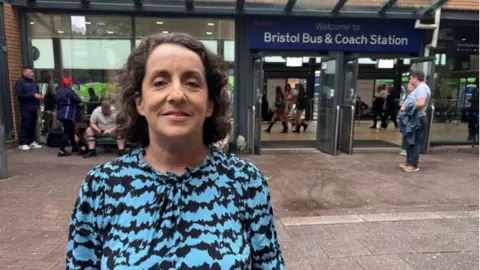
Campaign group Reclaim Our Buses is calling on Weca to explore franchising to provide better coverage and increase the quality of bus services.
Campaign coordinator Jo Sergeant has said the biggest benefit would be reliability.
"At the moment you go to the bus stop and you don't know if that bus is going to turn up – sometimes the information will tell you one story and the bus still won't arrive and other times you will have no idea," she said.
"It means that people are making other choices where they can, like getting in the car or not going somewhere at all."
Speaking at a committee meeting this month, Weca Mayor Helen Godwin said she was committed to reforming buses and improving services.
"We are looking carefully at all of the options for how to take greater control of our buses, with several different operating and funding models on the table, including franchising models," she added.
A spokesperson for the Department of Transport said: "We're giving local leaders more powers to design bus networks that best serve their areas – making services more reliable for passengers and putting buses at the heart of communities."
Follow BBC Gloucestershire on Facebook, X and Instagram. Send your story ideas to us on email or via WhatsApp on 0800 313 4630.
