The Polygamist's author says women see themselves reflected in her Netflix hit

 BBC
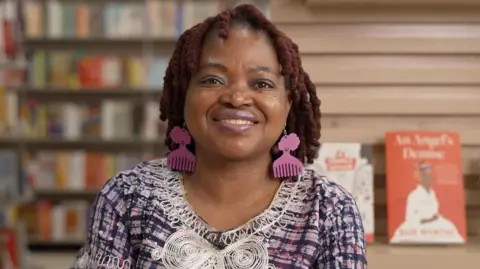
BBCWhen Sue Nyathi sent her debut novel The Polygamist to publishers, "they thought there was no market for the book" about a married Zimbabwean man and the women he seduces, she says.
So the Zimbabwean author found her own editor, typesetter and artist, and in 2012 published 500 copies herself. It defied the publishers' predictions and became a huge hit.
It has now been adapted for Netflix and is in the top 10 of the platform's most streamed series in more than 60 countries, reaching number two in the United States. Hollywood actress Taraji P Henson said the series had her in a "chokehold" and she binge-watched all 22 episodes in a single day.
It is not, Nyathi is careful to point out, a straightforward story about polygamy. The traditional practice of polygamy is not foreign to her. Her mother's side the family was polygamous for generations.
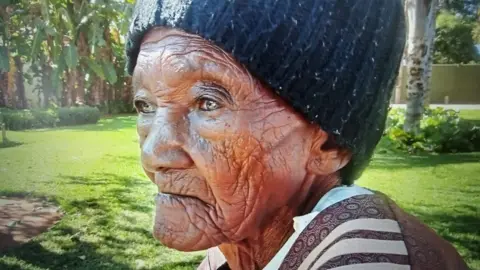
Her grandfather, who died in 1979, had five wives, her great-grandfather had 11. Her grandmother, the first woman his grandfather married, presided as matriarch over a farm where the wives lived together, and often helped choose the newcomers herself.
 Sue Nyathi family
"There was no infighting, because everyone knew their place," Nyathi says. When she asked her grandmother how she made sense of it, the answer was practical - more hands to do the work, physical labour and emotional labour alike. It was open.
"Everybody knows who's who in the zoo," Nyathi explains.
Polygamy is legally recognised in Zimbabwe and South Africa if conducted under specific established customs. But what Nyathi began to notice as a young working woman in Harare in 2001 was something else entirely.
Men who were purportedly monogamous were effectively living polygamous lives with secret women and secret households. That is the polygamy of her novel, what she calls "the modernised, or perverted, version" of the practice, relying on deception instead of consent
"I'm not against polygamy," Nyathi says. "What I'm against is the lack of agency. It's wrong for the goalposts to be shifted once you're inside."
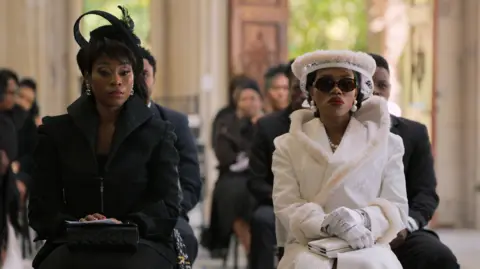
In the novel, Nyathi's heroine, Joyce, believes she has married into a union of one man and one woman, yet her husband, Jonasi, marries and sets up homes with three other women behind her back. There is no confession and no announcement; Joyce simply comes to realise, as the secrets accumulate and the women's lives intertwine, that her idea of a monogamous marriage has been a sham all along.
 Netflix/ Iconic Digital
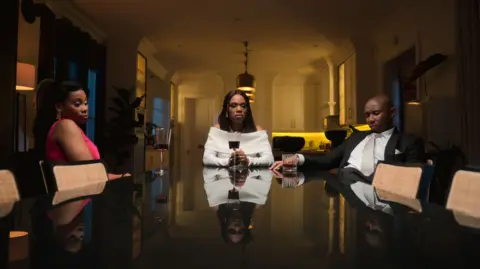
The question of who holds the power to negotiate and who does not runs through the whole storyline. Jonasi is a wealthy, self-made businessman, and in a patriarchal society he makes the decisions about everything.
Although Joyce helped him build his empire, her finances are dependent on him. The same goes for a later wife, Matipa who also works for Jonasi.
As a result the women have less autonomy, which leaves them exposed. Age gaps compound the imbalance, Nyathi notes, down to the most intimate negotiations.
An HIV thread runs through the story, and if "you're negotiating safe sex, you don't have a say in a relationship with those kinds of dynamics", she says.
There are a few differences between the book and the Netflix series - on the screen, the story is moved to South Africa, is shot in the Zulu language with subtitles and Jonasi has fewer wives. And unlike the television version, the novel is narrated entirely by Jonasi's wives.
 Netflix/ Iconic Digital
"I wanted to highlight women's voices," Nyathi says, to let each woman explain why she found herself in a relationship with a man who wouldn't be faithful to her. The themes resonate with many readers, she adds. Women write to her to say they see themselves in Joyce and Jonasi's other wives. Some add that they are married to a Jonasi figure and want out.
After the series aired, Amnesty South Africa circulated guidance on narcissistic abuse and what steps a woman can take.
"For some people, this is not just a series," Nyathi says. "It's their lived reality. It holds up a mirror to society."
Not everyone has welcomed the reflection though.
Kenyan civil servant Geoffrey Mosiria called for the series to be banned in Kenya, arguing that it conflates polygamy with cheating, fraud and abuse. Nyathi is unmoved. Culture evolves, she says, and practices can be diluted or corrupted and she is showing what has happened to this one.
Simply by making affluent black Africans the protagonists, she says she has opened many people's eyes. She recalls a European reader who said he had not realised that rich black Africans existed.
"We've always had this stereotypical view of what being African is, and it's always associated with poverty," Nyathi says. The series shows otherwise and, she argues, is the richer for being filmed in the Zulu language: "English doesn't carry the same cultural richness that our languages do."
 Netflix/ Iconic Digital
If there is a note of frustration in her, it surfaces around the question of who gets to write at all. Nyathi wanted to be a writer from childhood, but her parents pushed her towards a more traditional profession.
She worked in finance for almost two decades and says her time as an investment analyst taught her to see writing as both a craft and a business. While her financial career paid the bills, writing remained her passion and she wrote The Polygamist in the evenings after she had finished work. She left corporate life at the age of 40 to write full time, a few years after she had published the novel. She is now 48.
"People say, 'Oh, you're an overnight success.' Not at all," she says. "The recognition is overnight, but the work has been put in over many years, and I've made a lot of sacrifices."
Most writers, she adds, cannot live on their books, least of all in Africa. She says that often successful writers are supported by wealthy husbands, by grants, by residencies.
But those options were not available to her - a single mother who had to put her son through school, she has juggled various jobs to keep writing.
"There's a long period between when you start a book and you finish it. It could be two years, it could be eight years. How do you survive? Practically bills still need to be paid," she says. "I've walked that journey and it's erratic… you're definitely going to have to stay in that day job.
"Writing is a luxury that most people can't afford," she says, adding that the cost is measured in the voices that are rarely heard.
She also feels an imbalance in how African writing travels. "It's easier for an African writer published overseas to gain traction. Books are traditionally sold down to us. It's hard for our work to sell upwards."
What the "Netflix effect" has given her is precisely the visibility she had never enjoyed across four novels and more than a decade of writing, often on politically charged topics.
Nyathi is now finishing the first draft of a historical novel which she has been working on for the past two years - she says the themes will resonate with many people.
As for the craft of writing, "everything starts with a story", she says, advising any woman who thinks she has a book in her and no money, to start with a pen and paper, and do it for love.
"Money should never be the motivation. The love is what will fuel you when it gets hard."

- This is part of the Global Women series from the BBC World Service, sharing untold and important stories from around the globe
