New crannog unveiled five years after blaze

 Andrew Allan
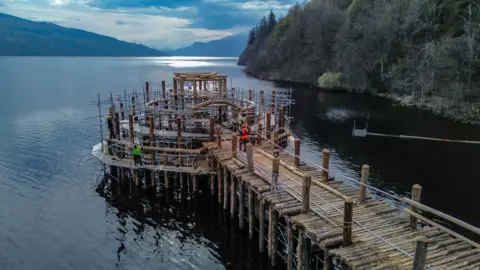
A new reconstruction of an Iron Age crannog has been unveiled five years after a fire destroyed the previous incarnation.
The Scottish Crannog Centre on the banks of Loch Tay burned down in June 2021.
Work to rebuild the centre began in May 2023, with work on the £700,000 crannog - a type of ancient artificial island - beginning the following October.
A ceremony to mark the new building will be held with First Minister John Swinney and it will open to the public in June.
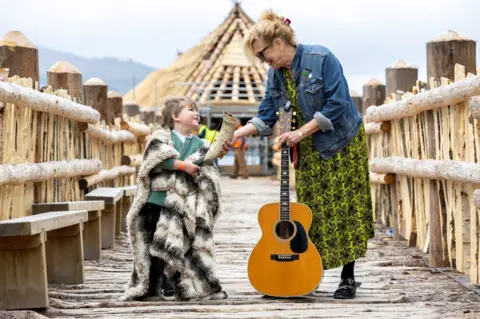
Singer Barbara Dickson performed at the new crannog to mark the unveiling.
The recreated Iron Age roundhouse was destroyed in just six minutes by the 2021 blaze.
The rebuilt £5m Crannog centre, minus its centrepiece, reopened in April 2024 on a new site, 12 times bigger than its predecessor.
 Martin Shields
The new crannog has been built by a team of specialist craftspeople and apprentices, with eight of them working in two teams at any one time, with volunteers working alongside the professionals.
The workers used traditional skills including roundwood timber framing and thatching to complete the structure.
 Arterra
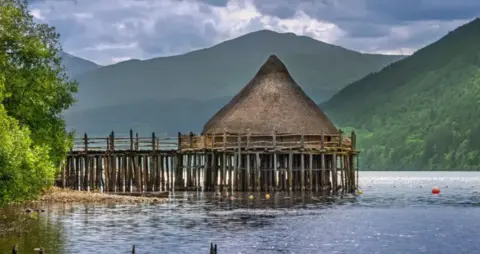
The centre said the crannog was "very much in keeping" with a dwelling place inhabited by prehistoric ancestors, including the materials they would have used.
About 300 European Larch trees were acquired for the crannog from a variety of local and Scottish woodland suppliers.
The roundhouse, the part of the structure where people lived is about 8m (26ft) high, and is reached by a 50m (164ft) bridge.
Scottish Crannog Centre director Mike Benson said: "The opening of the new crannog signifies that we have now completely recovered from the fire.
"Since the blaze we've been a bit like a Van Gogh museum without any Van Gogh."
He said the crannog was not just a building, but "part of our community."
He said: "Many consider our centre a home and a place of sanctuary.
"People come to learn about the past and find out what role it can play in our future.
"Aside from the crannog itself, we have a number of thatched buildings in which our team demonstrates traditional skills, such as weaving, blacksmithery and woodworking, to our visitors, keeping these crafts alive and introducing them to new generations."
