Democrat Graham Platner suspends campaign for key US Senate race after assault allegation
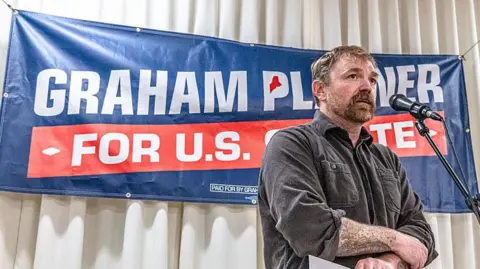
Democrat Graham Platner has suspended his campaign for US Senate in Maine, following a series of scandals that included a woman accusing him of sexual assault.
In the days since the accusation was made, Democrats have called on him to drop out of the race considered pivotal to their chances of gaining control of the US Senate.
In a video posted online, Platner said his decision was not an admission of guilt but due to Democrats' threats to cut off campaign support. He called the assault allegation "false".
He said he would officially file to withdraw from the race once he's assured his replacement in the race against Republican Susan Collins is selected in a "transparent and democratic" way.
"We're suspending campaign operations," he said in an 11-minute video posted to X, adding that he would file his paperwork to withdraw only after he was assured the process to replace him would be "open and democratic moving forward".
Platner added that he is not "trying to dictate to anyone who it should be or how we get there".
"But I will say this: it needs to be open, transparent, and democratic. It needs to be reflecting the will and the values of the people that built this movement," he said.
Under state law, Platner has to officially drop out by 13 July for a replacement name to be put on the ballot.
The race is one of several pivotal to Democrats eyeing a longshot bid to flip control of the Senate in November's congressional elections, commonly called the midterms.
Maine is considered a must-win state for Democrats to take the majority in the Senate. But it's an uphill battle. The party must flip Collins' seat, hold on to all their existing seats and gain three more in the November midterm election.

 Getty Images
Who is Graham Platner?
Platner, an oyster farmer and military veteran, rocketed to the top of the Democratic field with a message of plain-spoken populism.
He championed progressive policies like universal health care and affordable housing, and won over many frustrated Democratic voters with his critique of the party's establishment.
Endorsements from two liberal leaders, Senators Bernie Sanders and Elizabeth Warren, bolstered his candidacy. His momentum was so strong that his opponent for the nomination, Maine Governor Janet Mills, suspended her campaign.
The assault allegation was made public on Monday. By that night, Warren and other top Democrats called for him to withdraw and three of his strongest supporters in Congress - Representatives Ro Khanna and Senators Ruben Gallego and Martin Heinrich - had rescinded their endorsements.
The Democratic Senatorial Campaign Committee, which provides millions of dollars in support to the party's candidates, and the Maine Democratic party had both ended their backing, too.
What are the accusations?
Warning - this story contains distressing content
While Platner's non-political background elevated him in a climate unfriendly to establishment candidates, several scandals emerged that rocked his campaign.
Last October, US media reported he had a tattoo resembling a Nazi symbol, which he later said he covered up. He said he got the tattoo in Croatia with his fellow Marines in 2007 while drinking.
Meanwhile, old Reddit posts showed Platner saying victims of sexual assault should "take some responsibility for themselves" and not get so intoxicated. After the posts were unearthed, Platner asked voters for forgiveness.
In June, the New York Times (NYT) reported that Platner had exchanged sexual messages with other women while married, and his wife had warned his campaign of the potential scandal. He acknowledged the report was true.
The NYT followed with another report featuring the accounts of three former girlfriends who accused him of erratic and angry behaviour.
But the accusation included in a story on Monday in Politico led to the almost instant downfall of his campaign.
Jenny Racicot, 41, alleged in a series of interviews that after an on-and-off relationship with Platner for more than two years, he entered her home in Maine uninvited and sexually assaulted her. She said Platner allegedly appeared very intoxicated.
Racicot said she cut off contact with Platner after telling him the encounter was not consensual.
Jenny Racicot, 41, said she was one of the women interviewed by the Times but did not want to go public with her specific claims because she did not want to be known as a rape victim.
In the video on Wednesday, Platner called the allegation "false" and said it was "the worst thing that a person could do, and it was not remotely true".
"I learned about this through press inquiries with no time to truly respond, no time for investigations before a corporate media system and the political establishment got to act as judge, jury, and executioner," he said.
Platner is the second major Democratic candidate to suspend his campaign this year due to sexual assault allegations. In April, Congressman Eric Swalwell dropped out of the race for California governor and resigned from the House of Representatives after multiple women accused him of sexual misconduct. Swalwell denied the allegations.
Who could replace Platner? And how would it work?
The Maine Democratic Party has announced it will select a new nominee at a convention held sometime in the next two weeks. Media reports indicate hundreds of delegates will weigh in on the choice.
The party will have to tread carefully when nominating a replacement aligned with the policies that Platner successfully ran on, while ensuring the new candidate can take on Collins and her formidable operation.
"There is an unprecedented amount of energy and enthusiasm among Maine Democrats, driven in part by many of the dedicated volunteers and supporters who were inspired by Graham Platners's campaign," the party said in a statement after Platner dropped out.
"We look forward to coming together and harnessing that energy around our new nominee as we work to defeat Susan Collins in November," the statement said.
Platner said in his video announcement on Wednesday that the process "needs to be reflecting the will and the values of the people that built this movement" in Maine and added that "people in DC need to stay in DC. Decisions should not be made in back rooms by people in places of political power".
On Tuesday, Maine Democratic Party Executive Director Devon-Murphy Anderson accused the Platner campaign of trying to put its "thumb on the scale of what this process looks like".
"We have repeatedly reiterated to Graham Platner's team that they have no role in determining our next Democratic nominee to the US Senate, nor in determining what this process looks like," Anderson said.
Over the last few days, Senate hopefuls have been vocal with their interest in replacing Platner on the ballot. By Wednesday, it seemed as though every available Maine politician was gunning for the Senate.
Public health expert Nirav Shah, who ran for governor of Maine earlier this year, announced he would stand, as did former state senator Troy Jackson.
Jordan Wood, who ran for a US House seat in Maine earlier this year, has now switched to the Senate race.
Maine Secretary of State Shenna Bellows has said she is "still considering" and Dan Kleban, founder of the Maine Beer Company who had suspended his initial Senate campaign last year, announced on Wednesday, "I'm in."
Television actor Patrick Dempsey, who starred in the US medical drama series Grey's Anatomy, put to rest chatter around a potential bid on Wednesday in a newspaper opinion piece.
"As I reflected on all of this, I kept coming back to one question: Do I truly want to serve in Congress?" he wrote. "After a lot of thought, I realized the answer is no. Not because public service isn't honorable — it absolutely is. But because I believe I can contribute more effectively through the life I've already built."
Mills, Platner's previous opponent in the Democratic primary and the state's governor, had the backing of Senate Majority Leader Chuck Schumer but suspended her campaign before the election as she struggled to gain traction.
Platner officially won the Democratic nomination on 9 June as Maine voters, frustrated with the party establishment, gravitated toward his outsider persona and populist views. It was not immediately clear if Mills would revive her campaign after Platner's announcement.
