Glasgow's historic Pollok House transforms for art festival

 Eoin Carey
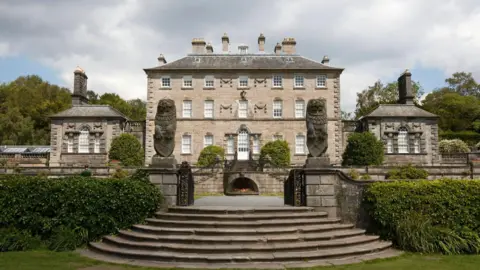
The stately Pollok House in Glasgow's southside has seen many visitors in its 274 years - but surely none quite like this.
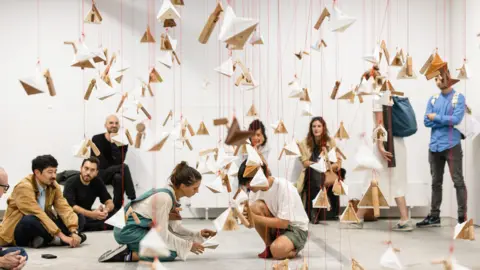
In one room, glowing lightbulbs flash on and off while electronic music pulses alongside the lights. In another room, more than 150 bird sculptures are being moved into position, while opera music drifts along a corridor from upstairs.
The Georgian building has been taken over as part of this year's Sonica festival, an experimental audiovisual and art event that has been running for more than a decade.
Pollok House itself has been closed to the public since 2023, when it shut for a renovation originally scheduled to last two years.
It is hoped the full re-opening of the building, which typically is home to period artefacts and paintings, will come in the near future.
For now though, it has been transformed into the Listening House, with many of its rooms hosting a spectrum of art displays.
Visitors can wander around and pop into whatever room catches their eye or ear.
A couple of days before opening, Cathie Boyd, the artistic director of Sonica, is flitting from room to room to check on the progress of each installation.
"The past two editions of Sonica, we have worked with the council on opening up buildings that people don't have access to," she says.
"Last time we did the Mercat Cross and the clock tower, and afterwards I went to the council and Pollok came up in conversation.
"I was like that's amazing – people haven't seen this house in years, so how can I turn it into a listening house?"
 Sonica
The answer was to create what she calls a "mini festival within a festival", based entirely at the house until 4 October.
Onsite installations will feature throughout the festival, with musical performances planned for some days.
Many of the exhibits place interaction at the forefront, but Cathie says the history of the building will always be respected.
"I'm really sensitive to the fact this building is a national treasure located in Glasgow," she says.
"When I was a child my parents were members of the Ulster Architectural Heritage Society, and I was dragged around all these old buildings. It had made me love them, and really appreciate them.
"Everything here is free standing, so there is nothing marking this glorious building."
 Eoin Carey
However the site itself seems transformed. A large sculpture by Scott Douglas Gordon and Adrian Murray sits outside, and asks visitors to make sounds themselves.
As people interact with it, chimes ring out across the surrounding gardens.
Those wanting something more placid can lie down on the floor in one of the building's halls, looking up at the Dutch artist Sara Vrugt's creation Unearthed - a damaged tree with hundreds of bells for decoration and music playing alongside it.
"I want people to stop, breathe, let the work wash over you", Vrugt told BBC Scotland News.
"The tree has been there for such a long time and has survived so many generations, and you can feel that with the building here too."
 Eoin Carey
Another section of the building is home to Ricochet, which encourages visitors to sit down in a mostly dark room and control eight algorithmically generated bouncing balls that trigger different pitches and lights.
It is the creation of Paul Russell, a musician and artist who previously lived in Glasgow for over a decade.
"This was originally written when my dad passed away a few years ago," he explains.
"It's quite an emotional connection for me, and what I hope is that people will feel an emotion and get involved with it, and to get stuck in."
Having lived in Glasgow for a long time, the idea of using Pollok House to display audiovisual art caught Paul's attention.
"It feels like one of the main instruments is actually the house itself. It's amazing working here, somewhere completely different to where I've been before."
Pollok House forms the centrepiece of the festival, with other exhibitions scattered across the city at places like Buchanan Galleries, Tramway and Glasgow Film Theatre.
 Sonica
Visitors who remember Pollok House from before will find it completely transformed, given the sheer amount of art installations.
However it is still uncertain when the building will be seen in a more traditional way.
It shut in November 2023 to allow for roof and general building repairs and was expected to reopen last year.
That has since been delayed.
Pollok House is owned by the people of Glasgow, having been gifted to the city by Dame Anne Maxwell Macdonald in 1966.
The National Trust for Scotland has managed the house under contract to Glasgow City Council for more than 25 years.
For Cathie, part of the appeal of the Listening House lies in combining the building's historic heritage with new music and art.
"I want people to be curious and I'm thrilled to see how they react," she says.
"You go into the basement and hear the radio, you walk along and get pulled in by something like Ricochet and then the bells of Unearthed pull people up the staircase.
"Then they hear opera from one room, or another sound elsewhere. The sounds are drawing you around the house."
