Concern that pellets clean-up 'could take years'

 Nurdle
The clean-up of millions of plastic pellets from the Sussex and Kent coast could take years, a non-profit organisation has said.
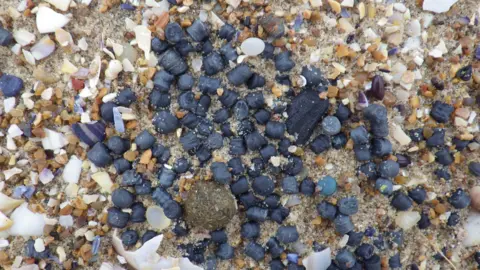
The pellets washed up in Camber Sands and Rye Harbour Nature Reserve - and later as far as St Mary's Bay - after a spill at a Southern Water treatment works in Eastbourne in October.
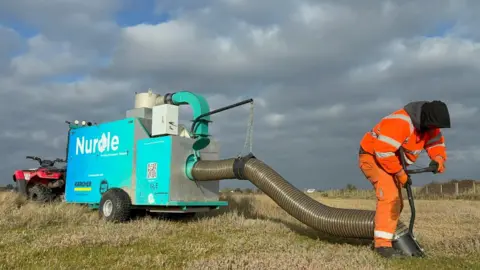
Josh Beech, founder of the organisation Nurdle, which is cleaning up the microplastics, said the operation could last up to three years in the "worst case scenario".
Southern Water said it was very sorry for the impact of what it called an accident.
"This release should not have happened," it continued.
The water company said it had strengthened containment measures to prevent a spill happening again, including using AI cameras to provide early warning of any unusual activity.
 Strandliners
Scientists have found the biobeads contain a number of heavy metals, including lead and arsenic, which could be toxic to wildlife.
Beech added the time to clean up the spill depended on the weather and oceanography.
Nurdle, which is receiving funding from Southern Water, is using a specialised vacuum cleaner to remove the biobeads from the beaches.
The group cleared a "significant proportion" of them in the immediate days after they were discovered in November, although not all could be collected, according to Rother District Council.
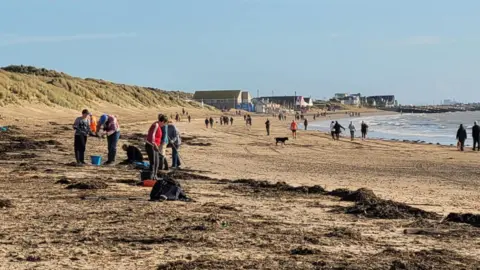
Beech explained that Nurdle now needed to wait for spring tides and storms to churn up pellets buried in the sand so they can be removed by the machine.
"Basically, it'll be storm hunting for the next few years," he said.
 Strandliners
Beech added the non-profit organisation expected to carry out 35 cleaning days this winter - then 20 days in 2027 and 2028, and a further 10 days in 2029.
"The winter after that... hopefully [we'll] get it [the beach] back to where it was," he said.
But Beech emphasised this was a "worst-case scenario".
The Environment Agency classified the pollution incident as a category one in January, meaning it was "deemed to have had a major environmental impact".
Volunteers have also been involved in the clean-up operation, alongside more than 850 Southern Water staff and contractors, according to the water company.
'Appalling pollution'
Hastings and Rye MP Helena Dollimore said she was told by Southern Water that about 312 million beads had been released.
She has also launched a petition to end the use of plastic beads in wastewater treatment.
A spokesperson for the Department for Environment, Food & Rural Affairs said: "The Environment Agency is investigating the appalling pollution at Camber Sands last year and will not hesitate to take appropriate enforcement action."
They added the government had "significantly bolstered" the agency's powers to hold water bosses to account.
"Those who obstruct investigations now face up to two years in prison," the spokesperson said.
Follow BBC Sussex on Facebook, X, and Instagram. Send your story ideas to southeasttoday@bbc.co.uk or WhatsApp us on 08081 002250.
