Safety fears over drought-impacted sports pitches

 BBC
BBCMonths of hot, dry weather have left sports pitches in an increasingly dangerous state.
Football, rugby and cricket clubs across Wiltshire have expressed fears that the hard ground could lead to players being injured.
The start of the community rugby season, scheduled for 5 September, has been delayed by the Rugby Football Union (RFU) until 21 September, and there are concerns football leagues may be forced to do the same.
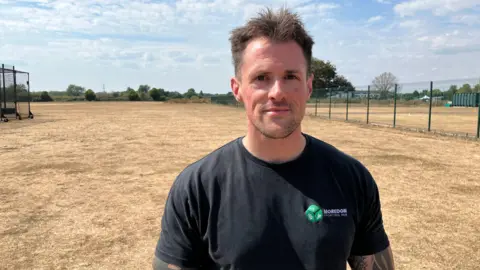
"Seeing the football pitches in the condition they're in now is tough," said Andrew Briggs, Head of of Operations at Central Swindon North Parish Council, which recently spent £35,000 on improving the grass pitches at the town's Moredon Sporting Hub.
"This year has been exceptional, in that we haven't had a single bit of rainfall in as many weeks as I can remember - and it's left the pitches struggling," he said.
"But player safety is paramount and that will be the main factor in deciding whether play actually can take place."
The weather has also meant many teams have not been able to complete their normal pre-season training - particularly contact practice - so are unlikely to be ready for the demands of a full game.
Recent guidance by England Football has urged match officials to arrive at games early enough to carry out thorough pitch inspections and decide whether it is safe for games to go ahead.
An "excessively hard surface", cracks in the ground, or particularly bad conditions around high use areas like goalmouths, can all be reasons to call off or abandon a match.
"I'm not convinced our pitches will be ready by the start of the season to play safely," said Sam Smith, a youth football coach at Rhode Lane Wanderers in Bridgwater, Somerset.
"It'll be postponements, which you don't want to happen at the start of the season - it's the opposite of last year, when we had all the rain.
"If we are driven to rent out 3G pitches, all of a sudden a matchday for children costs over £100."
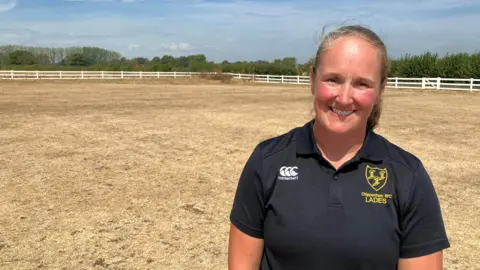
Clare Avenell, lead sports therapist for Chippenham Rugby Club, said hard ground can cause a range of injuries:
"We could see shin splints, tendon problems and even stress fractures," she said.
"Landing on the hard ground could lead to bone bruising and bursa problems, especially in rugby where you're also having to worry about landing on shoulders and elbows."
Bea Chubb, captain of the women's side at Yeovil Rugby Club in Somerset, agreed a delay to the start of the season was necessary.
"While we're all disappointed, it's safety that's the biggest thing - and I think there is an increased risk of injury were people to go out and play full contact very competitive rugby at the moment," she said.
"[The delay] isn't going to have too much of an impact on us - the RFU has been really good at communicating when rearranged fixtures need to be moved to"
But the decision to delay the start of the rugby season due to the dry weather has also affected many clubs behind the scenes.
Chris Elias, chair of Royal Wootton Bassett RFC, described the impact as "huge".
"If you've got a commercial club and a bar, it's the income that generates that keeps the club going really," said Elias.
"If you take a prime month out, then its a huge loss of revenue - and if you're not seeing players come back, there is a chance that you will see people drifting away from the sport," he added.
The cricket season is continuing, but here too, player safety remains a concern.
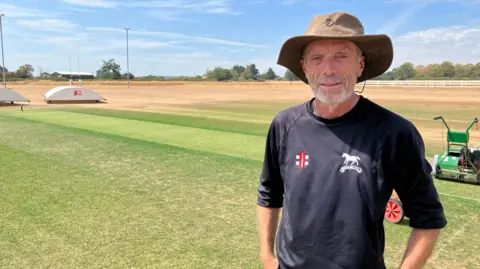
Cricket clubs are allowed to water the central square of their pitches, even during a hosepipe ban, but the outfield has to stay dry.
Richard Mosdell, groundsman for Allington Cricket Club, near Chippenham, said watering the pitch is crucial to allowing games to be played, but the dry outfields remain a danger.
"A cricket pitch is predominantly clay, which needs water to bind it together.
"As it starts to crack, it can mean the 5oz cricket ball is coming at you at 60mph and you don't know whether it's going to hit you in the knees or the face."
"In the outfield you're a brave person if you decide to dive for a catch."
The cricket season ends in late September.
Follow BBC Wiltshire on Facebook, X and Instagram. Send your story ideas to us on email or via WhatsApp on 0800 313 4630.
