Mum 'broken' as council's SEND tribunals rise

 LDRS/PA Media
A mother says she has been left feeling "completely broken" after taking the council to a tribunal over her daughter's educational needs.
Emma Booth wanted her 12-year-old daughter, who has autism and ADHD, to attend a specialist school, but North Northamptonshire Council had named a mainstream school instead.
She said the tribunal process lasted from February 2024 to May 2026, and she criticised the local authority for poor communication and inconsistent support throughout.
The council said it could not comment on individual cases, but accepted that "where our service falls below the standard families should reasonably expect, we need to learn from that and improve".
 LDRS/PA Media
The council warned it faced significant demand for SEND services (special educational needs and disabilities) and acknowledged challenges around timeliness and communication with families.
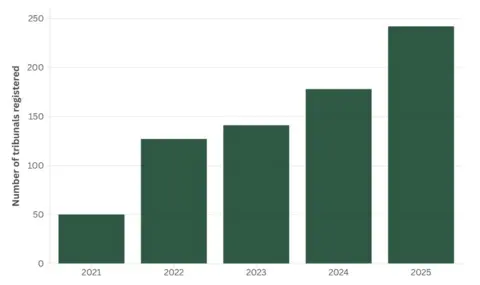
The number of SEND tribunals brought against North Northants rose from 50 in 2021 to 242 in 2025, the Local Democracy Reporting Service (LDRS) found.
A council spokesperson said: "We recognise that navigating the SEND system can be challenging for children, young people and their families, particularly where there are complex needs or different views about the most appropriate educational provision."
'Complete nightmare'
Booth said her daughter had missed out on the first year of secondary school because of the disagreement over provision.
In May 2026, she was told the council would be vacating the tribunal and an agreement was reached to name the specialist school she had requested.
She told the LDRS that the process had been a "complete nightmare from start to finish".
"[The council] have missed so many deadlines, then they ask to be allowed back in and then still miss more deadlines," she said.
"I was constantly emailing the council asking for information, and they wouldn't answer. It felt like I was banging my head against a wall and it's really taken a toll on my mental health."
She accused the authority of trying to "bamboozle, ignore, or gaslight" in the hope that parents would give up.
Rising tribunals
Samantha Hale, a solicitor specialising in education law, told the LDRS she was seeing delays of up to 18 months in the tribunal system due to increased demand.
Hale, who practises at the firm HCB, said many councils were in "firefighting mode".
"They just deal with whatever deadline or hearing is coming up, and then they don't have the capacity to deal with the other cases."
"It seems that local authorities don't look at the case until literally just before they're due to respond.
"It may be that some of them are doing it as a delay tactic, because if they settle six months later under pressure from the tribunal, that's six months of not paying a school's fees."
In certain cases, barring notices are issued to the council when it has failed to provide information on time - and caused delays to the proceedings.
However, Hale questioned if this was a "proper deterrent" as often the authority could apply to be allowed to take part again.
"It's not as final as it seems," Hale said.
 LDRS/PA Media
The council said action had been taken to address the issues, including establishing a permanent leadership and staffing structure within the service, to bring greater consistency.
"We are already seeing improvement, but we recognise there is more to do," a spokesperson said.
"Our focus is on ensuring families receive clearer and more timely communication, decisions are made as early as possible, and disagreements are resolved wherever possible without families having to go through lengthy tribunal proceedings.
"Our focus remains on continuous improvement and ensuring that children and young people receive the support they need at the right time," they said.
Do you have a story suggestion for Northamptonshire? Contact us below.
Follow Northamptonshire news on BBC Sounds, Facebook, Instagram and X.
