'Serious situation' as E. coli spikes in two rivers

 BBC
BBCE. coli levels have "spiked alarmingly" in two rivers, according to an environmental group that carries out regular monitoring.
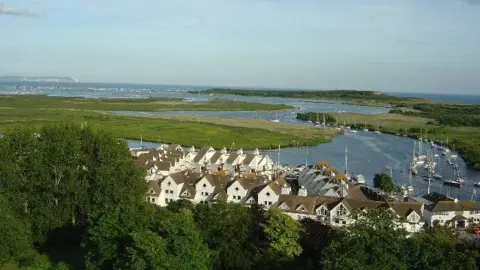
Christchurch Harbour and Marine Society (Chams) has been regularly testing for the bacteria in the Avon and the Stour in Dorset for a year.
Its figures show E. coli levels in the Stour peaked on 19 August at 370,000 E. coli colony-forming units (cfu)/100ml of water compared with 4,217 E. coli cfu/100ml for the same week in 2025.
Chams chair Martin Stewart said: "I am being fed details of cases of illness where people have been in the water and ending up in Bournemouth Hospital. It's a serious situation." The Environment Agency said it had begun its own investigations.
The agency added: "We are considering multiple sources of pollution including agricultural and private sewage sources across Christchurch Harbour's large catchment."
Speaking on BBC Radio Solent's Dorset Breakfast show, Stewart said Chams had been testing the water for nitrates and phosphates for four years but, a year ago, it had been advised to test for E. coli too.
"Anything above 500 cfu, you possibly shouldn't be swimming," he said.
 Dave Pardy
"After 1,000, it starts to get serious and, over the last few weeks, it's been between 1,000 and 5,000.
"Then, suddenly, 10 days ago, it blipped and it was well over 100,000."
The group's data shows that although E. coli levels have since fallen, they remain at more than 10,000 E.coli cfu/100ml.
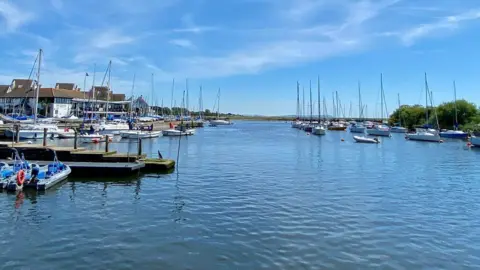
Bournemouth Christchurch and Poole Council has arranged a public meeting on Tuesday after receiving complaints from harbour users and residents about "horrible smells".
Environment councillor Andy Hadley said: "Before this incident, before Martin came up with these very high readings, we were already concerned.
"We don't have jurisdiction over it and that's why we've called this meeting to bring all these parties together."
 Iain Lees
The Environment Agency (EA) said it did not routinely monitor non-bathing waters such as the River Stour for E. coli "because its presence has no direct impact on the river's ecology".
An EA spokesperson thanked Chams for its data, and said of its own investigations into potential sources: "Our officers are out taking samples and checking the performance of Wessex Water assets after a reported pollution incident at Christchurch Harbour.
"We welcome the role citizen-science monitoring can play in improving water quality."
A Wessex Water spokesperson said: "There have been no recent storm overflow operations at or upstream of that location and all our sewerage assets are operating as normal.
"Christchurch Harbour is a catchment serving a largely rural area where water quality can be influenced by wildlife, agricultural run-off and numerous other factors.
"Environment Agency data does not identify discharges from water industry assets as the reason for the harbour not achieving a higher ecological status."
