Woman seeks stem cell donor match for 'second chance at life'

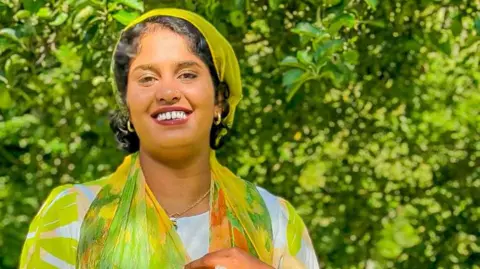 Rafiya Sherin
A woman who was only diagnosed with a life-threatening blood disorder after getting food poisoning has said a stem cell donation would give her a "second chance at life".
Rafiya Sherin, 30, of Preston, Lancashire, was on holiday with friends in Egypt in June, when she became ill.
She says her symptoms got worse when she got home but she was told on three occasions by medics she did not need to go to hospital.
Tests later revealed she had severe aplastic anaemia, which only came to light because of the food poisoning - leaving her needing regular blood transfusions. She said a donor match would give her a "chance to live, travel, work and to do whatever I used to do that makes me who I am".
She said: "In a strange way, getting food poisoning may have saved my life."
With no matches so far, Rafiya is working with a blood cancer charity to host a registration drive in Preston later this month.
"Finding a matching stem cell donor could be a second chance at life not just for me but for so many others," she said.
"I would be indebted to them forever."
According to blood cancer charity DKMS, which says it is the largest network of stem cell donor databases in the world, there are about 2,000 people in the UK waiting for a lifesaving match, but only 7% of the eligible population in the UK are signed up to the stem cell register.
She added: "I hope I can use this unfortunate scenario of mine to shed some awareness, ask people to register and make people aware of it."
Stem cell register
Finding a matching donor is also linked to ethnic background, the charity says.
"Only 16% of the UK stem cell register is from an ethnic minority background," DKMS UK said. "This means many patients of non-white heritages, like Rafiya, have less chance of finding their lifesaving match."
Rafiya, who said she had never heard of her blood disorder before her diagnosis, said she found this news to be "shocking".
"I never knew there was only a little amount of ethnic minority donors," she said.
"I always talk about cultural representation but that was a shocking revelation for me."
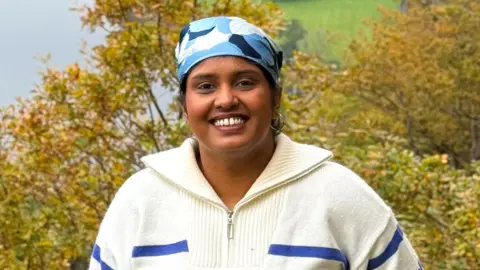 Rafiya Sherin
Two weeks before her diagnosis, Rafiya had been on holiday in Sharm El Sheikh, where she came down with food poisoning.
"I did have food poisoning when I was in Egypt and that is what that was," Rafiya recalled. "But I wasn't getting better when I got home."
She said she was suffering with dizziness, sickness, muscle pain, fatigue and diarrhea.
"I had never been more tired in my life," she said.
"I thought I still had food poisoning and that was what was causing the tiredness."
After going to her GP, then to A&E on another day, and then, later on, also calling an ambulance to her work, she still thought it was the after-effects of the food poisoning.
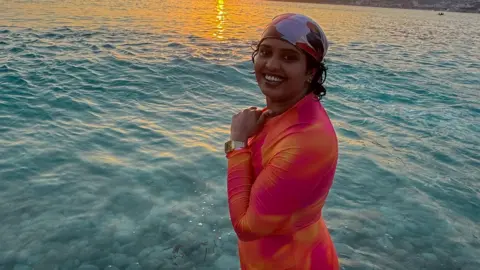 Rayfia Sherin
Eventually, Rafiya had a blood test at her GP surgery and the following morning she was told to go to hospital immediately, where she had an emergency blood transfusion.
Her condition means her bone marrow cannot produce enough new blood cells.
Rafiya said if she had not come down with food poisoning on holiday, she might not yet have found out about her rare and life-threatening condition.
"I'm really sad to know that if I didn't order the blood test, none of this would've been discovered," she said.
"That reality shocks me.
"I'm really glad I didn't neglect my health but I can't imagine where would I be if I could have."
Listen to the best of BBC Radio Lancashire on Sounds and follow BBC Lancashire on Facebook, X and Instagram. You can also send story ideas via Whatsapp to 0808 100 2230.
