How Wimbledon is supplied with iconic strawberries

 Getty Images
Strawberries and cream is a treat synonymous with Wimbledon.
"They're the best, I'm addicted," world number one Aryna Sabalenka told the BBC. "I cannot stop eating them".
But how does the championship keep tennis fans, and the players, in supply?
The BBC followed the berries from farm to fork to find out.
Farmed in Kent
The All England Lawn Tennis Club (AELTC), which runs the Grand Slam event, sources its strawberries from Hugh Lowe Farms in Mereworth, Kent.
The family farm has delivered several tons of fruit to SW19 every year for decades.
"It's probably the most photographed berry on the planet and so we're really conscious of making sure that people get the right iconic treat when they go to Wimbledon," said Amelia McLean, of the fifth generation to work on the farm.
She told the BBC that growing conditions so far in 2026 "meant that everything has ripened up really perfectly" and produce "should have really good quality".
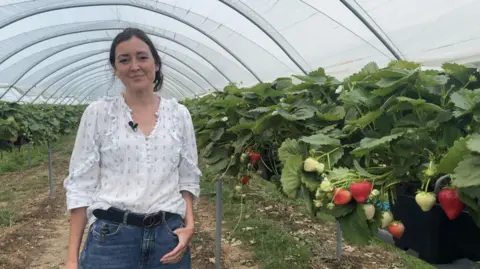
Recent hot weather "presented a few challenges" too but the farm was "pretty resilient and well set up for it", according to McLean.
The consensus among scientists is that human activities are causing climate change, posing serious threats to people and nature.
What was previously a once-every-10-year heat event was now "looking like once every three", she said.
The farm has adapted by installing a new reservoir in 2025 and collects water runoff from its polytunnels to help manage dry spells.
McLean said: "I think all farmers of our kind of crops are really looking at investing in their water storage."
Strawberries are dispatched daily to London throughout the tournament.
Berries arrive at venue
After strawberries arrive at Wimbledon, they have to be distributed around the venue.
Ryan Stanton, Wimbledon's culinary purchasing manager, said his team receives "15 to 16 pallets a day that would come to us early morning".
"As they arrive we would receive them and then basically distribute them around site, mainly to the Strawberry Centre," he told the BBC.
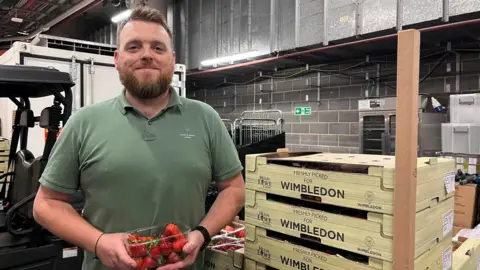
He described the tournament's 24-hour logistics operation as "a labour of love for all of us here".
"A lot of planning goes into what we do," he said.
'Hulled' by hand
Before the strawberries can be sold ready to eat, they need to have their leafy tops removed.
This process, known as hulling, takes place at Strawberry Centre.
Emily Ostrowska started work as a strawberry huller when the tournament got under way on Monday, using a spoon to take off the green and leave as much of the strawberry behind as possible.
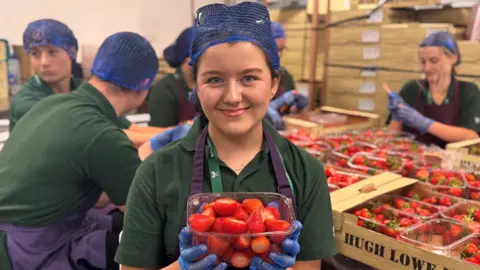
"You've got to maintain flow to keep up with the demand," she said, describing the work as "good fun".
Ostrowska told the BBC she loved strawberries but conceded "maybe after the two weeks" she would start to get a bit sick of them.
After being hulled, the berries are then boxed and distributed to kiosks, ready for tennis fans to enjoy.
 Wimbledon
Follow BBC Kent on Facebook, on X, and on Instagram and listen to BBC Radio Kent on Sounds. Send your story ideas to southeasttoday@bbc.co.uk or WhatsApp us on 08081 002250.
