Burrows denies 'deals done' to block NI minimum criminal age rise

 PA Media
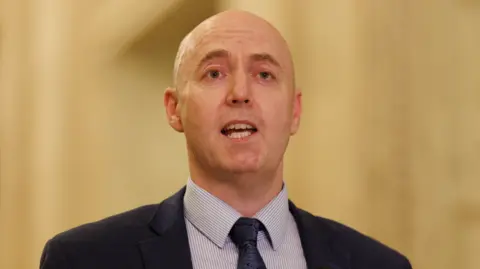
The leader of the Ulster Unionist Party (UUP) has said there were "no deals done" to secure support for blocking proposed laws on the age of criminal responsibility in Northern Ireland.
Jon Burrows said there were "no deals, no threats and no inducements" after he and three UUP colleagues signed a petition of concern tabled by the Democratic Unionist Party (DUP).
The triggering of the veto mechanism means a vote in the Northern Ireland Assembly now requires cross-community support from a majority of unionists and nationalists.
The move has been criticised by other Stormont parties which had backed raising the age that a child could be prosecuted for most crimes from 10 to 14.
Sinn Féin, Alliance and the Social Democratic and Labour Party (SDLP) had proposed the change as part of amendments to the Justice Bill.
The plan included exceptions for serious offences such as murder, where the age would be 12.
A valid petition of concern requires 30 signatures from at least two parties.
Traditional Unionist Voice (TUV) had earlier signed the petition, but it was unclear whether enough UUP assembly members (MLAs) would support the move.
On Monday evening, it was confirmed the petition had passed the threshold after four UUP MLAs signed it - Burrows, Diana Armstrong, Alan Chambers and Robbie Butler.
A 14-day "consideration period" will now be held before any of the amendments around the minimum age of criminal responsibility can be voted on.
Alliance deputy leader Eóin Tennyson challenged Burrows in the chamber, questioning whether he had made a "grubby deal" with the DUP or members of his own party.
In response Burrows described the remarks as a "shameful intervention".
Speaking at Stormont on Tuesday, the UUP leader described the proposed legislation as "ill-conceived" and denied any political deals were made to sign the petition.
"We got the four signatures we needed and the Petition of Concern went through," he told reporters.
"There was no deals, no threats and no inducements."
Burrows also denied suggestions of a deal with the DUP on unionist pacts in forthcoming elections.
"I haven't had a discussion about electoral pacts once. I haven't yet met (DUP leader) Gavin Robinson about electoral pacts, so that is simply untrue."
He added: "I used a legitimate tool to protect the most vulnerable in our society."
'A party decision'
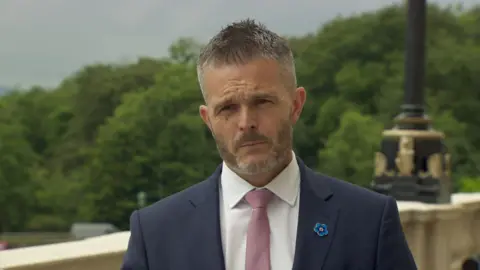
UUP MLA Robbie Butler said there was "nothing untoward" in his party signing the petition of concern.
He said it was a "party decision" following wider discussions on proposals surrounding the minimum age of criminal responsibility.
Butler said they concluded any future change should be considered as standalone legislation, rather than as an amendment to the Justice Bill.
"The conclusion that we came to is we need to do right thing by our children and young people by both perpetrator and victims, and this would be best done through a Youth Justice Bill," he said.
Butler was repeatedly asked by reporters at Stormont whether he had come under any pressure to sign the petition.
"There's pressure in politics and there's widely held views. It was a party decision and I'm a member of the Ulster Unionist Party," he responded.
He later added: "I don't bow to pressure and there was no pressure.
"I mean, there was an assertion made in the chamber yesterday about 'grubby deals' and pressure. There was nothing untoward in the Ulster Unionist Party.
"The Ulster Unionist Party came to a democratic decision in terms of the petition of concern, and that's literally it, guys."
What is a petition of concern?
Introduced as part of the Good Friday Agreement, the measure was designed as a way to safeguard minority rights in Northern Ireland's power-sharing assembly.
If a petition of concern is presented to the assembly Speaker, any motion or amendment will need cross-community support.
In such cases, a vote on proposed legislation will only pass if supported by a weighted majority (60%) of members voting, including at least 40% of each of the nationalist and unionist designations present and voting.
Effectively this means - provided enough MLAs from a particular community agree - that community can exercise a veto over the assembly's decisions.
A notable example of it being used in the past include when a majority of Northern Ireland Assembly members voted in favour of same-sex marriage for the first time, but the motion was blocked after the DUP deployed a petition of concern in 2015.
Over recent years the use of this mechanism has led to concern that it was being used in a way that departs from its intended purpose as a cross-community safeguard.
In light of these concerns, the parties committed in the New Decade, New Approach deal (NDNA) to reduce the use of the petition of concern, and return it to its intended purpose and included a number of reforms.
The NDNA deal introduced a 14-day period of consideration where an MLA can change their mind if they backed a petition of concern.
Also, a petition can only be triggered by members from two or more parties.
What is MACR?
 Getty Images
MACR refers to the minimum age of criminal responsibility.
This is the youngest age at which a person can be arrested and charged with committing a crime.
Ten is one of the lowest ages anywhere in the world.
Like Northern Ireland, it is also 10 in England and Wales.
In Scotland it is 12 - the same as in the Republic of Ireland - but provision has been made for exceptional cases, with criminal responsibility for the most serious offences being set at 10.
The UN body which monitors the UN Convention on the Rights of the Child has urged countries to raise their MACRs to at least 14.
In 2023, the Department of Justice found there was "strong support" for raising the age from 10 to 14.
Previous efforts to examine the legislation failed to attract sufficient political support.
