Is the UK finally waking up to the power of video games?

 Getty Images
The Bafta Games Awards take place later, celebrating the achievements of global video game developers and British studios alike.
This year smash-hit role-playing game Clair Obscur: Expedition 33 looks set to sweep the board with 12 nominations in total.
Made in France, the game's developers, Sandfall Interactive, have twice been publicly praised by President Emmanuel Macron, and even honoured by the country's Ministry of Culture.
But do video games get the same recognition in the UK?
Hugely popular series including Grand Theft Auto, Tomb Raider, Lego: Star Wars and Football Manager were made in Britain.
Some in the industry would argue that, despite their cultural and economic contributions, games aren't placed on the same pedestal as other creative sectors.
So could that be starting to change?
According to industry body UK Interactive Entertainment (UKIE), Britain's video game industry was worth £8.76bn in 2025- an increase of 7.4% on the year before.
They said this was made up of spending on:
- Software - £6.03bn, a 7% increase
- Game hardware (consoles, accessories) - £2.17bn, a 3% increase
- "Game culture" (video games-related film and TV) - £566m, a 42% increase
- Toys and merchandise - £333m, a 43% increase
At the same time, the global video games industry has endured one of its biggest periods of uncertainty in recent years with thousands of developers losing jobs and studios closing.
 Getty Images
Alanah Pearce, who's worked as a video game writer, actress and journalist since starting her career in the industry in 2012, tells BBC News it's a "frustrating" situation.
While the industry is still "incredibly profitable", she says, it is struggling to attract investment in the same way it used to, especially with artificial intelligence (AI) swallowing up huge amounts of cash.
"Most of the investors who are propping up the games industry have frankly fled to AI to a tremendous degree," says Pearce.
"So because that's happened for a lot of our publicly traded companies, they're just very nervous to make anything that isn't almost guaranteed profit, which is very difficult.
"How do you even guarantee profit in this day and age?"
Video game companies large and small are facing increased competition for people's attention, from social media platforms such as TikTok, AI apps and an ever-growing number of competing games being published.
"As a result of that," says Pearce, "All the bigger companies, but it goes the whole way down to indies as well, just got scared and thus have been funding things a lot less, unfortunately."
 Electronic Arts
The UK games industry has also been hit by a lack of investment, with industry body TIGA recently warning it had seen a "record downturn" in employment and a "collapse" in the number of start-up companies.
This week as part of the London Games Festival the government announced more details about a £28.5m games fund to support video game studios, with grants of £20,000 for new companies and up to £250,000 for those looking to expand.
Creative industries minster Ian Murray said the value of video games to the British economy "has been overlooked" for too long, and the government had "thrown its full support behind the sector".
It's part of the Creative Industries Sector Plan, which will also offer £75m of grants for TV and film productions, plus up to £30m for "emerging UK music artists".
Developer Adam Riches, from indie studio Robust Games, told BBC News the different levels of funding could be good news for companies like his.
It has so far published one game, the IGF award-nominated point-and-click murder mystery adventure Loco Motive.
"As indie developers, we're used to working with smaller budgets, so the newly proposed grants look really generous from our perspective," he says.
"This feels like a good fit for our team, so we'll definitely be looking into the finer details."
Journalist Christopher Dring, editor of The Game Business, tells BBC News the funding is "a strong statement from the government that it is taking video games seriously as an economic and cultural force".
But he says it still didn't quite match support for other industries.
Dring says that, while many major series are developed wholly or partially by British studios, many of them are owned by global companies such as Microsoft.
Following Expedition 33's success, Dring says: "The drive is to see more home-grown IP flourish on the international stage."
And the UK does have smaller, sustainable studios that punch above their weight.
 Sega
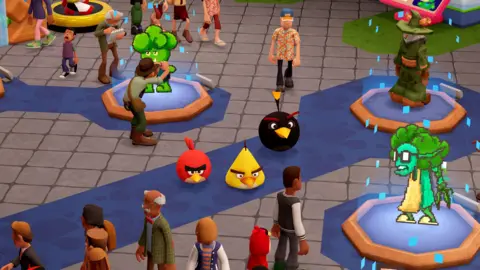
SegaTwo Point Studios, based in Farnham in Surrey, was founded in 2016 by veterans from legendary UK studios Bullfrog and Lionhead.
Its comedic simulation games, which put players in charge of managing hospitals and university campuses, found a dedicated audience thanks to their British humour, unique visuals and ease of play.
"We wanted to be in that more niche space and and do really good games that aren't necessarily trying to be a household name," director and co-founder Gary Carr tells BBC Newsbeat.
The studio's latest game, Two Point Museum, earned a nomination in the British game and family game categories at this year's Baftas.
It's also had commercial success too, and allowed the studio to grow to about 50 employees - a modestly sized developer.
"We haven't tried to blow the company up because we've had some successes," says Carr.
"We've kind of wanted to stay a very bijou, boutique studio. We're not too big, we're quite keen to stay a sensible size where everyone can feel like they're involved."
Carr also believes the UK industry is "resilient" and supportive of others working within it - a sentiment shared by Two Point design director Ben Huskins.
The studio is down the road from Guildford, one of the UK's major game development hubs and home to multiple studios.
"There's so many," says Huskins.
"We all have worked together at some point in our careers, so we look after each other and we look out for each other."
Huskins says game development is now more accessible than ever, which creates more competition but can also mean "amazing games" come out.
"I think it's fairer that everyone's got a crack of the whip," he says.
Carr says there has been a tendency to "wave the banner of success" when things are going well in the industry, but it's important for support to be there when things aren't so good.
"I definitely don't like to see game studios struggle when we are such an important part of what Britain does well," he says.

