Tree which survived WW2 plane crash up for award

 James Reader/Woodland Trust
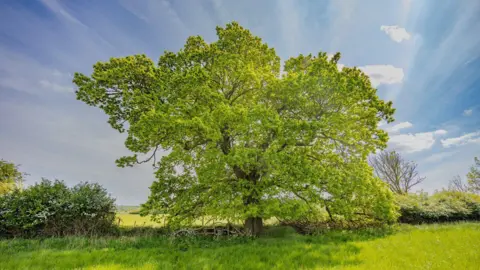
Ten of the UK's "toughest" trees, from an oak that survived a plane crash to a yew hit by a cannonball, have been shortlisted for this year's Tree of the Year award.
The Woodland Trust said its annual competition aimed to celebrate and raise awareness for rare, ancient or at-risk trees across the country.
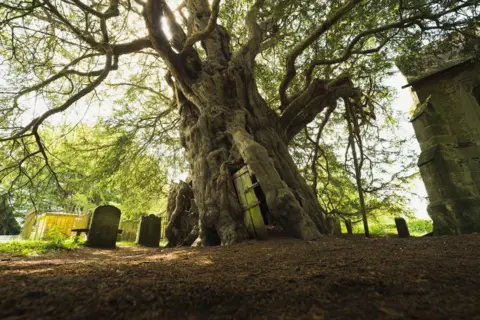
An oak tree in Rutland that was hit by a World War Two bomber - and a yew in Surrey which could be 4,000 years old and was struck by a cannonball in the English Civil War - are among the final 10 contenders for the title.
Actor and nature podcaster David Oakes, a Woodland Trust ambassador, said the nominees had "defied the odds in extraordinary ways".
Of the 10 shortlisted, a panel of experts selected eight trees of differing ages and species, while the public chose two as wildcard entries.
The public can vote for their favourite tree until late September via the Woodland Trust website, and the winner will be announced in early October - before progressing to represent the UK in the European Tree of the Year finals.
 Lee Cooper/Woodland Trust
The aptly named "Bomber Oak" in Rutland features a slight dip in the top of the canopy as well as twisted misshapen branches after it was hit by a Lancaster Bomber during World War Two.
The tree was also nearly lost some decades later when a water company sought to install pipes in a field.
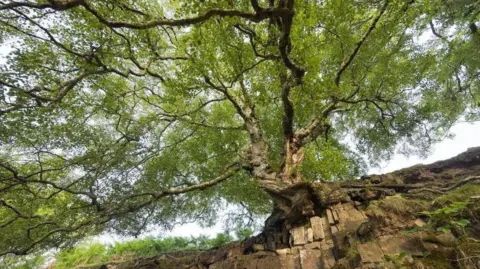
The Bollihope Burn Birch in County Durham has also been nominated. It is perched "precariously off a cliff" in an area once dominated by industry, including quarries, lime kilns, mines and a goods railway.
Another shortlisted tree - the Crowhurst Yew in Surrey - survived a direct hit from a Civil War cannonball that villagers later discovered in 1820.
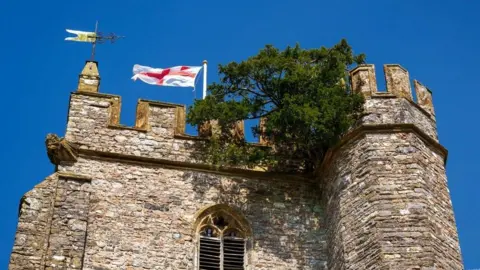
A different plucky yew in Devon is up for contention because of its location at the top of a church tower overlooking Culmstock Village, where it has been for some 200 years.
 Lee Cooper/Woodland Trust
Another nominee, the "Preston Twin" in Brighton - is said to be the world's oldest English elm and has lived four centuries despite the threat of Dutch elm disease, which killed another specimen of the same age that stood nearby.
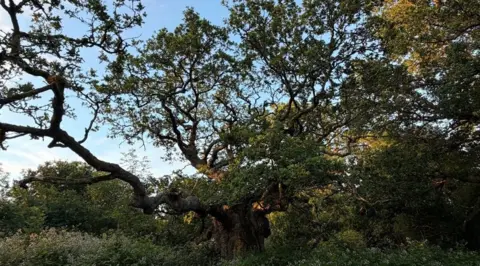
A wildcard selection for the list is the Donnington Oak, in West Berkshire, which stands between a small patch of forest and the ruined walls of Donnington Castle.
The Woodland Trust said it was a young established tree during the English Civil War and survived unscathed during the castle's gruelling siege and bombardment.
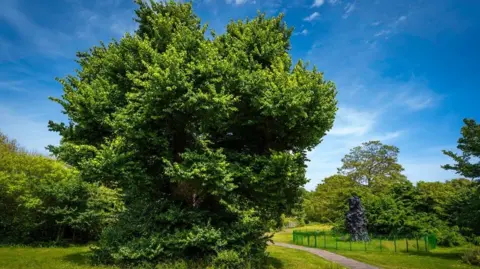
Another wildcard selected by the public is the Balloch Castle ash, which stands on the lawn of the semi-derelict castle by Loch Lomond and is more than 150 years old.
The trust said it had experienced a lightning strike, multiple storms, ash dieback, footfall from millions of visitors - and an Oasis concert.
 James Reader/Woodland Trust
The "Bendy Tree" in Newcastle, Northern Ireland - a much-loved wych elm along the town's seaside promenade that grows almost horizontally after withstanding more than a century of the harsh coastal conditions - has also been nominated.
Another nominee includes an oak, which stands alone in the Ynys-hir nature reserve in mid-Wales overlooking the Dyfi estuary, the Cambrian Mountains.
The "Earlstoun Lightning Oak" in Dumfries and Galloway made the list, not only for its stature but for surviving a lightning strike.
 Lee Cooper/Woodland Trust
Oakes added: "Most things survive by fleeing... a tree, rooted for life to a single patch of ground, doesn't get that option.
"So trees have perfected the opposite: the art of weathering whatever arrives. But a few are frankly show-offs.
"The 10 nominees for Tree of the Year have all defied the odds in extraordinary ways, from clinging to cliffs and church towers, to enduring collisions and cannonballs."
May Chemais, who runs the Ancient Tree Inventory at the Woodland Trust, said: "Trees can be both tough and flexible, as the shortlist proves.
"We hope people will enjoy discovering all the incredible stories of resilience behind our nominees this year."
 Jade Palmer/Woodland Trust
Listen to BBC Radio Leicester on Sounds and follow BBC Leicester on Facebook, on X, or on Instagram. Send your story ideas to eastmidsnews@bbc.co.uk or via WhatsApp on 0808 100 2210.
