Starmer wants to act tough to fix long-term problems - but is he avoiding the trickiest?

 BBC
BBCThe clock on the mantelpiece in the Cabinet Room ticks surprisingly loudly, marking every half-second. The moment prime ministers take their seat in the captain’s chair, time is running out.
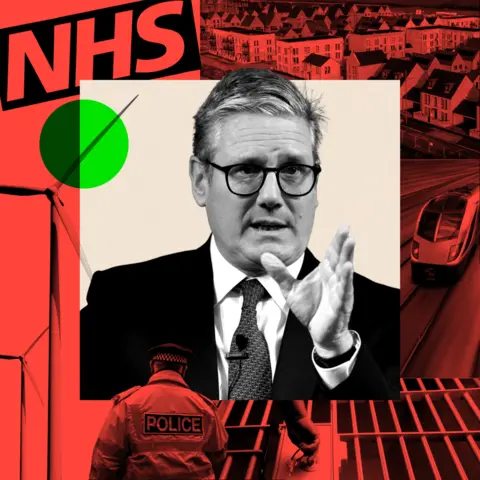
Sir Keir Starmer wants you to believe he’s brave enough - and determined enough - to stare down the country’s long-term problems. Even if it means saying what was previously unsayable.
To have clean energy, more people will have to put up with pylons near their homes. To have more houses built, more of us will have to accept developments in the neighbourhood. His decision to take cash to help with fuel bills away from most pensioners fits into that category too.
For years, many politicians privately thought it was daft to give wealthy pensioners extra cash for their fuel bills - but it’s Sir Keir who’s now said that out loud.
He says he wants to crack down on the UK’s problems, and has a whopping majority to boot. But no government can do everything all at once.
Over the years I’ve heard the same list of “unsayables” from senior officials and politicians time and time again - issues that need fixing in the UK but aren’t ever confronted.
So what would insiders - both current and former - put on their list of issues that are still unsayable for this new government?
When it comes to health, in almost the same breath as promising to overhaul the NHS, Sir Keir says that fixing the care of the most vulnerable and elderly - the most difficult thing - will have to wait.
It was the Tories’ plan to cap social care costs, and Labour were going to stick to it. They’ve now ditched it.
Many politicians accept privately that you don’t have much hope of sorting out the NHS properly if you haven’t made major moves to improve the social care system.
Successive governments have dangled, then dropped reform. It’s no one party’s fault. It’s no one politician’s fault.
But with an ageing population and many years of pressure on public spending the problem has only become more acute. Labour has nodded sagely at the urgency of the issue. But a fundamental overhaul is on pause for now.

Sign up for the Off Air with Laura K newsletter to get Laura Kuenssberg's expert insight and insider stories every week, emailed directly to you.

Another issue affecting the older generation comes up often too: the triple lock. It’s the guarantee that the state pension goes up each year by either 2.5%, inflation, or earnings growth - whichever is the highest figure.
“It’s not at all good for the country, but it is good politics,” a very senior opposition politician told me, even giggling at how wrong-headed it was in their view.
Labour had little political choice in the election but to commit to it too.
You’ll have heard Sir Keir saying repeatedly in the last few days that the winter fuel allowance cut will be offset because the triple lock, introduced by the Tories, is still in place.
You can see the political appeal to always protecting pensioners’ incomes, as one former official said, but it “bakes in rising spending with an ageing population, so, unless you suddenly get brave about tax, you have no answer.”
In other words, as there are more and more pensioners, more and more people will be guaranteed a certain hike in their income from the taxpayer.
Whether you think that’s right and proper or think, like many politicians, that it is asking for trouble, it comes with a hefty price tag that’s only growing.
Multiple sources also mentioned the serious quandary over university fees and numbers.
Millions more young people have gone to university in recent decades. For many of them, and many families, it’s been life-changing.
But it’s no secret that many institutions are struggling for cash, some even said to be on the verge of going under.
No politician would want to tell a family or a young person that they shouldn’t be allowed to attend. But as one former senior official put it bluntly, “fees need to go up or they need to find alternative money.“
Another Whitehall figure suggested the question politicians aren’t willing to ask is: should so many people go?
Though “vote for us, and we won’t help you get to university” won't be on any leaflets any time soon.
 Getty Images
Then, there is tax.
I’ve encountered a whole range of views on whether it’s fair to tax wealth and income so differently. Does the business tax system still work? (Not really, it’s claimed.) Shouldn’t it all be much simpler anyway? (Probably, most say.)
But also, what no politician wants to say out loud in public - but many in Westminster regularly say in private - is how wildly out of date the council tax system is, based as it is on property values from 1991.
You read that right. The size of your council tax bill, in England and Scotland, is based on what your flat or house was worth 33 years ago.
You don’t need me to tell you that property values have changed an awful lot since then, and not in a uniform way. The independent Institute for Fiscal Studies says it means the tax is “out of date, regressive, and distorted”, creating unfairness between households, and councils too.
There is no appetite in government to take a big look at the system. New Labour had a go, then backed away from any major changes.
One source claimed it was “wonkish” to believe reform was a priority, and it wouldn’t necessarily raise any extra cash that might be useful for the Treasury coffers.
But many sources reckon a revaluation is incredibly overdue, and has to take place.
There’s another whole list of anomalies in the status quo, that governments would never design now if you started with a blank page. But they haven’t got the bandwidth or desire to sort them out.
Fourty-three different police forces in England and Wales? “It’s mad,” says one insider. A maze of different types of local government – “baffling”, says another.
Then there are absolutely toxic political questions that most hardly even dare to whisper. Insiders wonder, can the model of the NHS survive for ever with an ageing population? Is it the right thing to subsidise the steel industry while it staggers on?
There are clear consequences of ignoring an unsayable.
For years, politicians didn’t want to say out loud that if you locked up more people (popular), you would also have to build more prisons (unpopular), or they would burst.
Now, the new government has been pushed to do something unpalatable - early releases on a big scale - because the unsayable went unsaid.
How far ministers will now go in being honest about any longer-term solutions for prisons? Watch this space.
This government believes that focusing on short-term politics - which create new long-term problems - is “unforgiveable”. And it seems that genuinely, ministers want to get to grips with problems that have been building up in the country for many, many years.
Yet, there is of course a limit to what they can do.
One senior figure acknowledged, “an enormous majority gives a massive advantage which is political stability – that means you can do difficult things.”
But addressing many of those long term problems is hard without a willingness or ability to spend a lot more cash, or take money away from other parts of the state.
It’s “much easier when you have the money of Thatcher 1983-87 and Blair 2001-2007”, one former official suggests.
When public finances are in trouble, they continue, “maybe it’s the right call to try to get growth first”, rather than ending up with more stubborn problems in a second term.
They remark acidly: "In a post-ideological age, no governments want to tackle these issues. The last one had 14 years to do so and didn’t."
But if we are to believe this government’s proclamations that they really want to pursue long-term solutions for the country’s ills, perhaps more of the unsayables will need to be said out loud.
Sir Keir Starmer is making the case that ignoring problems in the long term is part of the reason for what has gone wrong.
But when he vowed to do the “difficult things now”, the reality for any prime minister is that the list of difficult things can never be complete.
BBC InDepth is the new home on the website and app for the best analysis and expertise from our top journalists. Under a distinctive new brand, we’ll bring you fresh perspectives that challenge assumptions, and deep reporting on the biggest issues to help you make sense of a complex world. And we’ll be showcasing thought-provoking content from across BBC Sounds and iPlayer too. We’re starting small but thinking big, and we want to know what you think - you can send us your feedback by clicking on the button below.
