Renewable energy hub planned for Scottish coal museum

 National Mining Museum Scotland
A former 19th Century coal mining 'super-pit' in Midlothian is to be turned into a renewable energy hub providing green electricity for the local community.
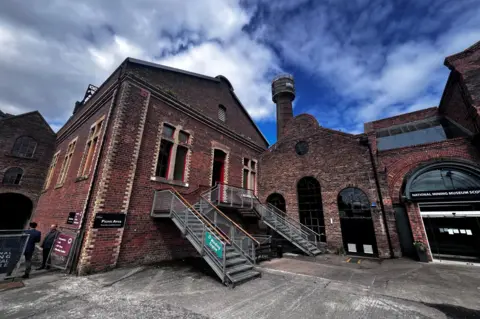
The Lady Victoria Colliery at Newtongrange, which closed in the 1980s after almost 90 years of operation, has since been preserved as Scotland's national mining museum.
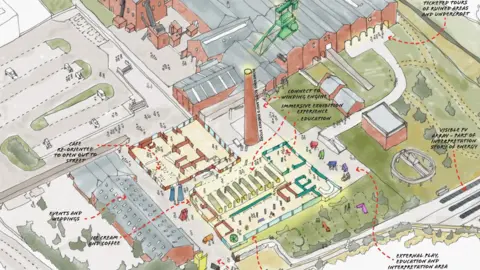
The attraction has unveiled plans to install solar panels on the roofs of colliery buildings as well as housing a battery and electric vehicle charging.
The charity is now beginning a fund raising campaign to help pay for the transformation.
 National Mining Museum Scotland
Once operational, the hub will cut energy bills and provide a revenue stream to help secure the museum's future
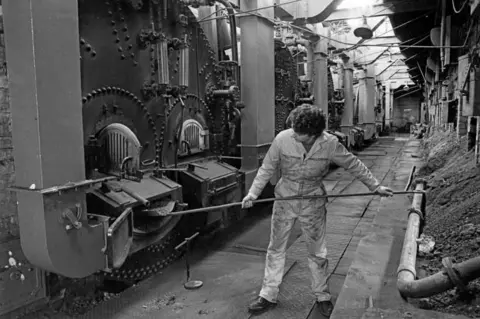
Marion Brown, 90, who worked at the colliery as a teenager in the 1950s says it's an important way of keeping alive the memory of those people who worked and sometimes died at the pits.
She said: "I'm glad [the museum] is being kept because history is a good thing. You've got to find out what happened in the past to get onto the future, to make it better."
The pit, which opened in 1895, has been described as one of the best preserved Victorian-era colliery sites in Europe.

It closed in 1981 before the surface site was turned into a museum piece three years later.
But the roofs of several grade A-listed buildings are in a poor state of repair and need to be replaced and so the opportunity is being taken to add the solar-PV panels.
Other solar panels will be installed on disused ground around the site.
Robin Patel, the museum's development officer, says that while coal powered the industrial revolution, which is charted in the exhibitions, renewable energy creates a new phase to its story.
"There's a huge opportunity here to make use of the heritage, the assets that we've got here, to generate our own power again.
"Not only does it enable us to better look after and care for the heritage here, but it allows a net benefit for the production of green energy which then goes back into the grid."
 National Mining Museum Scotland
The solar panels are expected to generate around 100 kilowatts of electricity which is enough to power the site with any excess being exported.
They will be installed alongside a large lithium-ion battery, around the size of a small shipping container, which will allow the bulk of the power to be stored and used locally.
The battery will allow electric vehicle chargers to provide super-rapid as well as cheaper slow charging for people living in former pit houses nearby which don't have driveways.
Dr Brenda Park from StorTera said: "Grid constraints are a real challenge for a development like this, these days. For example, we got a quote for a four megawatt grid connection here and it wouldn't be ready until 2040 and cost millions of pounds.
"So, in this situation, a battery allows you to optimise the grid connection you can get by putting the large power items, like the solar arrays, ultra rapid EV chargers, behind the battery."
The renewable energy hub is being created as part of a wider programme of investment on the site.
It includes plans to bring back into use the once steam-powered winding engine which has not been used for the past six years.
It first operated in 1894 and was used to raise and lower workers, equipment and coal from the surface to the seam below.
The project will be used to train engineering students in mechanical skills which experts say are disappearing fast.
Joanna John from design engineers Max Fordham said installing solar panels on historic structures is not an easy undertaking.
She added: "On older buildings there might be materials that need to be dealt with appropriately or you might need a structural engineer involved to help ascertain whether that roof structure can hold the weight of the solar panels."
Because of the complexity involved, the most immediate priority will be to build the ground mounted solar-array first with the rooftop panels coming at a later stage.
The museum needs to raise £450,000 to allow the work to go ahead and has launched a crowd-funding appeal.
