How insect brains could spark next AI revolution

 Getty Images
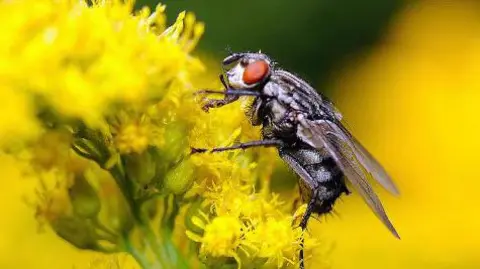
The "lightning fast" reactions of fruit flies and other insects could "revolutionise" artificial intelligence (AI) systems such as self-driving cars, according to experts.
Academics at the University of Sheffield who studied flies' brains and eyes have discovered a "turbo boost" feature, known as high-frequency jumping, which allows insects to react with remarkable speed and precision.
The mechanism could make robots and self-driving cars smarter and more energy efficient by using movement to gather information instead of relying on computers.
Prof Mikko Juusola of the School of Biosciences said: "Our findings reveal a fundamentally new way of thinking about how brains compute information."
The University of Sheffield research shows that house flies and fruit flies do not process visual information passively, as previously believed.
Rather than simply watching the world, insects twitch their bodies in sync with what they see.
Experts say these tiny, jerky movements, such as rapid movements of the eyes called saccades, help their brains receive clearer, faster information about the world around them.
'Extraordinary speeds'
The study, published in Nature Communications, found that when an insect makes a sharp turn, its brain "jumps" into a higher gear, said Juusola, which allows it to focus on the most important, fast-moving information.
This mechanism enables insects to overcome physical and neural constraints that would otherwise limit their perception and supports behaviours such as high-speed flight and predator avoidance.
Juusola, who is the senior author of the study, said: "We've demonstrated how even the smallest brains can solve complex problems at extraordinary speeds."
Future AI systems - particularly those used in robotics, autonomous vehicles and real-time decision-making - could be revolutionised by adopting similar principles of movement-driven, adaptive information processing, said Dr Jouni Takalo.
Takalo, who led the development of the biophysically realistic statistical model underlying the work, said: "The findings challenge traditional models of neural processing, which assume that information flows through fixed pathways with built-in delays.
"Instead, the results support a new framework where sight is a collective effort between an insect's movement, its visual input and its brain's response."
Listen to highlights from South Yorkshire on BBC Sounds, catch up with the latest episode of Look North
