Police chief addresses two-tier policing concerns

 BBC
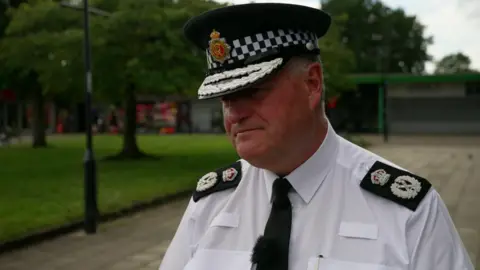
BBCMore work needs to be done to overturn the perception held by some that so-called "two-tier policing" is in operation, a police chief has said.
Greater Manchester Police (GMP) Chief Constable Sir Stephen Watson was speaking to BBC North West in the aftermath of the murder of 18-year-old student Henry Nowak and questions over how police treated him in his final moments.
The murder of Henry Nowak and subsequent police response have prompted accusations of what some have labelled two-tier policing.
Sir Stephen said he did not believe the perception of two-tier policing was justified in the case of GMP "but I recognise we need to work hard to overturn it".
"If you ask for my honest opinion, is there two-tier policing in Manchester, I will say to you absolutely not," said Sir Stephen.
Two-tier policing is a term used to describe the idea that some groups of people, or some behaviour (for example protests and demonstrations) are dealt with more harshly, more robustly, than others by law enforcement.
Sir Stephen said GMP "deals with people equally before the law", adding that he believed the operational reality was closer to what people were calling for than they perceived.
But he added that "I think, to an extent, we have to acknowledge that the public perceive there to be two-tier policing".
"And whether that be historically people from minority communities or in the aftermath of the tragic Henry Novak case, I think people perceive it now from different quarters and across the board."
He said this meant GMP needed to double down on the message that the force treated everybody fairly, "but without fear or favour".
He added: "Everybody is equal before the law and I do think there is something for wider policing to understand that we have, more assiduously, to stamp our mark on what impartiality looks like.
"I think we have, from time to time, strayed into difficult and contentious areas.
"We've uncritically adopted language that persuades people that perhaps we are not as impartial as we should be and so, in a sense, I see the perception.
"I don't think the perception is justified in the case of GMP but I recognise we need to work hard to overturn it."
 PA Media
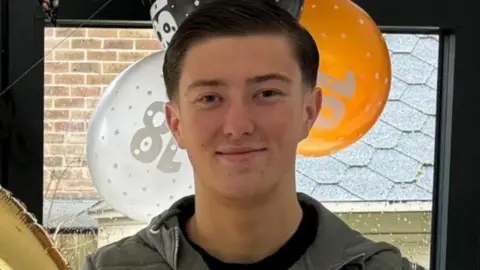
Henry Nowak was fatally stabbed with a large knife in Southampton in December by 23-year-old Vickrum Digwa who said he carried blade on grounds of his Sikh faith. He lied to police at the scene, falsely claiming he had been racially abused and had acted in self-defence. Nowak was arrested by officers as he lay dying.
Digwa was jailed for life with a minimum 21-year term on 1 June, while the Independent Office for Police Conduct's (IOPC) is investigating the response of officers.
There has been particular scrutiny of a National Police Chiefs' Council (NPCC) anti-racism commitment, which states that ensuring racial equality in policing "does not mean treating everyone 'the same' or being 'colour blind'".
The NPCC said it was reviewing the wording after opposition politicians pointed to it as evidence of unequal standards in policing.
 PA Media
Sir Stephen also discussed a review of the historical handling of child sexual exploitation cases by GMP, which found the force had made significant improvements after a series of damning reports into its handling of allegations.
The report into grooming gangs and child sexual exploitation issued by His Majesty's Inspectorate of Constabulary and Fire & Rescue Services (HMICFRS) in 2025 listed 265 live known cases of grooming, and Sir Stephen said the figure was similar today.
Only one person has been convicted as part of Operation Green Jacket, which was launched seven years ago to investigate child sexual exploitation in south Manchester in the early 2000s.
The HMICFRS review was commissioned in 2024 by the then Greater Manchester mayor Andy Burnham to look at the "current and ongoing provision".
'Slow burn investigations'
Speaking five years after he took up his role heading up GMP, Sir Stephen said the force bore the scars "of having failed victims in the past and these dreadful experiences that people were subject to".
He said investigations such as Operation Green Jacket were "slow burn investigations" which very often related to events sometimes going back 20 years, adding that they could only proceed "at a speed at which the victim is comfortable".
Sir Stephen said the HMICFRS report showed that the contemporary practice of GMP, along with its partners, was "at least as good as anywhere else in the country".
He added that on looking at the force's historical investigations in Oldham, Rochdale and Manchester, "you will see now there is a veritable queue of people who are going through the court system".
GMP had achieved "very long sentences for a very great number of people" with many still coming up before the courts, he said.
"I'm sure that justice will be brought to them too and that is really important because, in a sense, we have learned the lessons of the past.
"But our principle objective is to make sure that children today are never subject to the same offending as happened in yesteryear, because that was a shameful episode in our history and in our country's history and it's not something that we intend to repeat," he added.
Listen to the best of BBC Radio Manchester on Sounds and follow BBC Manchester on Facebook, X, and Instagram. You can also send story ideas via Whatsapp to 0808 100 2230.
