'Something wasn't right': Wrong sperm given to UK families by IVF clinics in northern Cyprus

 Keith Bridle / BBC
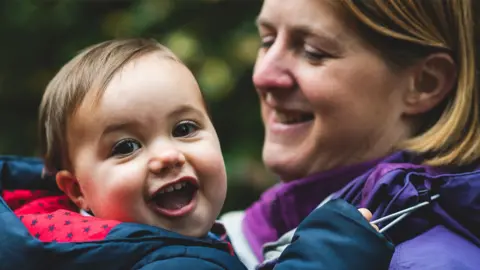
"It was pretty soon after James was born that I knew something wasn't right," says Laura.
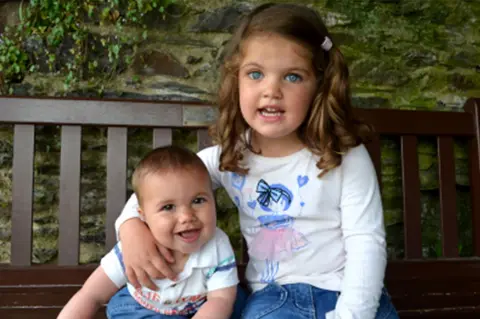
She and her partner, Beth, have two children - James, and their eldest Kate - both conceived through IVF treatment at a clinic in Turkish-occupied northern Cyprus.
The two women used their own eggs and carefully chose one anonymous, healthy sperm donor. They told the clinic which ordered the sperm for them that it was important the same donor was used for both babies - so their children would be biologically related.
But when James was born, they both noticed that his "beautiful" brown eyes were very different to those of his biological mum, Beth, and the sperm donor the family had requested. It sparked a flame of doubt in his parents' minds: "Had our clinic made a mistake?"
After nearly a decade of worrying, Beth and Laura decided their children should take a DNA test. The results indicated neither child was related to the sperm donor their parents had selected. What is more, the evidence suggested the children were not even related to each other.
The two women had received sperm from two different donors.
"The feeling of dread was knowing something had gone very much amiss, and what was that going to mean for the children?" Beth says.
 Family supplied
BBC News has spoken to the families of seven children in total who believe the wrong sperm or egg donors were used during IVF treatment. Most of these families have done commercial DNA tests which appear to confirm their fears.
All the cases are linked to clinics in northern Cyprus - a territory where European Union laws do not apply and which is only legally recognised by Turkey.
Northern Cyprus has become one of the most popular destinations for British people seeking fertility treatment abroad, say experts. Clinics are loosely regulated and promise low prices and high success rates.
- Have you been affected by the issues raised in this story? Contact the BBC at: fertilityinvestigation@bbc.co.uk
They boast a vast array of anonymous egg and sperm donors from around the world, making them particularly appealing to people with fertility issues, those from the LGBT community or single adults who might not be able to access such choice in their own countries.
There are lots of videos and photos on social media of hopeful parents sharing their positive experiences.
Northern Cyprus clinics also offer procedures which are illegal in the UK, such as sex selection for non-medical reasons. The territory's Ministry of Health oversees its fertility clinics but has not responded to our findings despite repeated requests.
'We thought we had ordered sperm from Denmark'
Building trust with all the families in this investigation took many months. We worked closely with Beth, Laura, Kate and James to ensure they were ready to share their story.
Beth and Laura told us they had decided to start a family in 2011.
They chose Dogus IVF Centre in northern Cyprus. The patient coordinator there at the time, Julie Hodson, told them the clinic could import frozen sperm from the world's largest sperm bank, Cryos International, in Denmark.
The couple were impressed, they say, by the range of anonymous donors who had undergone "comprehensive health screenings" and psychological examinations.
They were attracted to the profile of a donor referred to as "Finn" - a Dane who described himself as a fit and healthy person who rarely drank and never smoked.
In a handwritten note that they saw, Finn said his motivation for donating sperm was to "bring life and happiness to others".
Beth and Laura hoped the detailed profile would bring their future children comfort as they grew up. "We felt it was really important that our children had some sense of who their donor was, because that's half of who they are," says Beth.
Finn and his Danish relatives had similar physical characteristics to the UK couple - light eyes and brown hair, an extended family tree showed.
"We asked our patient coordinator, Julie, what we needed to do in terms of ordering Finn's sperm," remembers Laura. "And she said: 'Dr Firdevs will order it for you.' That was it."
The couple say their IVF treatment at Dogus was carried out by Dr Firdevs Uguz Tip - they describe her and her team as "nice and friendly".
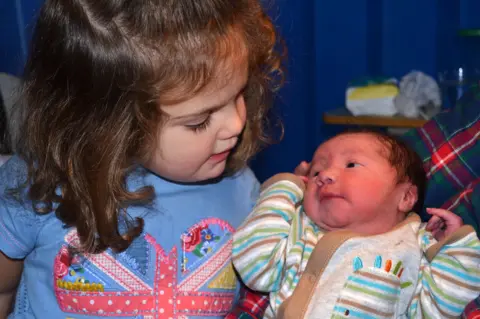
Nine months later, Laura gave birth to their first child, Kate.
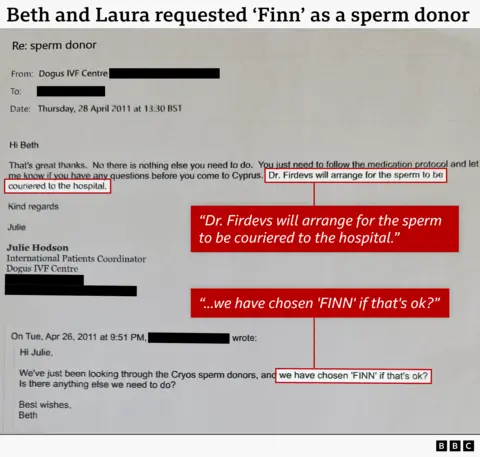
When the couple wanted a second child, they went back to the same IVF team and asked if they could use donor Finn again. Hodson confirmed via email that Firdevs would reorder the sperm.
This time, Beth went on to give birth to James.
The couple's fertility treatment in northern Cyprus, including medication, hotels and flights, cost an estimated £16,000 in total - with Finn's sperm costing £2,000.
Beth and Laura say, from an early age, they were open with their children about the man they thought had been the donor. "Both of them would describe themselves as 'half-Danish'," says Laura.
But James's dark eyes, dark hair and olive skin made his parents suspicious that his donor hadn't been Finn - and, after years of deliberating, Beth and Laura decided both children should do a DNA test.
Neither child had been conceived with Finn's sperm the results suggested. They also indicated the children came from different sperm donors and were not biologically related to each other.
The test results left the parents "absolutely livid" and with many unanswered questions. Who were the donors and what, if any, screening had been done for health checks?
"We went from having this nice profile of donor Finn and feeling like we knew the family history and the health history, to just nothing," says Beth.
Beth and Laura tried contacting Firdevs and Hodson but neither responded.
The BBC has spent months trying to establish what happened with Beth and Laura.
During our investigation, we found two other British families who had been treated by Firdevs and were also suspicious the wrong donors had been used during their IVF treatments.
They too have completed commercial DNA tests which indicate their suspicions were correct.
Beth and Laura question whether their clinic even ordered donor Finn's sperm.
When we contacted Firdevs she said she had not been responsible for ordering sperm at Dogus and said no information about the request for donor Finn had been passed on to her.
She also cast doubt on the reliability of Beth and Laura's commercial DNA test. It is not possible to conclude "with certainty" that the wrong donor was used, she says.
Firdevs has also told the BBC she "did not perform IVF treatment" between 2011 and 2014, when Beth and Laura were patients, despite there having been detailed descriptions on Dogus's own website of procedures that she offered during that time.
Dogus clinic, which Firdevs says was responsible for Beth and Laura's treatment, has not responded to our request for comment.
By 2015, Firdevs and Hodson had left Dogus and were working together at another clinic in northern Cyprus.
Hodson, who no longer works in the territory, has not replied to the BBC's questions about whether she passed on the sperm order to Firdevs.
Beth, Laura and the children have now done further, accredited DNA tests which can be used in British courts. These have confirmed James and Kate are not biologically related and were not conceived from the same sperm donor.
Prof Denise Syndercombe Court, a leading forensic genetics expert who has analysed all the family's tests, told us it is unlikely that either child is biologically related to donor Finn.
We spoke to Cryos International, the sperm bank in Denmark from where Beth and Laura, as well one other family in our investigation, believed sperm had been ordered.
"We have many security processes, but it will never give you 100%. It's human," says Ole Schou, the company's CEO. However, such an error has never been recorded in Cryos's 45-year history, he adds.
A wide range of fertility specialists from across Europe told the BBC the possibility of an incorrect donor accidentally being used once during an IVF procedure was rare.
However, for an error of this magnitude to happen more than once involving the same medical team could suggest "negligence" or even "deception", our experts concluded.
"It's an absolutely appalling position for patients to be in," says Dr Ippokratis Sarris from the British Fertility Society after viewing the findings. "I've never heard of an incident like this in the UK. It is the biggest fear of any IVF unit to mix up an egg or sperm or embryo."
Northern Cyprus has its own fertility laws but, unlike the UK, it does not have an independent fertility regulator to monitor clinics, uphold standards and, if necessary, revoke licenses.
Lawyer and activist Mine Atli, who lives there says: "Clinics who abide by the law do it because the owners have a good conscience. It's not something that they are forced to do by the state."
Regulation is expensive, which can make treatment more expensive in countries like the UK. Sarris from the British Fertility Society says that is one reason why he suspects northern Cyprus has become such a popular destination for fertility treatment.
We also heard concerns about the mental health of people who might find out their donors were not who they believed them to be.
Such a revelation could have a "significant impact" on them, says Nina Barnsley from the UK charity, the Donor Conception Network.
'I don't want to lie to my child'
The BBC has spoken to two other British families who were treated by Firdevs more recently than Beth and Laura, and who believe that they too were given the wrong donors.
They didn't want to be identified, but they were patients at Miracle IVF Centre, which Firdevs set up in 2019.
Both families needed egg donors to create their children - and suspected the eggs they received were not the ones they had selected. DNA tests taken since appear to confirm their fears.
"I don't want people to think that I need to have a baby that looks like me, that's not what this is about," says one of the women who we are calling Kathryn. "I don't want to lie to them about where they come from."
When we told Firdevs that these two families had felt misled, she told us the choice of the egg donors had been "made exclusively" by Miracle IVF Centre.
She also said her clinic does not provide patients with egg donor profiles which describe a "specific person" and that it never gives a guarantee about a donor's ethnicity.
According to Firdevs, this information had been laid out in the consent forms which all patients signed before treatment and had been "communicated openly".
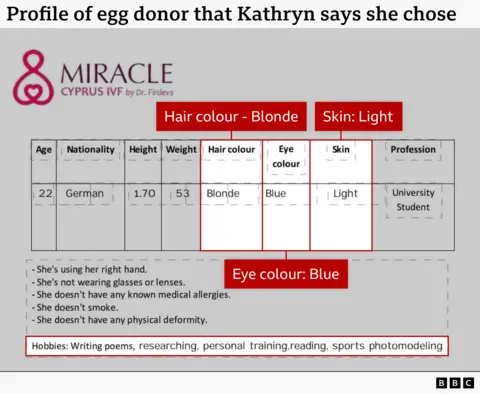
However, the two families we have spoken to say they thought they had chosen a specific donor and that it was never made clear to them that the final choice would be made by the clinic.
The BBC has seen egg donor profiles that were provided to Kathryn and another family by Miracle IVF Centre which all appear to show individual women.
Kathryn says that while she loves her child unconditionally, she would not have proceeded with her IVF treatment had she been fully informed that her chosen donor may not be used.
Firdevs told us that all the treatments she carried out at Miracle IVF were in accordance with legislation - and she was unable to answer all of our questions because of patient confidentiality.
'We're still a family'
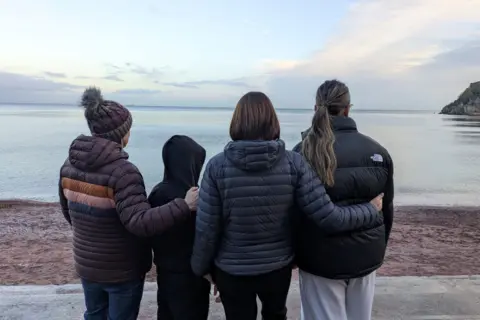
It has been two years since Beth and Laura spoke to their children about how Finn may not be their donor.
James is still coming to terms with what his family have discovered.
"You can't just say someone's something and then they're not. That's bad," he says. "Identity is the main thing. It's who you are as a person."
The children now know that they are not biologically related, but it hasn't changed the love they have for each other.
"We've all grown up together and our mums have raised us," says Kate. "We're still a family even if it's not by blood."
"We have two amazing children," say Beth and Laura. "At the end of the day, everyone will be OK."
- Details of organisations offering information and support with infertility are available at BBC Action Line
