Massacre survivor's 'remarkable' story told 200 years on

 PA Media/Jon Parker Lee/Findmypast
A historian has shared the "remarkable" story of a survivor of the Peterloo Massacre, 200 years on from the event.
David Olusoga has examined the story of William Cheatham, whose fight for justice reached Parliament after he was nearly killed by a cavalry sabre in the massacre, on 16 August 1819.
British Army troops charged into a crowd of about 60,000 people who were demanding parliamentary reforms on St Peter's Field, Manchester, with 18 killed and an estimated 400 to 700 injured.
Using new research uncovered from historical newspaper archives, Olusoga has explored the largely unknown story of Cheatham in a new podcast series.
Although the massacre is now recognised as a defining event in Britain's democratic development, many survivors' stories were largely forgotten.
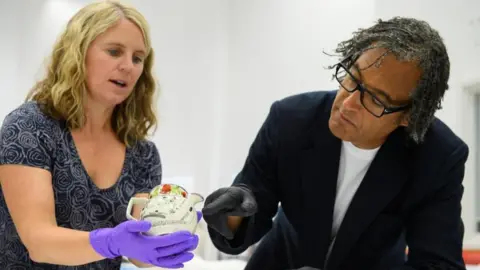
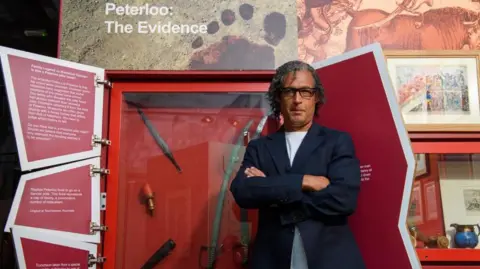
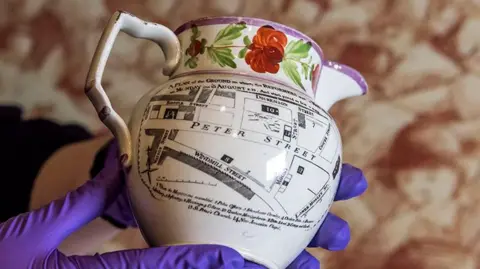
A Family History Of Peterloo: Britain's Forgotten Massacre, hosted by Olusoga and fellow historian Jen Baldwin, examines new research carried out in partnership with Manchester's People's History Museum, which holds the country's most significant Peterloo collection.
 PA Media/Jon Parker Lee/Findmypast
Cheatham, a working-class veteran and weaver, had travelled from Bolton to Manchester to join the peaceful protest demanding political representation and voting reform, Olusoga said.
He attempted to flee but, according to testimonies, more than a mile from the field he was attacked by Edward Meagher - a cavalry trumpeter dubbed the Butcher of Waterloo - who slashed him across the neck with a sabre, leaving a 3in (8cm) gash.
Olusoga said Cheatham's story offered "a powerful lens through which to examine enduring questions about democracy, right to protest and challenging established power".
"The events of that day resonated through the decades that followed," he said.
"William's story shows us that there is still so much more to learn and more to uncover about the tragedy that took place in Manchester in 1819."
 People's History Museum handout
Cheatham later spent years pursuing justice through the courts and Parliament, Olusoga said, but his campaign ultimately failed, despite the compelling evidence and even political support.
Olusoga said his story revealed just how difficult it was for ordinary people to challenge power in 19th Century Britain and raised questions that still resonated today about representation, accountability and whose voices get heard.
Jenny Mabbott, the People's History Museum's head of collections and engagement, said history was "at its most powerful" when it "brings to light the experiences of ordinary people whose lives and actions shaped the society we live in today".
Listen to the best of BBC Radio Manchester on Sounds and follow BBC Manchester on Facebook, X, and Instagram. You can also send story ideas via Whatsapp to 0808 100 2230.
