Addicted to running: How one of the nation's favourite pastimes can turn compulsive

 Getty Images
From marathons and parkruns to someone simply going for a jog, running is a universal sport.
The health benefits are clear but, for some, the obsessive nature of chasing personal bests, medals or even raising money for charity can create an unhealthy relationship with running.
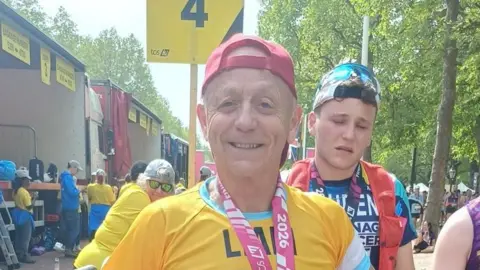
Liam McHugh began taking part in marathons to help raise money for cystic fibrosis (CF) charities but 34 years later he's been told he could end up in a wheelchair.
Meanwhile, Timothy Shiels' need to prove himself through competitive running ultimately led him to one of the darkest moments of his life.
The NHS says regular physical activity lowers the risk of heart disease and stroke, early death and depression.
And while running is an activity generally associated with health, fitness and mental wellbeing, taking it to the extreme has caused mental and physical harm to some.
My feet feel like they're being 'impaled'
 Liam McHugh
When McHugh's daughter was born with CF running became a way to raise money for charity and to escape.
That was 34 years, more than 50 marathons and about £450,000 in fundraising ago.
All of that running has taken a huge toll on the Castlederg man's body and despite being told he could end up in a wheelchair, McHugh said he can't stop until "everybody with CF is cured".
"Even if everybody was cured tomorrow, I probably still couldn't stop running. I'm addicted, 100%."
After more than three decades of chasing his favourite high, McHugh has been left with a condition called Haglund's deformity, which causes bony enlargements around the heel area.
He described the condition like having his feet "impaled by hot pokers".
To relieve the pain he has regular electroshock therapy, which is "like having your feet beaten with a sledgehammer".
Often when he is out training, so visible is his discomfort, drivers pull over and ask if he needs a lift.
But, still, McHugh does not see his story as a cautionary tale.
"Before every marathon, my wife pleads with me to make it my last," he said.
"I say, 'Aye, sure we'll see'. Then a few days later, I want to go again."
'Running led me to a dark place'
 Timothy Shiels
Timothy Shiels believes his relationship with running was a catalyst that led him to one of the darkest moments of his life.
After taking up the sport in his youth when his father was a running coach, Shiels, who is now a pastor in Omagh, said he associated "success with love", as winning medals made his family proud.
However, after falling away from athletics through his late teens and twenties, during which time a life of drugs and bad choices left him homeless, he returned to running aged 30.
Almost ten years after getting sober and returning to running, Shiels decided it was time to revive his competitive career.
He told his wife he wanted to represent Ireland on the track but "that just fed the success-brings-attention mindset".
That self-induced pressure of earning accolades was all that mattered to Shiels and, he felt, his friends and family too.
After failing to reach the podium at the 2016 World Masters Athletics Championships in Australia for Ireland, Shiels said he felt he had let "everybody" down.
"I thought I'd let down my wife, my children, my parents, the people from my church - everybody. It led me to a very dark place."
In the 10 years since, Shiels has had to rebuild his relationship with running.
"I had to make myself go from thinking losing a race made me a loser in life, to knowing that it really makes no difference whether to win or lose," he said.
"I used to wonder who I would be if I stopped running. People know me locally as the Faster Pastor. But you can't be the Faster Pastor if you don't run, can you?"
Running fixation can lead to problems
 Victor Thompson
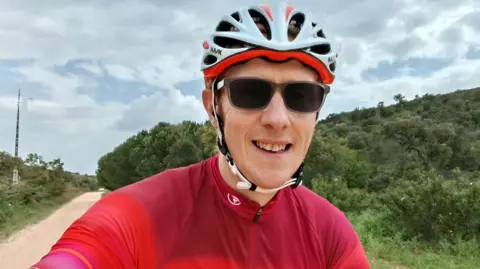
Dr Victor Thompson from Bangor has 17 years experience as a clinical psychologist and over 10 years as a sports psychologist.
He said unhealthy relationships with running are "relatively rare but very real".
This can come down to the psychological rewards running can provide or someone associating their whole life with the sport.
"People can feel euphoric when they run," said Thompson. "Endorphins - happy hormones - are released, and you get the runner's high. Afterwards you might feel elated, happy or just calm."
However, like anything, if taken to the extreme running can be dangerous.
"If a person gets obsessive about their running routine, fixated on improving times and adhering to a specific training schedule, that inflexibility can cause issues for themselves and others," said Thompson.
He added that there is still a stigma attached to getting help for mental health issues, as well as people being unsure of who to turn to for help.
"Like most of our problems, it is easier to dismiss, ignore and hope that they will go away on their own.
"Those who reach out are brave and have a greater chance of getting exercise back in balance, building greater psychological flexibility and becoming healthier."
If you have been affected by any of the issues in this story, help and support is available at BBC Action Line.
