General Strike was 'the boil that needed lancing'

 Mirrorpix/Contributor
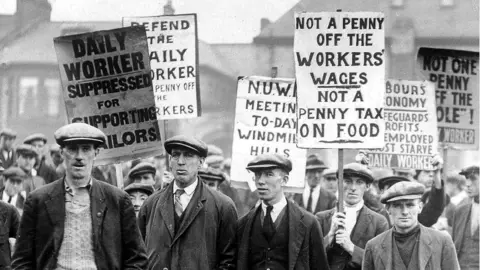
In May 1926, more than two million Britons downed tools and sought to upset the balance of power. On the centenary of the General Strike, historians examine the causes of one of the most tumultuous periods in modern British history and its impact on communities.
At one minute to midnight on 3 May, the Trades Union Congress (TUC) triggered what author Jonathan Schneer describes as "the single greatest demonstration of trade union power in British history".
It lasted just nine days, but brought Britain to a standstill.
One million coal miners had been locked out of their workplaces by powerful pit owners who demanded longer hours for less money.
Workers from other sectors joined the strike in sympathy of the miners, including transport and dock employees, as well as those employed in gas and electricity, printing, iron, steel and chemical jobs.
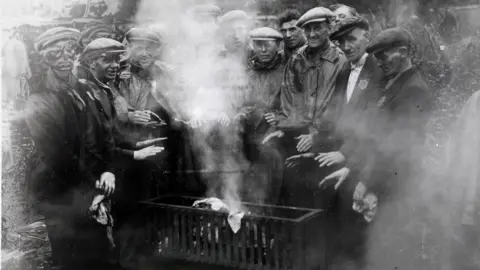
Violent clashes occurred in towns and cities across the UK.
 Hulton Archive/Getty Images
Schneer, author of Nine Days in May: The General Strike of 1926, published to coincide with the centenary, points out miners and pit owners had long had a fraught relationship.
"Practically everyone, including Conservative cabinet ministers, thought the mine owners were greedy and shortsighted," he says.
"Practically no one sympathised with the owners. Many, including of course the vast majority of trade unionists, sympathised viscerally with the miners, whose wages had declined relatively and absolutely since 1918, and whose work underground was dangerous and exhausting."
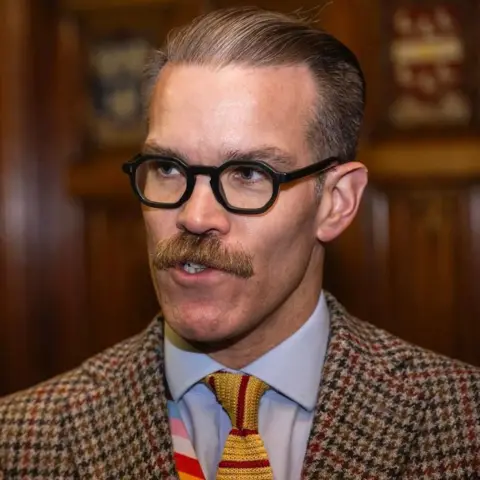
Prof Tony Collins, a historian and author, says some of the strongest support for the strike was found in northern industrial heartlands, where unions had a tight grip.
"The strongest industrial unions were by and large in the north," he says. "Manchester, Liverpool, Leeds, Hull, Newcastle...
"Hull's dockers, for instance, had an established reputation of being some of the most militant workers in the country. In 1893, dockers staged a large strike, and in 1911 there was an even bigger walk-out.
"The General Strike brought to a climax deep industrial conflict that had existed since the 1910s."
Tensions eased when World War One broke out in 1914 but quickly resurfaced after conflict ended in 1918, he says.
Conditions were ripe for disorder.
 House of Commons
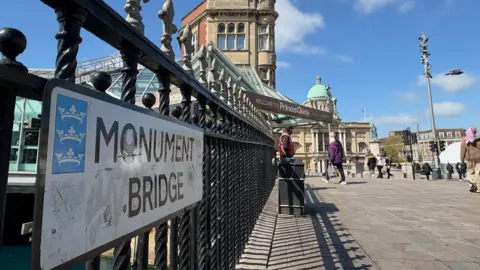
Collins describes a flashpoint, later dubbed The Battle of Monument Bridge, that occurred on 7 May 1926 in Hull.
"Mounted police charged into a crowd gathered on Monument Bridge in the city centre," he says. "Batons were used to hit strikers. Forty-one people required treatment for injuries."
Strikers had been angered after posters were put up in Hull City Hall calling for volunteers to take over the running of public transport, explains Collins.
"There were no guarantees those on strike would have a job at the end of the dispute. So these posters inflamed the situation. The strikers feared these volunteers would take their livelihoods.
"The police were used to push the crowds back away from the city hall. There were some vivid accounts from witnesses. One person recalled how the sun was gleaming off the officers' helmets as they charged."
 Kevin Shoesmith/BBC
Across Britain, similar scenes unfolded, with special constables recruited to suppress the strikers, says Dr David Torrance, author of The Edge of Revolution: The General Strike that Shook Britain.
"These specials were often a little overzealous with their batons," says Torrance.
Records show officers also came under attack.
According to the minutes of a Kingston upon Hull Municipal Corporation meeting, now kept at Hull History Centre, a number of officers were hurt by bricks and stones thrown by a "disorderly crowd" on 8 May.
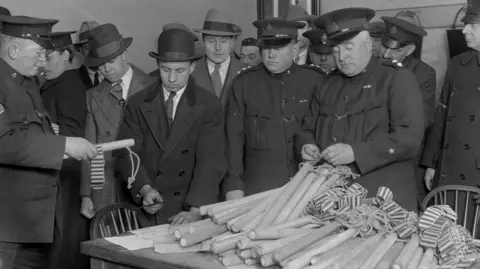
Collins says the Conservative-led government of the day was so concerned that docks would be blockaded by strikers that Royal Navy warships were deployed to key port cities, including Hull.
"A machine gun was even erected at King George Dock," he says.
"The day after the Battle of Monument Bridge, troops from a Royal Navy cruiser came out on to the streets of Hull with bayonets fixed to disperse the crowd.
"Rioting then broke out across the city."
 Fox Photos/Getty Images
Collins says Prime Minister Stanley Baldwin's government had prepared for the strike.
"They prepared the military and thought about plans to bring in volunteers to fill the roles of striking transport and dock workers," he says.
"The TUC was less prepared. It found itself in a position it did not want to be in, and I think it was pushed into calling the strike. It was fought on the government's terms."
Schneer agrees the government had "carefully and thoroughly prepared" for a general strike, adding: "Amazingly, the TUC did not."
"It [the TUC] did not want one, although it thought threatening to call one worked to its advantage," says Schneer.
"It thought actually preparing for one would be provocative and make the mine owners even more intransigent than they were already.
"It did not want to win one, since winning would mean beating the government, which would mean replacing the government, and none of them wanted to do that except as the result of a general election."
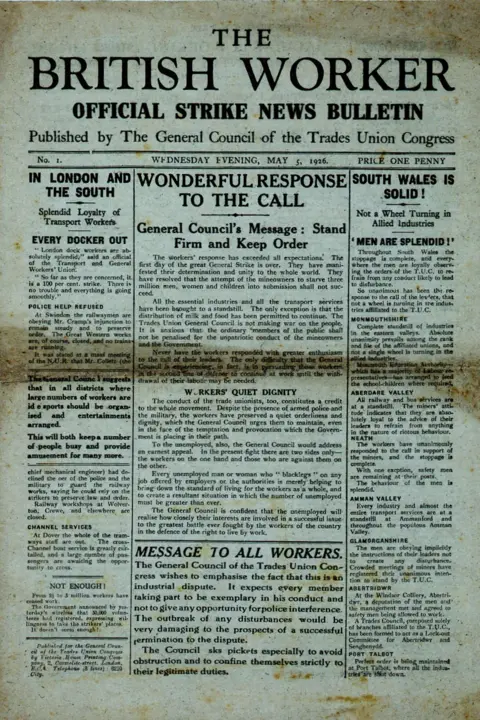 Photo 12 / Contributor via Getty
Torrance says the TUC, almost immediately, looked for a way to end the strike.
"They were conscious they could not sustain it," he says. "But there was a general feeling in Britain at the time that the boil needed lancing."
Schneer, though, makes the point that lancing a boil is usually therapeutic, and "there was nothing therapeutic about the General Strike".
He adds: "TUC did not think a general strike needed to happen; it did all it could to avoid one."
The General Strike came against a tide of growing fear of communism, Torrance discovered during his research for his book.
"Some were worried this might be a precursor to a revolution, an uprising of workers, similar to what had been seen in Russia a few years earlier," he says.
Collins discovered the government attempted to "recreate the spirit of 1914", when a wave of patriotism swept across Britain at the start of World War One, in a bid to minimise the impact of the strike.
"There was a large campaign to recruit volunteers," he says. "It was pitched as a call to the British public to do their patriotic duty to keep the nation moving.
"In Hull alone, about 700 students - mainly from Oxford - came to work on the trams and on the docks."
 Jonathan Schneer
Schneer found both sides of the dispute appealed to that spirit.
"Strikers exhibited that spirit by defending miners who, they said, represented British ideals, just as their older brothers had defended British ideals against Germany eight years earlier," he says.
"On the other side, many thousands volunteered as strike-breakers, thus defending the government against the TUC which threatened it, they thought, as their older brothers had defended Britain from Germany in 1914."
According to Torrance, no deaths were recorded during clashes, but he asserts fatalities happened as consequence of the strike.
"Several serious train crashes in May 1926 were blamed indirectly on the General Strike," he says. "Many drivers joined the strike, leaving volunteers - non professional drivers - to attempt to fill the gaps.
"One such incident left three people dead. A train crashed into wagons in a tunnel on the approach into Edinburgh Waverley station."
 Topical Press Agency / Getty
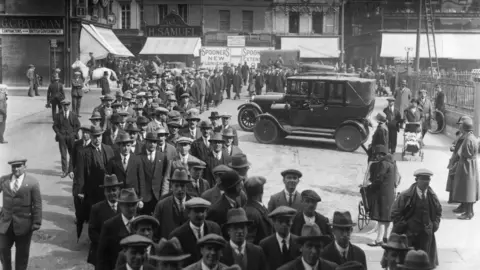
Torrance says it is difficult for historians to determine, with accuracy, the level of public support for the strikers.
"Public opinion polls were introduced in the 1930s, so we only have contemporary newspaper reports, letters and official documents to go on," he says.
"The government of the day framed this [the General Strike] as a battle between wild, extreme unions and a measure, elected governance.
"Given the available evidence, most Britons favoured parliament but undoubtedly there was a great deal of sympathy for the miners, who many believed had it bad in terms of their pay and hours."
Collins says, at least in Hull, it was more clear cut.
"The strike was very strong," he says. "From the word go, people felt they needed to support the miners in order to defend their own rights."
The TUC called off the strike without any concessions given to the miners.
Most returned to work - if they still had a job - but the miners held out for six months.
"King George V famously wrote that 'not a shot has been fired and no one killed', adding that it 'shows what a wonderful people we are'," says Torrance.
"But I think that was a bit complacent. It was a pretty important couple of weeks in British history."
 Dr Tony Collins
In 1927, the Conservative government - scarred by the events of the previous year, passed the Trades Disputes Act, outlawing sympathy strikes and mass picketing.
The act was repealed in 1946, but in the 1980s the then Prime Minister Margaret Thatcher reintroduced the ban.
According to Torrance, The Trade Union and Labour Relations (Consolidation) Act 1992 "tidied up previous legislation", would make another general strike "unlikely".
Today, the TUC's director of organising, Sian Elliott, views the General Strike as a "turning point", adding: "It showed what happens when working people refuse to accept declining pay and unfair conditions as inevitable. That moment reshaped the labour movement for generations.
"While it didn't achieve all of its aims, a century on the lesson is unchanged. Crucially, that collective action is still the most effective way for workers to win better pay, stronger rights and a fairer economy."
Schneer believes the TUC learned "valuable lessons" from the General Strike.
"First of all, never to call another, unless prepared to overthrow the government, since a successful national general strike threatens everything a government is supposed to provide, most obviously provision of essential commodities and services.
"Secondly, to stick to economic issues and to look to Parliament for political reform.
"Thirdly, when calling a strike, to do so when most convenient to itself, and never to be pushed into one by the employers."
Dr Tony Collins will deliver a free talk on the General Strike at 12:30 BST on 12 May at Hull History Centre.
Listen to highlights fromHull and East Yorkshire on BBC Sounds, watch the latest episode of Look North.
Download the BBC News app from the App Storefor iPhone and iPad orGoogle Play for Android devices
