'Human' is Cambridge Dictionary Word of the Year

 Olly Courtney/BBC/Boffola Pictures
"Human" is the Cambridge Dictionary's Word of the Year — defined as "having the qualities, faults, and feelings that people have, as opposed to gods, animals, or machines".
"The growth of AI means it is now necessary to explicitly say 'human' for things that once could only be done by humans," said chief editor Colin McIntosh.
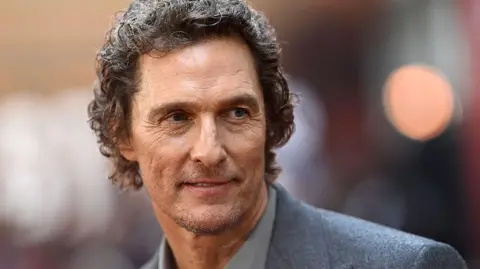
Examples of current usage included actors Scarlett Johansson challenging "an assault on human creativity" and Matthew McConaughey protecting himself against unauthorised digital reproduction of his voice or image.
"The measure of AI's success should be how much it improves human lives," said Microsoft co-founder Bill Gates on learning about the dictionary's choice.
McIntosh said dictionary editors had to be on top of how words could change over time "to reflect what people say and what they write".
His research revealed a four-fold use of the word human since 1900.
"'Man' used to be used in this sense a lot more, but now it is not acceptable to use 'man' to mean men and women," he added.
"Human didn't come into use in Middle English until the 14th Century, from a French word. Shakespeare used it, but after that it was very restricted in use."
There had also been an increased use of compound words such as human-made and human-driven, to distinguish the works, qualities and skills of people from AI.
"Fears about what humans may lose when we outsource our thinking have made us reconsider the extent to which we rely on AI, from top mathematicians to teachers of young children," said McIntosh.
 AFP via Getty Images
Gates recently made the case for "human reserved jobs", such as caregiving, and reiterated his call for a robot tax to help fund training for people who lose their jobs to AI.
Other examples included the Nobel Prize in Physics laureate Geoffrey Hinton, who has been described as the godfather of AI, who warned "we're creating alien beings. I'm willing to be selfish and choose humans".
Pope Leo XIV has spoken of new forms of "dehumanisation" and the "pressing duty to remain profoundly human".
"Right now our understanding of humanity is changing," said Dr Tom McClelland, a philosopher of science at the University of Cambridge.
"We're trying to understand the difference between a human mind and an artificial mind, between living beings like us and artificial beings that we're creating. What sets us apart? Is it consciousness, creativity or compassion?"
 Cambridge University Press & Assessment
In response to the surge in AI-created content, academics are hoping to develop a universally recognised symbol to denote something that is "human made", similar to the "Fairtrade" label that emerged in the 1980s.
Prof Rachel Adams, an expert on AI governance and human rights at the University of Cambridge, said: "AI brings us back to questions that we've asked for millennia — who are we? What does it mean to be human?
"AI is going to be a profound test for humanity. There's a real risk that it deepens existing inequalities, but it also has the potential to solve them."
Do you have a story suggestion for Cambridgeshire? Contact us below.
Follow Cambridgeshire news on BBC Sounds, Facebook, Instagram and X.
