Man guilty of terror attack plot at migrant hotel

 Counter Terrorism Policing North East
An alleged white supremist has been found guilty of plotting to firebomb a migrant hotel in Hull and possessing weapons for terrorist purposes.
Mikka Lee Anderson, 24, of Morpeth Street, Hull, had planned to attack the Royal Hotel using petrol bombs, a jury at Newcastle Crown Court was told.
He was arrested after meeting a would-be accomplice in February who later reported him to police.
Anderson had denied preparing an act of terrorism, including making Molotov cocktails, conducting reconnaissance at the hotel and possessing knives and other weapons for terrorist purposes. He was convicted on both counts.
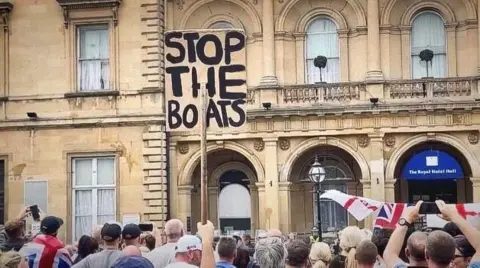
During the trial, prosecutor Adam Birkby said Anderson had outlined "his plan to attack the Royal Hotel by the city's railway station, and to kill as many of the migrants who were housed inside it as possible".
The court heard the men met in Hull city centre and talked for about an hour and walked up to the Royal Hotel.
Two days later the other man, who cannot be identified for legal reasons, told police of his concerns about Anderson, that the hotel would be attacked the following month and showed them messages they had swapped.
The hotel is no longer used to house asylum seekers.
Police later found knives, a crossbow, petrol bombs, camouflage clothing and a gas mask at Anderson's home. Officers also discovered social media posts and messages shared with "like-minded individuals".
Birkby said: "Anderson considered non-white people to be a societal pest, which needed to be dealt with."
In his closing speech to the jury, Birkby said Anderson "not only anticipated but in many ways welcomed" a race war.
Asked by defence barrister Andrew Stranex if he had planned an attack, Anderson claimed it was the other man who had suggested targeting the hotel, including poisoning the water supply and creating a decoy to draw away nearby transport police.
He also said he had felt intimidated by the man, but later described him to others as "a proper warrior".
'Brainwashed'
Jurors heard Anderson had previously filmed the hotel and shared footage, including of the security measures in place.
"I wanted to show other people online that I was being proactive and taking part in what I thought was citizen journalism about what was going on," he told the court.
The defendant accepted posting messages about race, nationalism, civil war and violence, but claimed they were exaggerated to impress others.
He told the court he felt "brainwashed" by social media, and described going "down a rabbit hole".
In his closing speech, Stranex said while comments Anderson made online were "frequently violent, frequently offensive, frequently racist", there was no plan to carry out terrorist acts.
Anderson, who the court heard had a "troubled childhood" and few friends, claimed his comments were to "big himself up" in front of others in order to be accepted.
Jurors were told he had also previously applied to join the Army for "a sense of brotherhood" and to protect people, but was unsuccessful.
Anderson also explored Islam in his early twenties after meeting Muslims in Beverley, but later rejected the faith, the court heard.
He said he had "dabbled" in right-wing politics, adding: "It really started for me after the Southport stabbings in 2024."
The court heard the defendant made and tested Molotov cocktails, which he said stemmed from an interest in military history and was "something fun to do".
He claimed most of the knives found during a search of his home were ones he had collected over the years as part of his interest in the outdoors and prepping, or were collectable items.
Anderson has admitted possessing and sharing The Anarchist Cookbook - which contains instructions on how to manufacture explosives - and other weapons-related documents, but denied using them to prepare an act of terrorism or to manufacture weapons.
He is due to be sentenced at a later date yet to be fixed.
Speaking at the conclusion of the case, Det Ch Supt James Dunkerley, head of Counter Terrorism Policing North East, said Anderson's extreme right-wing views led him to plan a terrorist attack in order to spread fear amongst the migrant community.
"Counter Terrorism Policing officers and our partners conducted an in-depth investigation to understand the threat that Anderson posed and were able to apprehend him before anyone came to harm."
Listen to highlights fromHull and East Yorkshire on BBC Sounds, watch the latest episode of Look North.
Download the BBC News app from the App Storefor iPhone and iPad orGoogle Play for Android devices
