Investigation into Scotland's maternity units to start in autumn

 Getty Images
A review of Scotland's maternity services will begin after the summer and is to last nine months.
Health Secretary Angela Constance said it will focus on workforce, culture, safety and experiences in rural or island communities.
Families who have lost babies following failures in care said they are angry that the same issues have been reoccurring for years and have called for immediate action.
Christine McCourt, a professor of maternal and child health at City St George's at the University of London, will chair the review.
The Scottish government committed in November to an independent maternity review weeks after families, NHS staff and experts called for improvements to poor and sometimes deadly care as part of a BBC Disclosure investigation.
Constance said she had heard concerns raised by families and MSPs and that the review will consider the right maternity services to meet the needs of women and families.
 Julie Keegan
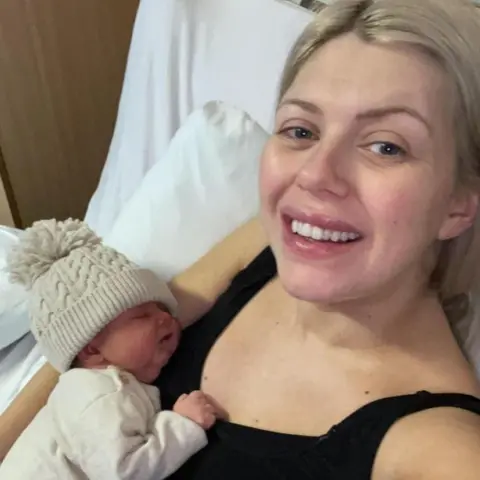
Julie and Angus's three-day old baby Mason Scott McLean died after a series of errors in his care at the Queen Elizabeth University Hospital (QEUH) in Glasgow in 2023.
Failures in Mason's care included missing key tests that would have indicated he had a life-threatening infection.
An internal review by NHS Greater Glasgow and Clyde found "several systematic issues" that may have caused his death.
The couple said they are still trying to get answers to questions asked three-and-a-half years ago.
The health board apologised for "missed opportunities for care" and said it had taken action on the recommendations in the review.
Julie Keegan said it had been seven months since the review was announced and that if it had started earlier then then it would nearly be finished.
She told BBC Scotland News it felt like those in charge of NHS maternity services believe "Mason's life didn't matter" because of the lack of action.
Angus said the Scottish government had "to live up to their promises" to make improvements.
There have been seven unannounced inspections by the healthcare watchdog since January 2025.
These were ordered to be carried out by Healthcare Improvement Scotland (HIS) following a review into a number of spikes in newborn baby deaths.
All 18 maternity units in Scotland are to be inspected by March 2027.
Common themes have arisen such as staffing shortages, delays in care to pregnant women and issues around investigations when things go wrong.
Angus said: "I don't know how many more reports they need to actually take action on it, what's it going to take?"
Julie, who works as an NHS intensive care nurse, said she was angry to read inspection reports that included the same problems they faced with Mason's care.
She said it had been "horrifying" to see "the same problems happening time and time again".
Julie added: "All these really traumatic things are happening and really nobody's listening."
 Lori Quate
Lori Quate lost his wife and child within 24 hours.
Jacqui Hunter and Olivia died at Ninewells Hospital in 2020 and he said families like his continue to be "devastated".
He was asked to be involved with the Scottish government's Maternity and Neonatal Taskforce but said he has had little contact since.
Lori welcomed progress but said it was happening too slowly.
"The same issues have been repeatedly identified across Scottish hospitals and failures are allowed to persist in environments where accountability is weak and, too often, avoided," he said.
He believes immediate, meaningful change is needed to avoid families suffering "catastrophic loss".
Over the past 18 months midwives have spoken to BBC Scotland News anonymously about their concerns about overstaffing and a "toxic" culture.
They have described being frightened and upset when working on wards that are overcapacity and stretched staffing.
These issues have come up in several inspections leading to delays in care for pregnant women and staff feeling conditions are "unsafe".
Jaki Lambert, the director of the Royal College of Midwives Scotland, welcomed the government making maternity services a priority with a review with workforce "front and centre".
"The next steps following this review will be key to driving forward the change that women, babies and midwives desperately need," she said.
A review of England's maternity services is to be published but an interim report revealed consistent problems with women not feeling listened to and NHS organisations "marking their own homework" when babies died or were harmed.
Some parents of premature babies have also called for the Scottish government to rethink plans to reorganise neonatal intensive care units with proposals to reduce the number of facilities treating the sickest babies from eight to three.
 Julie Keegan
Julie and Angus have a two-year-old daughter, Meadow, and nine-month-old son, Clark.
Julie praised staff "who were absolutely out of this world" and said it showed how "amazing the NHS can be".
The couple said everyone should get these positive experiences but added fundamental change was needed to make that a reality.
Constance said the "review will deliver real and tangible change" and will build on improvements already being made in the NHS.
"Every woman in Scotland deserves safe, compassionate and high-quality maternity care, regardless of where she lives," she said.
The review will look at inequalities and access to maternity in care taking into account experiences from all across Scotland and also from Black and Asian women.
Scotland's rural areas face unique problems with some expectant mothers facing a 70-mile trip.
Christine McCourt said she looked forward to listening and learning from families across Scotland.
She added: "This will help draw out lessons for maternity and neonatal services and contribute to ensuring the best possible care for all."
